“I did.” Her tone became firmer. “And I don’t need you to give me a script.”
He nearly smiled. “Good. Because my script’s a mess.”
“Then we should probably both use our own words.”
They walked in opposite directions when the warning bell sounded, leaving Eli with a feeling he hadn’t expected: his account could stand beside someone else’s without controlling it. That was both relieving and frightening. If Zoe remembered something differently, would he be glad she’d told the truth, or disappointed that the version was no longer entirely his? He hoped he would choose the first.
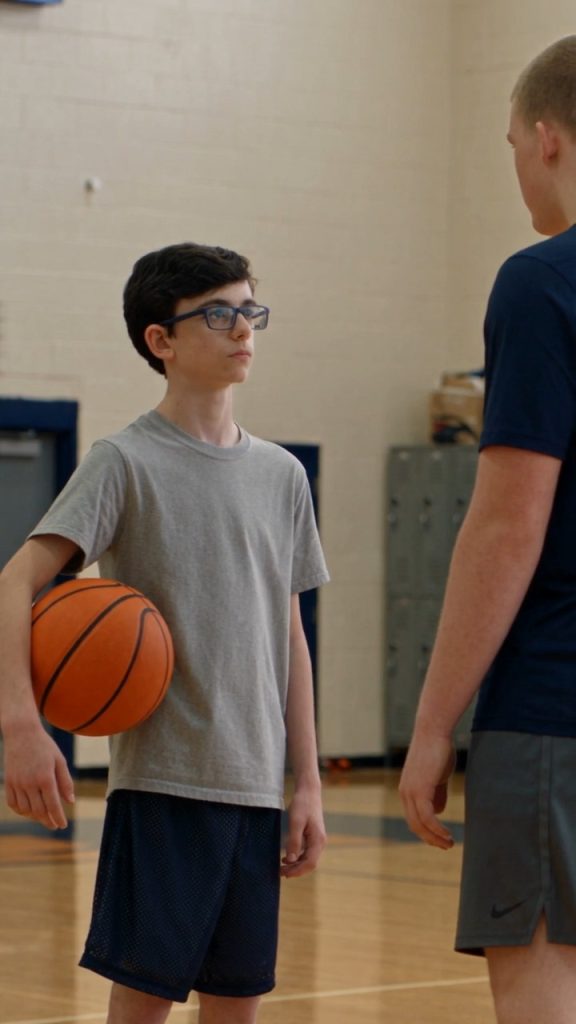
Third-period PE was different in a way that looked minor from outside. Coach Parker had assigned pairs for a passing and pivoting activity rather than letting students choose. Mason stood across the room with a boy from his usual group. Eli was partnered with a student who had barely spoken to him all semester. The boy followed directions politely and made no eye contact between turns. When they switched stations, he moved away quickly, as though staying near Eli might count as choosing a side.
Nothing happened that Coach could stop. No shove, no shouted threat, no thrown ball. The class was quiet and orderly. For Eli, the quiet came loaded with all the things people could refuse to say.
Before they dismissed to change, Coach Parker asked Eli to stay by the equipment alcove. He did not summon Mason over. That small mercy made it easier to stand there.
“I thought about what you said yesterday,” the coach began. “I saw the end of that game. I didn’t see how it started, and I’m sorry I missed that part. Tell me what you can.”
Eli explained the bounce and the challenge. He described the earlier equipment orders and how Mason liked to perform them for an audience. His voice shook once, on the phrase “I didn’t feel free to say no,” and he hated that it did.
Coach Parker listened without interrupting. “I’m going to make a note of what you’ve told me,” he said. “What I personally observed was the end of the game, a crowd around it, and a change in everyone’s mood. I can’t claim I heard the challenge.”
“I know.”
“You’re allowed to be upset even if I didn’t witness it. And you shouldn’t have to solve this by beating somebody at basketball.”
That sentence stayed with Eli. A part of him had hoped the coach would praise his composure or call the game impressive. Instead Parker had named the thing beneath it: nobody should have been required to perform in order to be treated decently.
“Ms. Brooks can take a fuller report if you want,” the coach added. “I can walk you there after lunch, or you can go yourself.”
“I’ll go,” Eli said.
He heard himself say it and immediately wanted to cancel. But the words were his own. He did not take them back.
The counselor’s office was on a quieter hallway near student services. A paper sign outside listed drop-in hours, and an upholstered chair near the door had one arm slightly worn. Eli had passed the room hundreds of times without entering. He stood in the doorway until Ms. Lena Brooks looked up from her desk.
“Can I help you?”
“I need to tell someone about gym.”
She moved a stack of folders aside and pointed to the chair. There was no dramatic reaction when he described the ball or the game. She asked whether he felt physically safe today, whether Mason had tried to contact him, whether there had been earlier incidents. She repeated some of his words back to him to check that she’d understood them. The careful questions felt slow, and sometimes he wished she would simply agree that Mason was cruel. But she did not hurry him into a conclusion either.
When he showed her the notebook, she read the dated page and asked which parts he had witnessed directly. Eli said the September commands had happened to him; the October epithet he’d heard himself; with Noah’s drill, he’d seen some of the scene but not its beginning. He pointed out that Mason’s hallway remark had no second witness. Ms. Brooks thanked him for being specific.
“Is this enough?” Eli asked.
“It’s enough to begin a report and to take steps to support you while we look into it,” she said. “It’s not enough for me to tell you, right now, that every part has been established. A basketball score tells us who made the shots. It doesn’t by itself tell us why somebody issued the challenge.”
He stared down at his hands. The sentence was reasonable and still landed like a door closing.
“So because I won, it doesn’t count?”
“No,” she said. “I’m not saying that. I’m saying the question we’re looking at is whether you’ve been singled out and pressured or humiliated repeatedly. What happened to you can matter even though you won. We need to listen carefully to the people involved.”
Eli looked toward the office window, where rainwater made thin tracks down the glass. “People won’t want to talk.”
“Some may not. I’ll ask people separately. I won’t ask you to gather statements or confront Mason. And I can’t promise that nobody will guess who’s involved. But your safety shouldn’t depend on making everyone like you.”
She started a school intake record, explaining what she was writing. She said Mr. Price, the assistant principal, would likely need to review it. She also asked whether Eli wanted help telling his mother. He said he could do it himself, then wondered if that had been another unnecessary attempt to look fearless.





