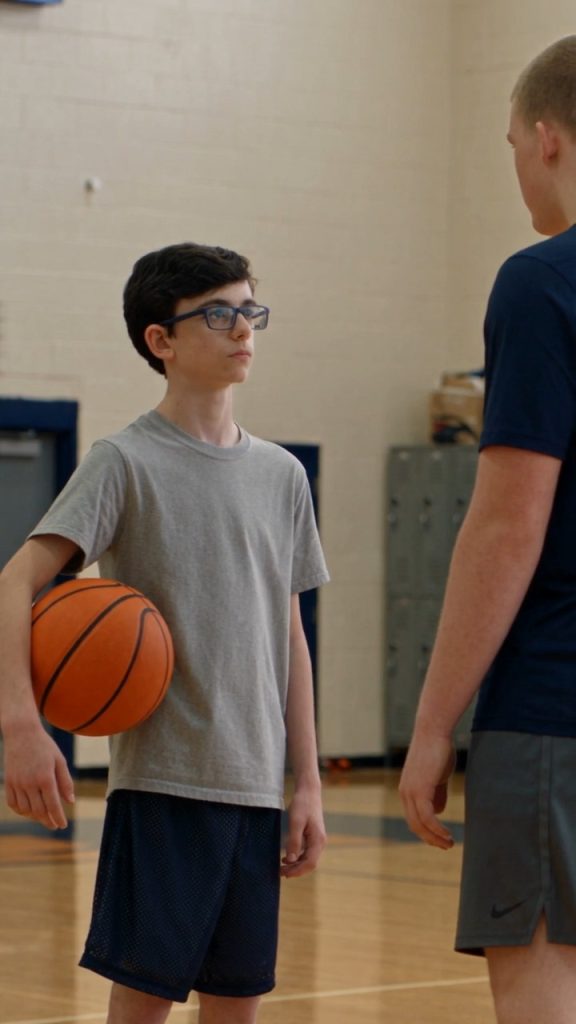
He almost reached the stairs before Mason stepped out from beside a trophy case. There was room to get past him, and Eli noticed that first. The older boy didn’t raise a fist or grab him. His eyes were fixed on Eli’s face, his own expression carefully emptied of the grin he’d worn during the challenge.
“You didn’t win anything,” Mason said.
He spoke softly enough that the words belonged only to the two of them. Then he moved aside and joined the stream of students without looking back.
Eli stood beside the trophy case for one extra breath. He had won three baskets. That was certain. He could still remember the sound of the ball passing through the net. But Mason’s voice had found the place that sound couldn’t reach: tomorrow, and the day after, and the long ordinary stretch of time when no crowd would be there to witness what happened.
Eli started up the stairs. He didn’t yet know what he would do about tomorrow. He knew only that if he allowed Mason to define what winning meant, the game in the gym would never truly be over.
By Friday morning, the game in the gym had been given a new beginning.
Eli learned this outside his first-period classroom, where two boys from PE were talking beside the lockers. One was describing how Mason had offered him a friendly one-on-one and Eli had somehow argued about the rules until Mason grew bored. The other said Eli’s last shot shouldn’t have counted, although he couldn’t explain why. Neither boy lowered his voice when Eli passed.
“I was there,” Eli said before he could stop himself.
The boys looked at him. One shrugged. “Then you know.”
Eli wanted to deliver the whole scene in perfect order: the ball at his shoe, the demand to perform for Mason, the glasses sliding down his nose, the first two shots Mason made. But there was no empty gym in which he could replay it. There was a crowded hall and a classroom door about to close and two classmates who had already decided which version took less effort to repeat.
He went inside without answering.
The first hour was algebra. He completed the worksheet slowly, checking the same equation three times. Usually numbers helped him feel that mistakes had edges: a solution was right or it wasn’t, and a teacher could point to where his reasoning failed. This morning he kept returning to the scoreboard that didn’t exist, a score everybody had heard but some people now treated as negotiable. He had won a game, not a trial. That should have been obvious. Yet he was still furious that even the small, factual part of it might be taken away.
At lunch on Thursday, after Mason’s hallway warning, Eli had managed only half a sandwich. He’d sat with a few acquaintances from science class and listened while they discussed an upcoming lab. Nobody mentioned the gym. His silence felt like a favor they were doing him, one that could be withdrawn whenever they wanted to hear the story. At home that evening he washed the same plate twice, then took it out of the rack to dry it. His mother noticed.
“Something at school?” Marisol had asked.
“Just gym,” he’d said, and left it there. It was not exactly a lie. It was a smaller container than the truth needed.
Now, on Friday, he could see that silence had allowed Mason to choose the words. Eli couldn’t control the hallway, but he could at least make a record before his own memories became blurred by everyone else’s versions.
During the short break before second period, he took the spiral notebook out of his backpack. On a fresh page he wrote the date: Friday, October 16, 2026. Under it he wrote what he knew from Thursday. At 10:42, roughly, Mason had bounced the ball toward his right foot. Mason had said, “One-on-one. Don’t chicken out.” Eli had picked up the ball, adjusted his glasses, and asked for the same rules for both of them. Mason had agreed to first to three. Then the game: two made baskets for Mason, a miss, three made baskets for Eli. Coach Parker had come over after the final shot.
He stopped before adding, Mason wanted to make everyone laugh. That was what he believed, but he couldn’t read Mason’s mind. He crossed out the sentence and wrote instead: Students gathered and watched. I did not feel I could refuse without being embarrassed. Afterward I asked to be left alone.
On the next lines he recorded the September 29 equipment incident and Mason calling him “extra equipment” on October 6. He included the later hallway sentence, because no one else had heard it. Writing that limitation down felt strange. It seemed almost like making Mason’s case for him. Then Eli saw that he was making his own account more exact, and the distinction mattered.
His notebook looked ordinary: blue ink, a smudged margin, one badly formed capital letter. It was not proof of everything. It was a way of refusing to let his future self say, Maybe it wasn’t so bad, just because other people preferred that explanation.
At the next break he found Zoe at the drinking fountain near the library.
“Can I ask you something?” he said.
Zoe turned. “About yesterday?”
“Did I remember the game right?”
“Three-two,” she said. “He had the first two. You got the next three. I was counting.”
Eli felt his shoulders release a little. “Some people are saying I cheated.”
“I heard.” She pressed her water bottle cap into place. “Nobody said that while we were standing there.”
“I don’t want you to take my word for it. If someone asks, would you tell them only what you saw?”
She considered him, not offended so much as surprised. “Yes. I should’ve said something when Coach came over.”
“He didn’t see the start.”





