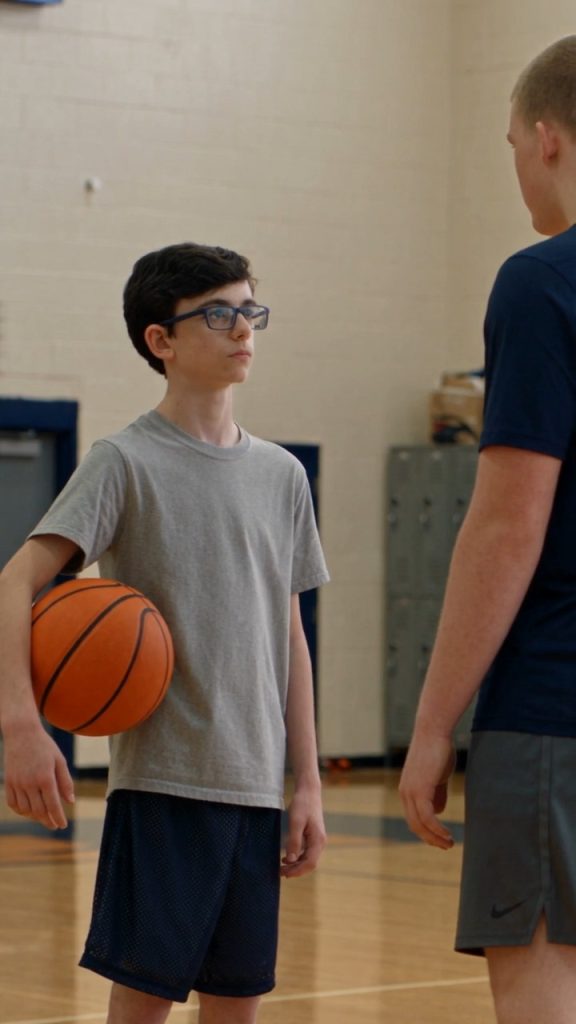
Coach Parker stood near the center line at the beginning of PE with a clipboard and a whistle hanging unused around his neck. He announced each station and each partner assignment himself. Nobody chose teams. Nobody pointed to a classmate and ordered another lap. Mason worked with two boys on the far side of the gym, and Eli completed his drills with Zoe and another partner near the west sideline. By every visible measure, the class ran better than it had a week earlier.
Yet Eli kept checking where Mason was. When the coach called for equipment to be returned, Eli hesitated until he saw which group had been assigned the ball rack. It embarrassed him that an ordinary room now required this much calculation. He reminded himself that the purpose of a safety plan was not to make him forget what had happened. Its purpose was to give him a way to participate while he remembered.
At the end of class, Coach Parker asked whether he could speak with Eli for a moment. This time they stood near the open gym doors, in view of the hallway but out of easy earshot of the departing students.
“Mr. Price asked for my account,” the coach said. “I was careful about what I could say.”
“What did you say?”
“That I saw the last part of your game, that students had gathered around, that both you and Mason seemed tense afterward. That I ended the game and heard you ask to be left alone. I didn’t claim to hear the initial challenge or see how the ball came to your feet.”
Eli gripped his backpack strap. “So you couldn’t help.”
“I can help by saying what I know. I can also do my job better going forward. I should have noticed the group forming sooner.”
The coach’s answer frustrated Eli, partly because it lacked the dramatic confirmation he’d imagined. He wanted the adult in the maroon polo to say he had seen everything and could end the argument. But Parker was offering something more durable than a convenient memory: responsibility for the room he supervised and honesty about the moments he missed.
“People think you can tell who’s right just from watching the end,” Eli said.
“Sometimes people think that about adults, too,” Coach Parker replied. “It doesn’t make it true.”
Eli left the gym with the uncomfortable understanding that his case might depend on several imperfect accounts being accurate in different ways. No one witness had seen every earlier incident. No one could supply a single picture that explained Mason’s decisions. Eli wished the world offered clean diagrams for things that happened between people.
At lunch, Zoe told him the rumor about cheating was fading, replaced by something less specific: the idea that Eli was the kind of person who could get another student in trouble by complaining. Two girls at a nearby table stopped talking when Zoe sat beside him. A boy from PE asked whether Mason was “really getting suspended” and seemed disappointed when Eli said he didn’t know. There was a hunger around the story that had little to do with whether anyone felt safe.
“Everybody wants an ending they can repeat in one sentence,” Zoe said.
“Maybe I did too,” Eli admitted.
“That’s not the same as inventing one.”
They worked through homework while the cafeteria filled and emptied in waves. A few classmates greeted them normally. Those small exchanges mattered more to Eli now than the whispered arguments. They showed that the entire school hadn’t become a referendum on him. A world could hold a conflict and other things at once, even when his attention resisted believing it.
That afternoon Ms. Brooks asked Eli whether he wanted his mother included in a meeting with Mr. Price. Eli said yes, then spent the last period worrying that Marisol would become furious and tell everybody what to do. When she arrived at the school after her shift, she looked tired rather than fierce. She shook hands with the two staff members and sat beside him, setting her keys carefully on her lap.
Mr. Price reviewed the process without reading other students’ statements aloud. He said Mason had been given an opportunity to respond and had described the encounter as joking and mutually agreed. He did not say the school’s assessment was complete. He explained that the school was also examining an earlier pattern, but the conclusion would depend on what the students and staff could substantiate.
“He says I wanted the game?” Eli asked.
“He disputes that it was intended as intimidation,” Mr. Price said. “We have your account and are considering other information. I won’t put words in either student’s mouth.”
Marisol leaned forward. “My son agreed to play. He also says the way it was offered made declining feel humiliating. You’re not treating those as mutually exclusive?”
“No,” Mr. Price said. “That distinction is important.”
The answer visibly eased something in her face. Eli found himself proud of the question she’d asked. It did not demand an instant punishment; it demanded that the school understand his actual concern.
They discussed how to keep him participating in PE. The no-pairing direction would remain in place during the review. Mason was not to approach Eli to argue about the report. If anyone crossed that boundary, Eli could tell Coach Parker, Ms. Brooks or Mr. Price without having to confront the student first. The staff would monitor transitions more closely. Marisol asked how the school would check that the steps were working, and Mr. Price described specific adult check-ins rather than promising every uncomfortable look would disappear.
Eli had been carrying one question for days. “If you decide there isn’t enough evidence, does the plan go away?”
“The expectation that students don’t intimidate one another doesn’t disappear,” Mr. Price said. “We may adjust particular arrangements, and we’d explain any change. We also don’t have to wait for a final finding to manage classroom safety.”





