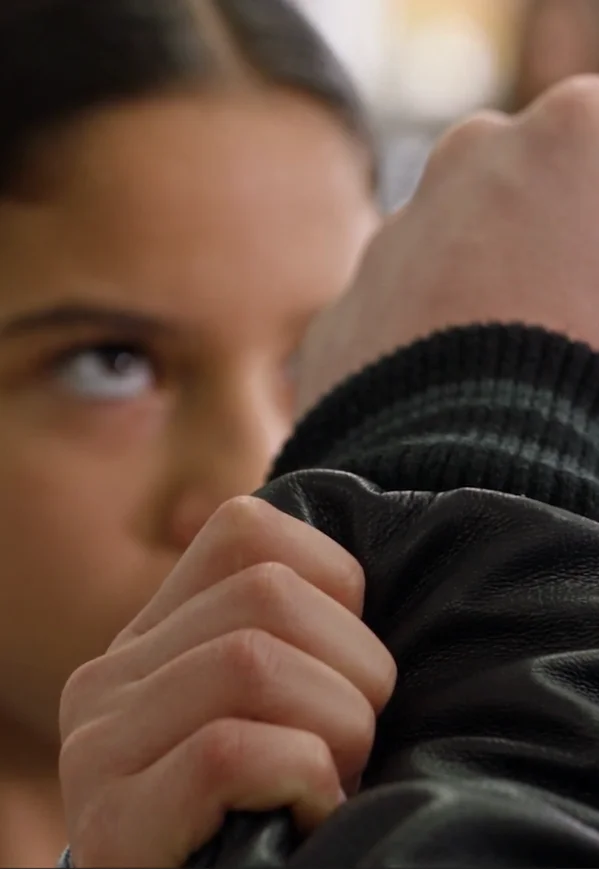
“Please tell Avery I won’t ask her to share it online,” Maya said.
“You can tell her yourself if that’s appropriate. I won’t ask a student to reveal someone else’s private part of the review.”
Maya understood. She was starting to recognize when someone was protecting a boundary instead of hiding an answer.
Outside the office, Maya sat on the same bench where she had found Mr. Grady the day before. She thought about how she’d once assumed proof would feel like a final bell. Instead it felt like a door opening onto another room of questions. There would still be meetings. Someone would still have to decide whether her grip had crossed a line. Even the original video could be misunderstood if a viewer chose to overlook the fist.
A student passing the bench said, “I heard the real video clears you.” Maya didn’t know who had told him that, and she didn’t confirm it. She said the school was reviewing what happened. He seemed disappointed by the absence of a triumphant ending.
At lunch, Chloe spread her map drawings between two plates of cafeteria pizza. One showed a seaside town with curving roads and a library beside a fountain. She’d labeled streets after fictional characters, then crossed out the names because they sounded too much like a game.
“Which road would you take if you wanted to get from the library to the water without crossing the market?” Chloe asked.
Maya traced a route around the town square. “This one, but you need a footbridge.”
“I thought that too. The river’s supposed to be narrow there.”
For five minutes they argued about a footbridge. Nobody came over to ask about Trent. The ordinariness felt fragile and therefore precious.
Then Avery passed their table carrying a tray. Chloe looked up. Avery slowed, obviously uncertain whether to speak. Maya didn’t intervene. Avery said, “Hi,” and Chloe replied, “Hi.” It wasn’t reconciliation, only a beginning that neither girl had demanded. Avery walked on toward a table near the west wall.
After lunch, Maya found a folded note in the front pocket of her backpack. This one was from Chloe, not an anonymous taunt. It contained a rough drawing of the art room as a village in a fantasy book, with the school hallway rendered as a dangerous mountain pass. On the back she had written: For next time you need a better place to stand.
Maya tucked it inside her sketchbook. She wasn’t sure whether the drawing counted as friendship yet. It seemed like the kind of thing people who might become friends did before they knew the word applied.
By Friday afternoon, Coach Hall had been informed that the captain’s conduct was under review. Maya knew this because the team announcement about who would lead practice named two other seniors “for the time being,” and because someone posted a furious complaint that the captain was being sidelined over gossip. She didn’t assume Hall had reached a conclusion. Ms. Price had explained that the coach would make any leadership decision separately after the school finished its findings.
On the way out, Maya saw Trent near the athletic entrance. His heavy jacket was folded over one arm instead of worn. He was speaking with a teammate, shoulders tense. When he noticed Maya, his expression hardened. He did not approach. An adult was nearby, and the temporary instructions were clear. Maya kept walking. She had expected to feel triumphant seeing him without his jacket on. She felt only tired. It was easier to imagine a villain as a silhouette than as an angry boy whose choices still mattered.
That night, Alicia asked if Maya was glad the longer file had been found. Maya said she was glad Avery had submitted it, but didn’t feel anything resembling victory. She described the angle, the sounds that couldn’t be heard, and the way the file began after the tray hit. Her mother listened without suggesting that they should release it online.
“Do you think Price believes you?” Alicia asked.
“I think she believes the things she can check. That’s different.”
“Maybe it’s what you need from her.”
Maya wasn’t sure. She wanted someone to say plainly that a smaller girl didn’t become an aggressor because she refused to back away from a threat. She also knew she’d made physical contact, and the outcome could have been worse. She couldn’t honestly call every question about that contact unfair.
Before bed, she read a short message from Chloe: Thank you for not asking me to tell your version.
Maya typed: Your version counts on its own.
On Monday, she had entered the cafeteria thinking she needed to get one girl off the floor. Now she understood that letting Chloe speak for herself was part of the same act, stretched over days instead of seconds.
A final school message arrived just before midnight. Ms. Price would continue the review with families early the next week. The school would consider both Trent’s threatening behavior and Maya’s physical response in context; no decisions had yet been made. Maya reread the phrase in context. It should have comforted her. Instead, she was reminded that the fist and the sleeve would remain linked until someone with authority decided what that link meant.
The following Monday, Brookdale seemed to have learned how to carry the cafeteria incident without mentioning it aloud. The basketball club held a bake sale near the entrance, a history teacher complained about students leaving water bottles under desks, and the student council hung orange paper leaves from the hallway ceiling. Yet when Maya opened her locker, the girl beside her glanced inside first, as if expecting another anonymous note.
There wasn’t one. Maya felt relief, then resented that an empty locker could feel like a prize.





