On Tuesday, the school asked Chloe whether she wanted a support person present during another conversation about lunch arrangements. She invited Renee, not Maya. Maya learned this when Chloe mentioned it at lunch, and she said it made sense. Chloe’s independence had begun to look less like distance and more like trust: she could ask for company when she wanted it, and neither of them had to interpret an unasked invitation as rejection.
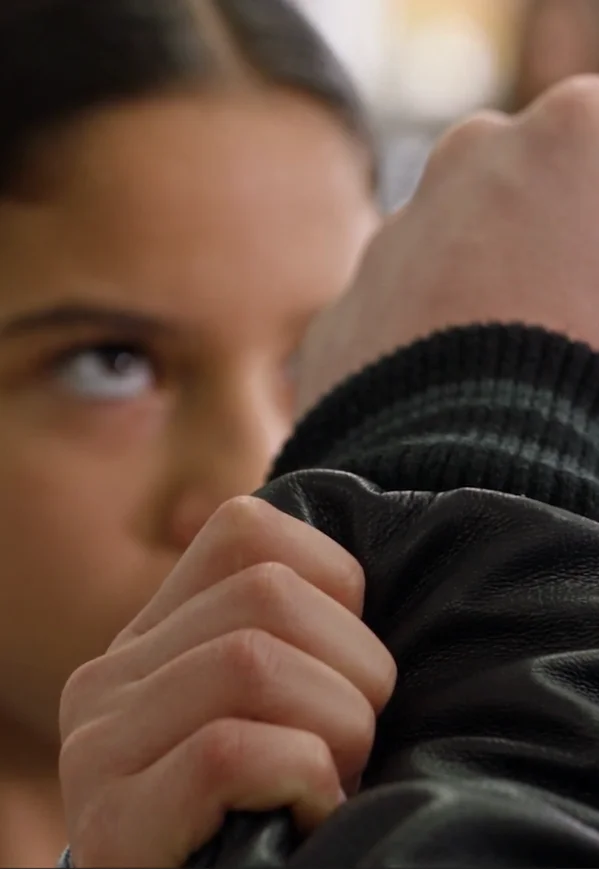
That afternoon, Maya returned to Ms. Price’s office for clarification about the chronology. Price had set out the statements on her desk, covered to protect other students’ information. She asked Maya to confirm the order of the sleeve grip, the withdrawal and the slip. The original video supported the sequence, but Maya’s testimony still mattered because it explained her perspective and intention.
“His fist was still raised when I touched his sleeve,” Maya said. “It dropped after he pulled away. When he stumbled, I wasn’t holding him.”
“Did you see what made his boot slide?”
“The milk was already there. I saw his boot go into it when he moved.”
“Was your intention to bring him onto the spill?”
“No. I hadn’t made a plan. I was trying to stop his fist from coming closer.”
Ms. Price made a note and asked whether Maya had spoken with any other students about what they should tell the school. Maya described her conversation with Avery and admitted she had asked her to preserve the file. She had not told Avery what to say; she had asked her not to post the recording. Price thanked her for being clear about both parts.
“I know some people want the video released,” Maya said. “I don’t.”
“Why not?”
“Because it would show Chloe on the floor again. And because there are things it doesn’t show. People would just pick another starting point.”
Price sat back. “That’s a thoughtful answer.”
“It’s also because I’m tired of seeing it.”
“That counts too.”
When Maya left the office, Avery was sitting on a bench near the windows. She held an unfinished biology worksheet and seemed to have been waiting. Maya sat beside her, leaving space between them.
“I heard some people are mad you didn’t share the full video,” Avery said.
“They can be mad.”
“Someone accused me of editing it. I told Price I didn’t make the crop and don’t know who did. She said not to get into arguments about things I can’t prove.”
“She’s told me that too.”
Avery tapped the edge of her worksheet. “I used to think being fair meant everybody got to watch and decide for themselves. But the people watching weren’t all trying to understand. Some just wanted a new clip to laugh at.”
Maya nodded. “I think a lot of them still do.”
“Chloe barely talks to me.”
“She doesn’t owe you a conversation.”
“I know.” Avery looked down. “I’m going to apologize to her anyway, if she’ll let me. Not because the file helped. Because I filmed when I could’ve gotten help.”
“You can ask. She gets to decide.”
“Right.”
Maya wanted to say something to make Avery feel less guilty, but guilt wasn’t always a problem to be solved. Sometimes it was a sign that someone had finally stopped pretending her choices had been harmless. They sat without speaking until the bell for after-school activities sounded.
At home Tuesday evening, Alicia was heating soup while Maya checked her school email. An appointment notice from Ms. Price said the written decisions would be communicated Wednesday morning. Separate notices would explain each student’s outcome, and Coach Hall would determine team leadership after the school findings were available. Maya read the words three times.
“Tomorrow?” Alicia asked.
“Tomorrow.”
“Do you want me to come in?”
“Yes.” Maya was embarrassed by how quickly the answer came. “I can talk on my own. I just don’t want to be alone in the building when I find out.”
“Then I’ll be there.”
They ate at the kitchen counter while rain began tapping against the window, the first wet evening since the incident.
Maya asked Alicia how she should behave if the letter criticized her for touching Trent. She wanted a plan that did not begin with anger. Alicia suggested reading the exact wording together, asking what facts supported the decision, and requesting clarification about any part that didn’t match Maya’s account. “You can disagree without inventing a worse version of the person you’re disagreeing with,” Alicia said. Maya realized this was the same discipline she had been trying to practice in her statement: the part she knew, the part she feared, and the part that remained unknown. She wrote the questions on a small card to keep in her pocket. Having them didn’t mean she expected a bad result. It meant she no longer wanted to react only after she felt cornered.
In the rain, headlights moved slowly along the residential street outside. Maya remembered how many classmates had offered her invented applause and how few had asked whether she felt safe. The school might issue a letter that settled a formal allegation. It would not instantly teach everybody to see Chloe as a person. Maya knew that work could continue in quieter choices: asking before sitting, listening when Chloe said no, and refusing to treat next week’s lunch as a reenactment. Maya asked whether her mother thought there would be a suspension. Alicia said she couldn’t know, and wouldn’t try to guess from the wording of an email.
“I keep thinking if I had let him shout and kept my hands to myself, nobody would be asking about me,” Maya said.
“Maybe,” Alicia replied. “And maybe he would have hit somebody. You don’t get to know the version that didn’t happen.”
“I wish I could stop everyone talking.”
“You can stop making their judgment the thing that tells you who you are.”
Maya wished the sentence were easier to practice than to hear.





