Maya noticed that Avery had stopped glancing toward the passing students. She was looking at Maya as if the conversation had finally become something other than a trial. “I don’t want Chloe to have to thank me,” Avery said. “I just want the school to understand why you were standing there.” Maya answered that Chloe would decide for herself what the video meant to her. The two girls walked into homeroom separately, but for the first time Maya was not wondering whether Avery would destroy the evidence to avoid an uncomfortable choice.
During her next meeting, Ms. Price told Maya she had received an original video from a student who had recorded from the southwest edge of the cafeteria. Price had checked that the file ran continuously from its beginning until after Trent went down, and had asked the student about the recording position. She couldn’t certify events outside the frame. She said the school was comparing the video with interviews instead of treating it as a complete story.
With appropriate privacy precautions, she allowed Maya to view the relevant section of the file as part of responding to the allegation that she’d initiated physical aggression. Maya had expected relief. Instead she felt nauseated when she saw Chloe kneeling on the floor again.
The video began after the tray was down. Trent’s boot knocked Chloe’s notebook toward the east aisle. The camera wobbled as the person filming moved her weight. A teammate laughed. Trent’s voice carried through the cafeteria hum, ordering Chloe away from the table. Maya’s denim jacket came into view as she knelt. The shot missed the first part of what she said to Chloe because a student’s shoulder crossed the frame.
Then Trent blocked the aisle. His voice was nearer. He demanded to know whether Chloe had permission to get up. Maya rose. “Back off,” she said on the recording, her voice thinner than she remembered. Trent answered, “Or what, little girl?”
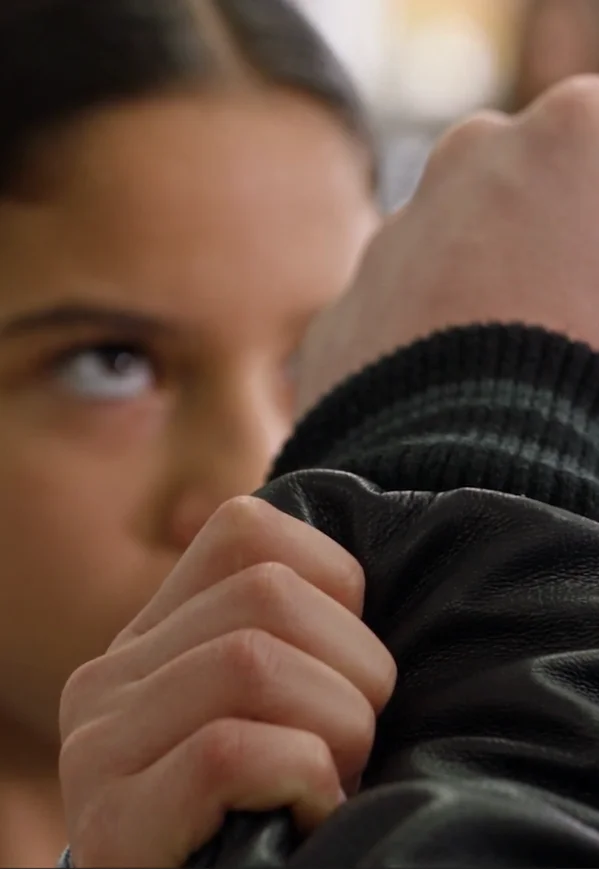
The camera briefly swung toward a laughing face in the crowd, then returned in time to catch Trent’s right fist lifting near Maya’s head. Some words were obscured by scraping chairs. The fist wasn’t. Maya’s left hand caught his sleeve. He jerked his arm away, stepped into the milk and dropped to one knee. In the same continuous sequence, Maya’s hand opened and she turned to Chloe.
Ms. Price stopped the playback after the first adult arrived. Maya was grateful she didn’t have to watch herself helping Chloe again, because she was suddenly afraid she would cry.
“That is what I remember,” she said.
“It’s consistent with important parts of your account,” Ms. Price replied. “It also shows the physical contact you described.”
“I didn’t deny the contact.”
“I know.”
“Can you tell people who are saying I threw him?”
“The school can address false or harassing behavior within its authority. We can’t control every version of a story students tell outside school. And we cannot distribute footage of a vulnerable student just to prove a point.”
Maya looked at the paused image of Trent rising. The video had captured one person’s worst lunch from a stranger’s phone. “I don’t want you to post it,” she said. “I just want you to see that he threatened us.”
“We are taking that seriously.”
Price explained that another student who had been near the central table remembered hearing Trent tell the girls to obey him. That student had not clearly seen Maya’s left hand because several people were in the way and couldn’t say who had caused the tray to fall. Mr. Grady’s report began after Trent lost his balance. Chloe’s own account described the notebook kick and threat but acknowledged her limited view of the sleeve grip. The pieces had different shapes. They didn’t need to become identical to matter.
For a moment after the playback, Maya wanted to ask Ms. Price to start it again. She remembered seeing the milk shine beneath Trent’s boot, but the phone camera’s view had been crowded and shaky. What if a different angle made her memory wrong? What if she had held the sleeve an instant longer than she thought? She didn’t want an answer that depended on pretending her own recollection was perfect.
“I can look at it again if you need me to,” she offered.
“We have a copy and your account,” Ms. Price said. “You don’t need to watch distressing footage repeatedly to demonstrate honesty. If a specific point becomes contested, we’ll identify it.”
Maya nodded. There was a kindness in that answer she hadn’t anticipated. The room was full of papers and procedure, but the people in the recording were still teenagers, not specimens that could be rewound until their faces stopped looking frightened.
“Could Avery get in trouble for filming?” Maya asked.
“Students are expected to seek help and behave responsibly. The circumstances of each person’s conduct matter. What I can discuss with you is why we asked for the file: not for public viewing, but to evaluate the events in combination with personal accounts.”
“Do you think whoever made the crop knew what it would do?”
“I can’t tell you what that person thought. I can tell you that a fragment doesn’t give viewers the whole context.”
That was another useful boundary. Maya could feel herself reaching for an anonymous editor to blame, someone who could be confronted and forced to admit malicious intent. She didn’t know who had made the crop. She knew what the crop excluded. The distinction was less satisfying than the accusation but far more defensible.
She thought of Chloe watching the same frames on her own phone, perhaps before she was able to wash the jacket properly, and wished the internet could be asked to put something back where it had found it. But the best they could do was prevent the school from relying on the partial clip as the whole story. Avery’s decision had given them that chance without sacrificing Chloe to another public viewing.





