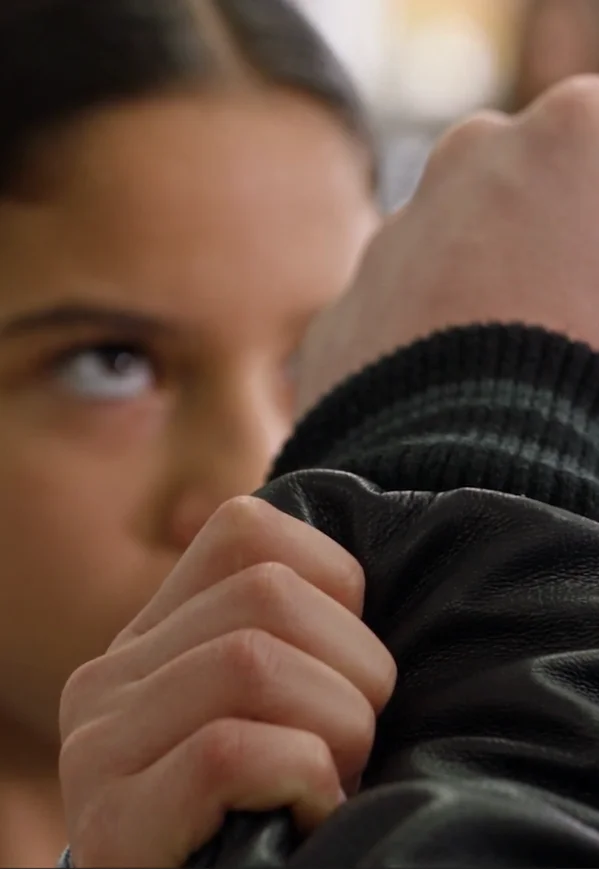
She had spent the weekend drawing the south side of the cafeteria from memory. Alicia had asked whether it was helping, and Maya had answered that it was helping her decide which parts she needed to let go. The hand, the fist, the wet floor—those were facts. The faces of every student who had laughed were not facts she could hold forever. Some had been afraid. Some had been cruel. She knew only what they’d done in the minutes she was watching.
At nine, Ms. Price met with Maya and Alicia. Her office now contained a paper folder labeled with the date of the incident, rather than the stack of loose notes Maya remembered from last week. There was nothing dramatic about the folder, which made it more intimidating. A file meant the cafeteria had become a sequence of statements adults would have to interpret.
Ms. Price told them she had spoken separately with Trent, Chloe and several witnesses. She had reviewed Avery’s uncut recording alongside the crop that had circulated. She explained again that the original did not include the tray’s fall, that the witness who heard Trent’s threats had a limited view, and that Mr. Grady had arrived after the slip. The school would not attribute the tray’s fall to anyone without reliable support.
Alicia leaned forward. “But the school can decide what it makes of him kicking the notebook?”
“Yes. That action is visible and supported by accounts.”
“And the fist?”
“Yes, that is also visible. The exact words are partly affected by background noise, so we have assessed those with the firsthand accounts.”
Maya watched the assistant principal turn a page. She had wanted the school to take the threat seriously. Hearing it separated into categories of evidence was strange, but she understood why Price was doing it. A story couldn’t be made fair simply by choosing the person whose pain was easiest to see.
“Now we need to talk carefully about your contact with Trent,” Ms. Price said to Maya.
Maya folded her hands. “I know.”
“Why his sleeve?”
“His fist was near my face. He was blocking the exit. Chloe was behind me on the floor. I thought he might hit one of us. I wanted him to stop moving closer.”
“Did you consider stepping back?”
“I did. Chloe was behind me. I couldn’t step straight back without stepping on her or the mess. I could have turned toward the dry side, maybe. I didn’t think of that fast enough.”
Price waited. “And what did you think would happen when you grabbed him?”
“I thought he’d stop. Maybe look at my hand instead of Chloe. I didn’t plan the part where he pulled away and slipped.”
Alicia reached toward her daughter’s elbow but didn’t interrupt. Maya was glad. She needed the adults to hear the choices as they had happened, including the part that was not a perfect choice.
Ms. Price said physical contact in a confrontation carried real risks. A different motion could have caused injury; another person might have reacted with violence. She did not say Maya should have abandoned Chloe. She asked Maya what safer options she could use if someone was threatened again: move toward staff, draw attention, keep a barrier of distance when possible, and avoid engaging physically except when circumstances left no safe alternative.
“I don’t want to do that again,” Maya said. “I don’t want anybody to have to.”
That answer came more easily than she’d expected. She had grown tired of students treating her grip like a signature move. There had been nothing graceful about it. Her palm had hurt, and afterward she had been afraid to walk to class. She didn’t want a trophy for those seconds. She wanted the seconds not to repeat.
Ms. Price asked Alicia whether the family had concerns about Maya’s safety at school. Alicia spoke about the locker note and the online accusations, and asked how students were being instructed not to retaliate. Price described the temporary directions, the option of contacting a named staff member immediately, and supervision near the central tables. She admitted the school could not promise that no student would make another cruel comment. It could intervene when concerns were reported and corroborated, and it had responsibility to address ongoing harassment, not merely the original incident.
“Please don’t move Chloe to a hidden room as a solution,” Maya said.
“Chloe has said she wants to keep eating lunch where she chooses. We’re working with her and her mother on that,” Price replied. “You can support her. But her plan is hers.”
Maya felt heat climb into her face. She had been trying to defend Chloe’s choice and had nearly spoken over it again.
In the hall afterward, Alicia asked whether Maya regretted touching Trent.
“I regret being close enough for him to swing at me,” Maya said. “I regret how scared Chloe was. I don’t know what I could’ve done in the same second instead.”
“You don’t have to invent a better version of yourself in order to learn from this.”
Maya looked at her mother. “You sound like Price.”
Alicia made a face. “That is not the compliment you think it is.”
They both laughed. It was a brief sound, but it loosened something in Maya’s chest.
At lunch, Chloe had taken their usual south-window table and was sketching a road that crossed a bridge between two neighborhoods. The line of the bridge seemed darker than everything around it. Maya waited while Chloe finished shading the railing.
“My mom came in this morning,” Chloe said. “Renee Bennett, professional librarian and professional question asker. She wanted to know exactly who I was supposed to tell if someone started doing it again.”
“What did Price say?”





