Her mother knocked at her bedroom door and offered clean laundry. When Maya told her about the messages, Alicia sat beside her on the bed. “You don’t have to answer everybody,” she said. “Especially the people who only want a show.”
“What if not answering makes it worse?”
“Then we deal with what happens. But you don’t owe strangers a performance.”
Maya asked whether she should go to school tomorrow. Alicia didn’t dismiss the question. They talked about how to reach Ms. Price, where Maya would eat lunch, and which classes she shared with Trent’s teammates. They made a modest plan: go in, report direct harassment, and call home if the school couldn’t keep her safe. It didn’t make the situation disappear, but it converted a fog of fear into decisions she could understand.
After Alicia left, Maya reopened her statement. She was tempted to add a line claiming she had seen Trent deliberately knock over Chloe’s tray. It would have made the narrative cleaner. It might even have been true. But she hadn’t seen it. She kept the original sentence and saved the document again.
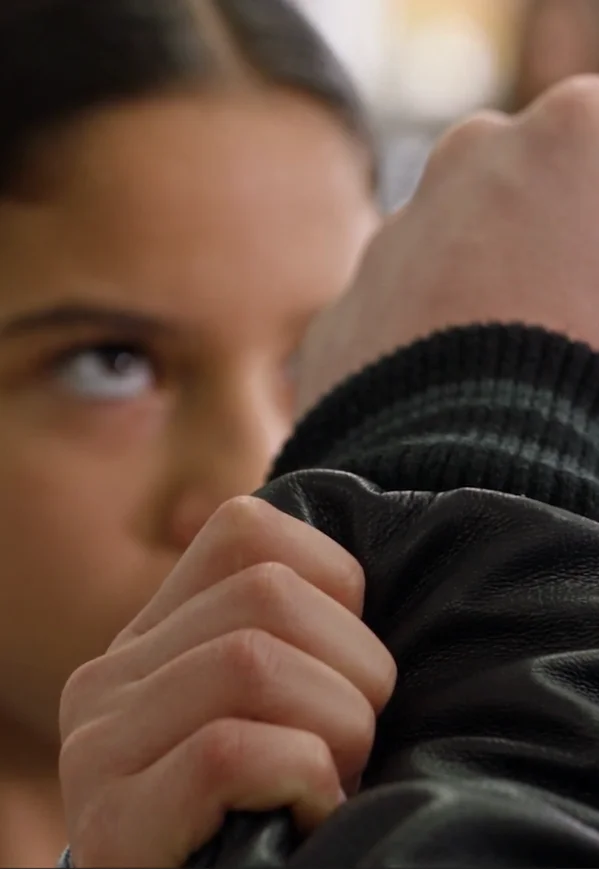
Close to ten, Chloe sent one final message. There was an image attached: a screenshot from a video post. In the frozen frame, Maya’s left hand was fastened to Trent’s black sleeve. His right fist was mostly out of view, cut away at the top edge. The caption beneath read, New girl attacks Brookdale’s captain at lunch.
Under the screenshot Chloe had typed: They cut off everything that happened before.
Maya watched the short clip once. It began at her grip and showed Trent wrenching free and dropping to one knee. Without the spilled tray, the blocked aisle or the raised fist, it looked like the story the caption told. The video ended before she helped Chloe stand.
Maya closed the app. She could still see the scene as it had happened, the milk stretching into the east aisle and Chloe’s hand opening to meet hers. But on her phone, the cafeteria had become a place where the truth could start several seconds too late.
On Tuesday morning, Maya reached Brookdale twenty minutes before first bell because she didn’t want to arrive with the crowd. The front doors opened onto a hallway full of autumn fundraiser posters, students carrying coffee, and the familiar squeak of sneakers against polished tile. Everything looked ordinary until two girls by the trophy case went silent when she passed.
Her phone held thirteen messages from numbers she hadn’t saved. One congratulated her. Another called her a liar. Three included the cropped clip. The most inventive claimed she had studied martial arts with her uncle, although she didn’t have an uncle who taught martial arts and had never learned to throw anyone. A stranger had turned her into a character before she had even finished her homework.
She put the phone into her backpack and walked to English. Her teacher was discussing a short story about unreliable narrators. Maya almost laughed, then felt sick. When someone asked whether a narrator could tell the truth and still mislead, she kept her hand beneath the desk.
At passing period, a teammate of Trent’s stood across from her locker. He was not wearing a football jacket; without it he looked like any other sleepy senior holding a half-finished granola bar.
“Hey, Maya,” he said. “You could’ve just asked him to move.”
“I did.”
“He didn’t hit you.”
“He raised his fist in my face.”
The boy’s eyes shifted toward the students listening nearby. “That’s not what the video shows.”
“Then the video doesn’t show what happened.”
He shrugged and left. Maya’s pulse kept racing after he turned the corner. The exchange had lasted ten seconds, but she felt as if she had been asked to defend herself before a jury that already wanted a verdict.
Ms. Price had arranged for Maya to come to her office before lunch. She explained that the school had given Trent instructions not to contact Maya or Chloe and had told the girls the same about him. Those temporary directions weren’t findings of equal fault. Staff would monitor the central lunch aisle more closely; students involved in the incident could use different seats without being ordered out of the cafeteria. Ms. Price wanted each person to describe the event separately, in writing and in conversation.
“Someone’s telling people I attacked him,” Maya said.
“I know the short clip is circulating.”
“Is that enough for you to punish me?”
“No,” Ms. Price said. “It’s enough to ask questions. It isn’t enough to answer them.”
She asked Maya to review the statement sent the night before. Maya read it line by line, surprised by how precise the wording sounded compared with the fog in her head. She added an approximate location for the notebook after the kick, and noted that Chloe was behind her when the fist rose. She didn’t change the sentence about the tray.
“Trent says he felt his arm being held,” Ms. Price told her. “He says he pulled away because he wanted to get free.”
“That’s true. He did pull away.”
“He disputes your description of the threat.”
Maya looked up. “Did he tell you about the fist?”
“I’m not going to summarize another student’s entire interview. I’m telling you the part you’re entitled to respond to.”
“Then please write down that I never said he had no reason to pull his arm away. I said he raised his fist first.”
Ms. Price made a note. She asked whether Maya had been injured and whether the online attention had led to direct threats. Maya described the locker conversation and the speculative comments but couldn’t name anyone who had threatened her physically since Monday. Price asked her to report any change. Maya appreciated the distinction even while wishing the school could make every cruel comment vanish.





