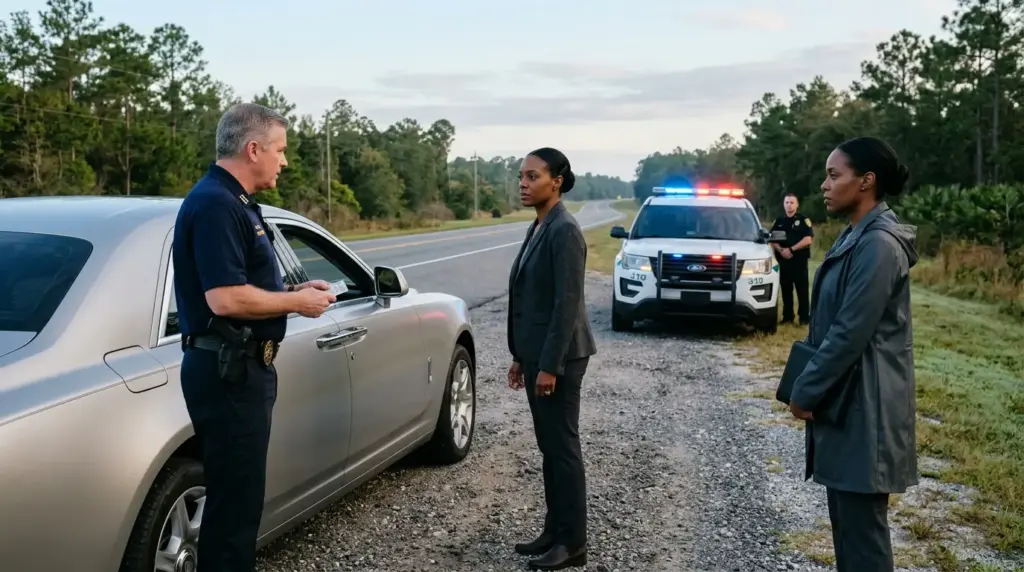
Calhoun was cuffed at 2:22 p.m. Fenwick was present. He said three words to Calhoun as the cuffs went on: “Say nothing. Nothing.”
Calhoun’s wrists were secured behind him—the same configuration he had put Nadia in, with the same model of cuffs, on the same stretch of asphalt roughly two hours earlier. He was walked to a federal vehicle. He did not look at Nadia as he passed her.
She did not look at him either. She was looking at the photograph she’d recovered from under the seat: her father, her mother, herself at twenty-four, Renata with the legal pad and the pen behind her ear. And she was thinking about what her father had said in the car on the way home from that Atlanta courthouse twenty years ago.
He had said, “The system protects itself first. Always. Your job, both of you, is to make the cost of protecting itself higher than the cost of doing the right thing. That is all the law ever is: the management of costs.”
Renata came to stand beside her. She looked at the photograph. “He would have had a lot to say about today,” Renata said.
“He would have said it quietly,” Nadia said, “and he would have been right.”
Sharp was cuffed at 2:31 p.m. He did not resist. He had been speaking with an agent for forty minutes—not a lawyer, not yet—because he had made the decision during those forty minutes that getting ahead of this was more valuable than protecting the man who had ordered him to destroy the device. He asked what cooperation looked like. The agent told him. He said he had information about the auction network: not just the Florida LLCs, but a parallel operation in Georgia involving four additional seizures.
The agent said, “We’ll need that in writing, on record.”
Sharp said, “I’ll write as many pages as you need.”
Okafor sat in the rear of a federal vehicle and did not speak. He had called a private attorney—not the union rep, his own attorney—and had been advised to say nothing until counsel arrived. He sat with his arms on his knees and looked at the floor. He was not the architect of what had happened; he knew that. He also knew that the line between participant and architect was a legal question, not a moral one, and that the answer would be decided by what he chose to do in the next forty-eight hours.
He had been present when Calhoun ordered cameras off. He had executed the order. He had cuffed Nadia Voss. He had put his hand on Renata Voss’s shoulder and turned her away from the scene. These were not small things. He looked at the floor.
Priya Holden was the last to leave the scene. She had been asked to remain until the evidence documentation was complete, and she had remained. She watched the vehicles clear out one by one: the patrol cars, the Durango, the federal Expeditions.
The civilians across the road began to disperse slowly, the way people disperse when the thing they gathered around has moved from event to aftermath. The woman in the church hat stayed until the last federal vehicle pulled away. Then she put her phone, which had recorded sixty-three minutes of footage, in her purse, started her sedan, and drove home.
She would call her nephew that evening. She would tell him what she had seen. She would tell him that the women had not flinched. She would tell him that one of them had kept a notebook and written everything down, even while her portfolio was being taken from her.
Her nephew, who had lost a pickup truck and $1,400 in cash to a Duval County asset seizure two years earlier, listened without speaking. When she finished, he said, “You think something will actually happen?”
She was quiet for a moment. “Something already happened,” she said. “Today. I watched it.”
The Rolls-Royce was loaded onto a flatbed at 3:14 p.m. and transported to a federal impound facility in East Jacksonville for documentation. Priya Holden took the last photographs of it on the shoulder: the dented quarter panel, the damaged interior visible through the open doors, the evidence markers still in place from the scene processing. She took sixteen photographs. She logged each one with timestamp, her badge number, and the case reference number Merritt had given her.
She walked to her patrol car. She sat in it for a moment without starting the engine. She thought about the memo that had been retracted. She thought about the LLC names on the folder tabs. She thought about the four words she had told the federal agent she’d heard from Calhoun: We fix the report. And the precision with which she had qualified her statement, noting she could not confirm full context.
She thought about what it had cost her to press the secondary device under her vest. She thought about what it would have cost her not to.
She started the engine.
The federal building on West Bay Street received three individuals for processing that afternoon: Captain Ford Calhoun; Sergeant Devlin Sharp, who had shifted from detainee to cooperative witness within two hours—a transition that would shape the legal trajectory of the entire case; and, an hour later, a Lieutenant Terrance Bowman, who had been connected to the LLC network through the financial analysis Renata’s team had assembled over twenty-two months, and who had been taken into custody at his home in Mandarin at 4:06 p.m.





