The third page was a list of specific charges under federal consideration: 18 U.S.C. Section 242 (deprivation of rights under color of law), 18 U.S.C. Section 1519 (destruction and falsification of records in a federal investigation), 18 U.S.C. Section 1512 (tampering with a witness, victim, or informant), and conspiracy charges under 18 U.S.C. Section 371 related to the asset forfeiture scheme.
Calhoun held the document. He held it for a long time.
Sharp, twenty feet away, watched his captain hold the document. The way Calhoun held it—hands slightly unsteady, weight back, jaw set against something—told Sharp everything he needed to know without being told anything at all. Sharp set the crowbar down. He set it down carefully at his feet and took a step back from it.
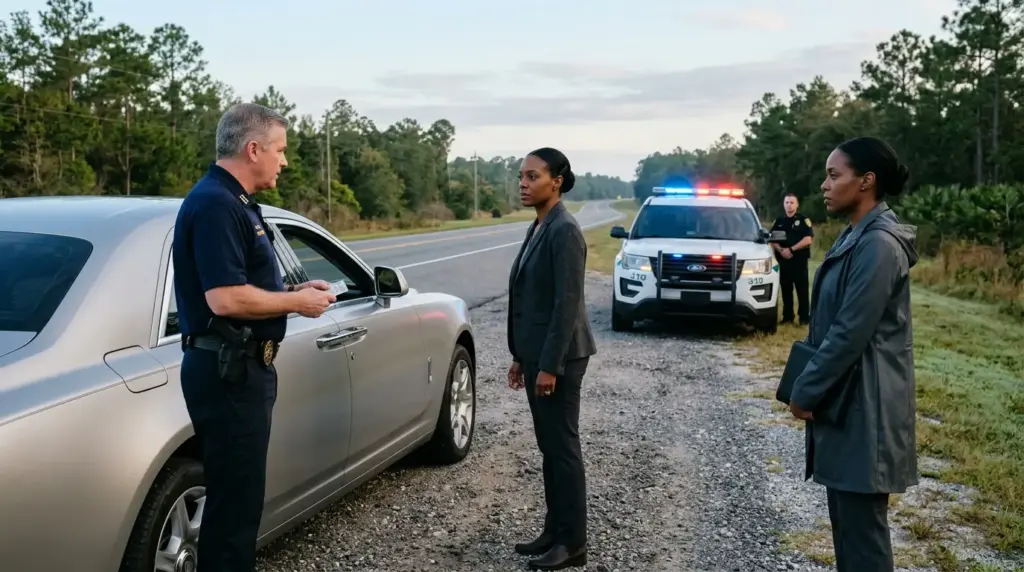
Nadia walked to the rear of the Rolls-Royce. She looked at the damage methodically, without performance: the rear quarter panel dent, the missing interior trim stacked in pieces on the asphalt, the broken seat base, the torn door pocket. She reached in through the open rear door and retrieved, from beneath the front passenger seat where it had slid during the search, a small photograph—the same one Renata had carried to the cemetery that morning: their father, their mother, themselves at twenty-four, the Atlanta courthouse in the background.
She looked at it. She put it in her blazer pocket.
She turned to where Renata was standing with the DOJ official and two agents, speaking in the measured, specific way that Renata always spoke when she was in working mode: precise, sequential, referring occasionally to the notepad she’d managed to write in during the stop. Renata had documented thirty-one separate items during the forty-seven-minute stop: badge numbers, times, exact dialogue in quotation marks, a sketch of vehicle positioning, a notation of the moment Calhoun ordered cameras off, including his exact words as she had heard them from eight feet away. Thirty-one items. She had been doing this in some form or another for twenty years.
The attorney on Beach Boulevard, his name was Marcus Duval, and he had practiced civil rights law for eighteen years, was on his third phone call of the morning by the time the federal convoy arrived on State Road 228. His first call had been to the federal clerk. His second had been to a colleague at the ACLU of Florida. His third was to a journalist, a woman named Petra Sandoval at the Florida Times-Union, who covered law enforcement accountability and had been working a story on civil asset forfeiture in Duval County for six months without quite enough documentation to publish it.
He told her what he had seen in the forty-three-second video. He told her where it had been filmed. He told her to check the federal court docket for the Middle District of Florida, case designation starting with the name Voss.
Petra Sandoval was in her car within four minutes.
Back at the scene, a conversation was happening between Calhoun and his union representative, a man named Dale Fenwick, who had arrived in a personal vehicle approximately eight minutes after the federal convoy, having been called by Okafor before the agents could fully secure the scene. Fenwick was a compact man in a sport coat who moved with the purposeful neutrality of someone whose entire professional value lies in making other people’s disasters less catastrophic.
He spoke quietly. Calhoun spoke back louder. Fenwick said something that made Calhoun lower his voice.
Priya Holden, sitting in the rear of a federal Expedition giving her statement, could see them through the window. She could not hear them. She did not need to. The statement she was giving was precise, chronological, and complete. She included the moment Calhoun ordered cameras off. She included the secondary recording. She included the four words she had heard Calhoun say to Sharp about the report. And here she paused and said, “I want to be precise. The exact words I heard were, ‘We fix the report.’ I cannot verify that I heard it in full context, but those four words were distinct.”
The agent taking her statement typed without comment.
Priya said, “I also want to state for the record that I believe Sergeant Okafor’s camera may have been disabled before the order was given. I saw him reach for it approximately ninety seconds before the order. That may have been standard protocol, but the timing is notable.”
The agent typed. Priya looked out the window. Calhoun was still talking to Fenwick; Fenwick had one hand up, a steadying gesture.
She looked back at the agent. “I have one more thing,” she said. “Six months ago, I received an internal memo regarding asset seizure discrepancies in Precinct 14. It was retracted two weeks after it was issued. The memo referenced three LLC names. Two of those names appeared on tabs in the document case that Captain Calhoun opened at the scene today. I can identify those names. I kept a copy of the memo.”
The agent looked up from the keyboard. “You kept a copy?”
“I keep copies of things that get retracted,” Priya said. “It’s a habit.”
Inside the lead Expedition, Renata Voss was finishing her walkthrough of the investigative timeline with two senior agents and the DOJ official. The case she’d been building, designated internally as Operation Clean Ledger, had begun twenty-two months earlier with a pattern analysis of civil asset forfeiture filings in four North Florida counties. The pattern showed a concentration of high-value vehicle seizures along specific highway corridors with a statistically anomalous rate of cases dismissed at the administrative level before any legal challenge could be mounted.





