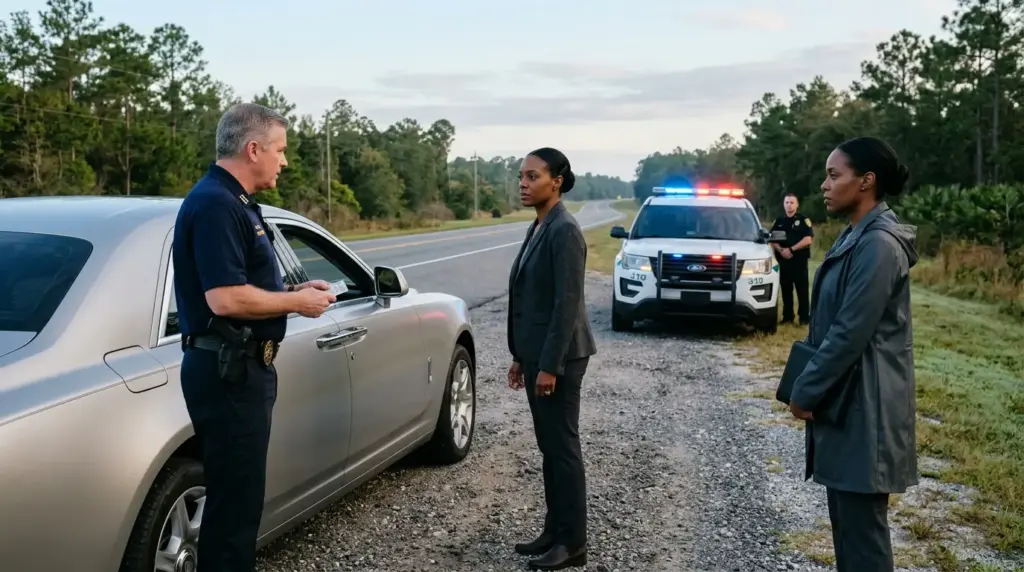
Priya Holden watched from the rear of the vehicle. She had both hands at her sides. Her expression was composed in the specific way of a person who has identified a threshold and is watching someone cross it in real time.
Sharp, meanwhile, had gone back to the car. The crowbar was still in his hand. He started on the rear interior paneling—the kind of methodical destruction that is performed when someone wants to look thorough and has no idea what thorough actually requires. He pulled the trim from the C-pillar. He pried at the seat base. He worked with the focused efficiency of a man who has done this before and does not expect to be questioned about it. Wood veneer trim—the real thing, hand-fitted—cracked and splintered under the pry bar. Leather split. The cream-colored rear seat panel came away from the door in three pieces.
Renata watched this happen. Her face was still, but she reached one hand slowly, visibly toward the inner pocket of her coat.
Okafor caught the motion. “Hey!” He stepped toward her. “Hands!”
“I have a pen in my pocket,” Renata said. “I would like to make a note.”
“You don’t get to make notes.”
“I am noting the time,” she said. “The current destruction of vehicle interior, the officer name and badge number of everyone present.” She paused. “For the record.”
“There is no record,” Okafor said. “Cameras are off.”
He said it with a confidence that, in another circumstance, might have been correct. It was not correct.
Priya Holden, standing four feet behind him, heard those words. The upload indicator on her secondary device, invisible under her vest panel, had gone green eight minutes earlier. The footage was already off her device and stored somewhere that was not accessible by any standing request from a precinct captain in Duval County.
She looked at the road. She looked at the treeline. She looked at the women: one in cuffs against a ruined car, one standing at the roadside with her hands visible and her face giving away nothing. She thought about a memo she’d received six months ago—an internal affairs inquiry about asset seizure discrepancies in her precinct. A memo that had been quietly retracted two weeks after it was issued. A memo that she now noticed had referenced three LLC names, which were the same three LLC names she had just read upside down on the tabs of the folder Calhoun had taken from the black case.
She thought about that memo for eleven more seconds. Then she pressed her hand flat against her vest, feeling the small shape of the secondary device. She made her decision.
A white sedan had slowed on the opposite lane, then stopped. The driver—a woman in her sixties, silver-haired, wearing a church hat on a Thursday for reasons known only to herself—had a phone raised at window height. She was recording.
A pickup truck had stopped behind the sedan. The driver, a man in a contractor’s vest, was already out of the cab with his own phone up.
Calhoun noticed them. He walked toward the road’s edge. “Move along. This is an active scene.”
The woman in the church hat did not move along. She lowered her window the rest of the way. “My nephew had his truck taken on this road,” she said. “Two years ago. Cash in it, too. Never saw either one again.”
Calhoun stopped walking. “Ma’am, I need you to move your vehicle.”
“I’m on a public road,” she said, “and I’m not breaking any law.” She kept recording.
A second vehicle had stopped behind the pickup, then a third, until the road that had been empty twenty minutes ago now had a small stationary audience on its opposite shoulder. Every one of them had a phone, and none of them were moving.
Calhoun walked back to Sharp. “Finish up. And someone get those civilians back.”
Okafor moved toward the road. Priya did not. She stayed where she was, near the rear of the Ghost, and watched Sharp pull the last of the interior paneling from the driver’s door.
The car had been opened, searched, and partly dismantled. The module was destroyed. The case had been broken open. The two women stood at the roadside, one in cuffs, both composed, both watching Calhoun with the particular patience of people who are not waiting for rescue; they are waiting for process.
Calhoun came back to Nadia. He stood close—closer than professional distance—in that deliberate way that is not quite a physical action, but is meant to be felt as one. “You want to tell me who you really are?”
“My identification is in your sergeant’s hand,” Nadia said.
“Your ID says you’re a federal employee. It doesn’t say much else.”
“No,” she agreed. “It doesn’t.”
He stared at her. The air between them was very still. Somewhere on the opposite shoulder, a phone camera was still raised.
“What’s on that drive?”
“You destroyed the module,” she said. “The drive is encrypted, and it’s now additional evidence.”
“Evidence of what?”
She looked at him directly. The expression on her face was one that Calhoun would later describe to his union attorney as “like she was reading from something I couldn’t see.” He meant it as an insult. He was more accurate than he knew.
“Evidence of what happened here today,” she said. “All of it.”
Calhoun leaned in closer to Nadia. Not touching, but near enough that it was a decision, not an accident. His voice dropped. “You think you’re the first person to cite Florida statutes at me on the side of a road? I’ve been doing this job for nineteen years. I’ve heard every line.”
Nadia looked at him. “I’m sure you have.”
“Then you know how this ends.”
“I do,” she said. “Yes.”
Something in her certainty stopped him. Not long—three seconds, maybe four. Then he turned.





