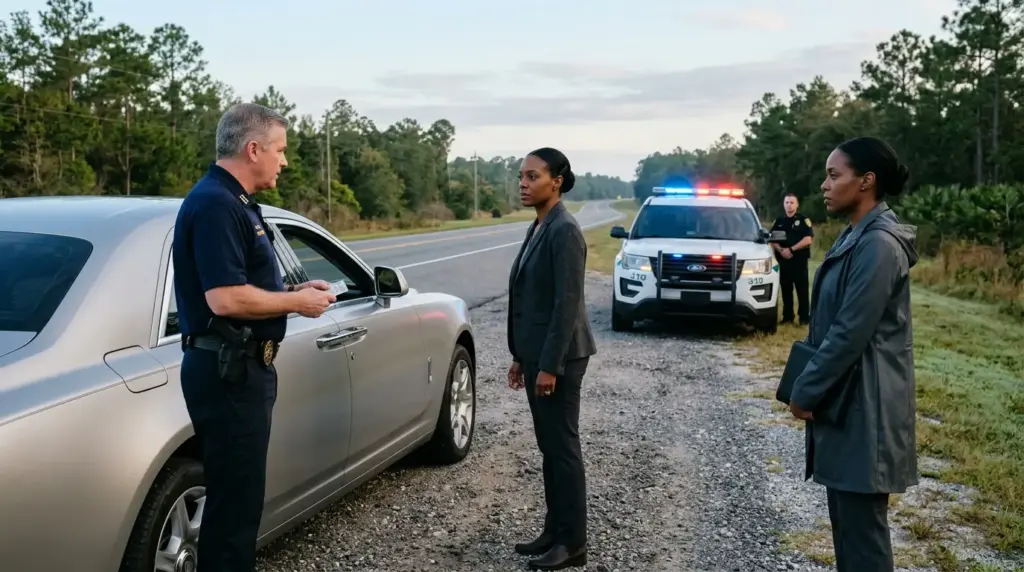
Sharp was working on the driver’s door panel when he found the secondary port: a small recessed channel behind the trim that ran a hairline wire toward the dashboard. He called Calhoun over.
Calhoun crouched. He pulled the trim back farther with his bare hand, snapping the retaining clip. He followed the wire with one finger, his jaw set. “She said this was a federal device.”
Sharp said nothing.
Calhoun stood. He looked at Nadia. He walked toward her until he was close enough that she would have had to step back to maintain standard conversational distance. She did not step back.
“Last chance,” he said. “Tell me what’s on the drive. Tell me who sent you. Tell me who runs this vehicle.”
“The vehicle is registered in my name,” Nadia said, “which your officer confirmed twenty-six minutes ago.”
He grabbed the front of her blazer. Not a strike—a grip, both hands, fabric bunched at the lapels, the kind of contact that stops just short of the legal threshold he’d spent nineteen years calibrating. He held it for one second. Two.
Renata said from eight feet away, her voice absolutely level, “Release her. You are being recorded.”
Calhoun released the blazer. He stepped back. He smoothed his polo shirt.
Priya Holden had gone very still.
Nadia looked down at her lapels. A small button had come loose. It lay on the asphalt at her feet. She looked at it. She looked at Calhoun. “I’d like to note that for the record as well,” she said.
He turned away. He walked back to Sharp. He said something that Priya was close enough to partially hear—three words, maybe four, the last of which was “the report.”
She looked at the road. She thought about six months ago. She thought about the memo that was retracted. She pressed her hand against the secondary device under her vest one more time: green, still transmitting.
The older woman in the church hat had been joined on the opposite shoulder by six other people. Two of them had been driving past and stopped when they saw others stopped. One was a teenager on a bicycle who had come from the direction of the neighborhood three blocks north. The contractor in the vest had called someone on his phone; whoever he called had told two more people, because there were now two more vehicles behind his truck. None of them knew who the women in the Rolls-Royce were. None of them needed to.
An older man, heavy-set, wearing a JSO retired cap, had stepped out of his car and was standing at the road edge with his arms folded—not recording, just watching. He’d worked seventeen years in this county. He knew what a clean stop looked like. He knew what this looked like. He watched.
At forty-one minutes into the stop, a female witness in a red jacket approached the road shoulder. She held her phone with the deliberate casualness of someone who has already sent the video somewhere else and is no longer worried about what happens to this particular device. She addressed one of the stopped civilians, not a law enforcement officer, and handed them a piece of paper with a phone number on it.
“That’s the attorney I used,” she said quietly. “When they took my brother’s van three years ago. He never got it back.”
The piece of paper passed from hand to hand among the civilians on the opposite shoulder.
Calhoun’s phone rang. He stepped away from the scene to answer it. His posture changed slightly as he listened—a stiffening that was not visible from the road, but that Priya, twelve feet away, registered in the set of his shoulders. He said “yes” twice. He said, “I have the situation under control” once. He ended the call.
He stood for a moment with his back to the scene. Then he turned and walked back toward his Durango. He passed Sharp. He passed Okafor. He passed the broken remnants of the module on the roof of the car. He said to Sharp without stopping, “We need to talk about the report.”
Sharp nodded.
Nadia Voss stood with her wrists cuffed behind her beside a car that had cost $1.5 million and was now missing three panels of interior trim, a rear seat base, and a module that had transmitted its data to Quantico four hours before anyone tried to destroy it. Her expression had not changed since the moment the lights came on behind her on State Road 228. Her breathing was steady, her spine was straight.
Renata stood beside her, no longer held by Okafor. He’d stepped away, portfolio returned to her after Sharp extracted and photographed its contents. She had her pen now. She was making notes in a small spiral-bound pad she’d produced from her coat pocket while Sharp was occupied with the door panel. She was writing down names, badge numbers, times, exact words as she recalled them with quotation marks. She had done this before, many times, in many different rooms. She did not appear to be in distress.
On the opposite shoulder, someone sent a video to the personal cell number written on the piece of paper. The attorney who received it was sitting in his office on Beach Boulevard. He watched the video. He watched it again. He picked up his desk phone. He called a number he rarely called before 10:00 a.m. on a weekday. The person who answered was a federal court clerk.





