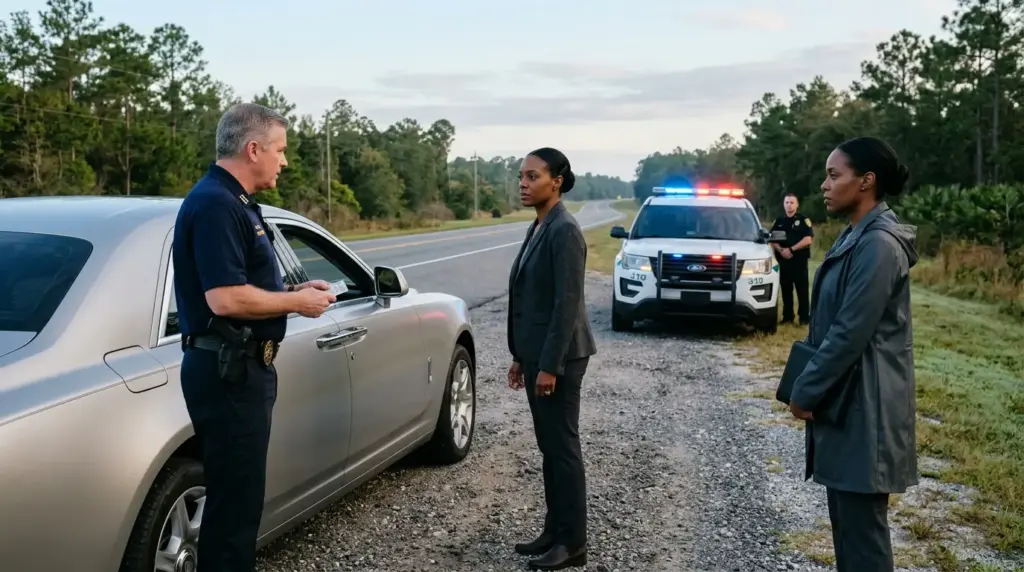
Officer Priya Holden, twenty-eight years old, four years on the force, stood at the rear quarter panel of the Ghost and ran the plates a second time on her handheld. The first time, the system had returned clean. The second time returned identical information: Nadia Voss, current registration, zero flags, VIN verified.
She looked at the readout. She looked at Captain Calhoun. She said nothing. Not yet. She had learned in four years that there was a particular silence required of junior officers when a captain was in the middle of forming an opinion.
Calhoun handed the documents to Sergeant Brian Okafor, who had exited the patrol car and now stood at the passenger window—6’3″, built like a linebacker. His presence at that window was clearly calculated.
Okafor looked down at Renata. Renata looked straight ahead.
“Ma’am, I’m going to need you to step out of the vehicle.”
Renata turned her head slowly. “On what basis?”
Okafor’s jaw tightened. “On the basis that I asked you to.”
“That’s not a legal basis.”
The air between them shifted. Okafor was not accustomed to being answered. He was accustomed to compliance—a compliance that his size and tone had always efficiently produced. He put one hand on the door handle. “I’m not going to ask again.”
Renata kept her hands visible on her lap. Her voice was entirely even. “You have not provided a valid legal reason for this stop, for requesting that I exit the vehicle, or for detaining us. If you have one, I’m listening.”
Okafor yanked the door open. Renata didn’t move. She looked at him the way a person looks at something they have already documented and filed away for later.
Calhoun came around to the passenger side. He looked at Renata. He looked at Nadia. He looked at the interior of the car again—that same cataloging quality, that same offense taken at the existence of something he decided shouldn’t belong to the people inside it.
“Both of you, out. Now.”
Nadia opened her door. She stepped out with measured deliberateness, neither hurried nor slow. She stood beside the car in her charcoal blazer and looked at Calhoun directly. “Captain,” she had read his collar rank, “can you tell us the reason for the stop?”
“Failure to maintain lane.”
Nadia said nothing. She had been traveling in a straight line on an empty two-lane road. She had checked her mirrors every eight seconds, as her father had taught her. She had not deviated from her lane by a single foot.
She said, “I’d like to note that for the record.”
Calhoun stared at her. “What record?”
She didn’t answer that.
Priya Holden, standing quietly behind the vehicle, had switched on her body camera at the moment the Rolls-Royce pulled over. Standard protocol. It was recording. She was aware that Sergeant Okafor’s camera was also on. She was not yet aware that within the next twenty minutes, Captain Calhoun would order all cameras off.
Calhoun walked a slow circuit around the Ghost. He stopped at the rear. He crouched and looked at the taillights. He stood. He circled back to the front and looked at the windshield. He was not looking for a traffic violation; he was constructing one. Building the story backward from a conclusion he had already reached.
“Registration says this car is out of a storage address. You just drive it occasionally?”
“Yes,” Nadia said.
“Where are you coming from this morning?”
“We visited a family member’s grave. Riverside Memorial Gardens.”
Calhoun’s eyes moved to Renata, who had finally stepped out of the vehicle at Okafor’s second instruction. She stood with her leather portfolio under her arm. Her expression was the same as it had been since the moment the lights came on: present, attentive, disclosing nothing.
“What’s in the case?”
“Personal documents.”
“I’m going to need to see those.”
“No,” Renata said. “You’re not.”
Okafor took one step toward her. He was close. Too close. And he was using that proximity the way he used his size: as a statement, a declaration of hierarchy delivered through physical space. “You want to run that by me again?”
“The contents of that portfolio are private documents. You have not established probable cause for a search. Under Florida Statute Section 901.151, a stop and detention requires articulable reasonable suspicion of criminal activity. ‘Failure to maintain lane,'” she said it with a quality that made the words into quotation marks around themselves, “‘does not provide probable cause for a search.'”
Calhoun turned toward her slowly. His expression had changed. It was no longer the expression of a man inconvenienced; it was the expression of a man who had decided to win something for reasons that had nothing to do with law enforcement.
“You a lawyer?”
“I didn’t say that.”
“You sound like one.”
“I sound like someone who read the statute posted on the notice board at the precinct waiting room,” Renata said, “which is publicly accessible information.”
A vein moved at Calhoun’s temple. He turned to Okafor. “Search the vehicle.”
Nadia said, calmly and without raising her voice, “That is an unlawful search. We are not consenting. I want that stated clearly for any active recordings.”
Calhoun looked at Priya Holden. He looked at her body camera. “Kill that.”
Priya’s hand moved toward the camera. She hesitated—a hesitation that lasted less than two seconds, and that Calhoun did not appear to notice. Her thumb found the camera’s power button. She pressed it. The red light went off. The camera appeared to go dark.
What Calhoun did not see, because he had already turned away, was Priya’s left hand moving to the small secondary device clipped to her inner vest panel—a personal dash unit, department-issued for field supervisors, that she had been authorized to carry since her promotion to senior officer three months ago. She activated it with a single thumb press. The upload indicator blinked once, green.





