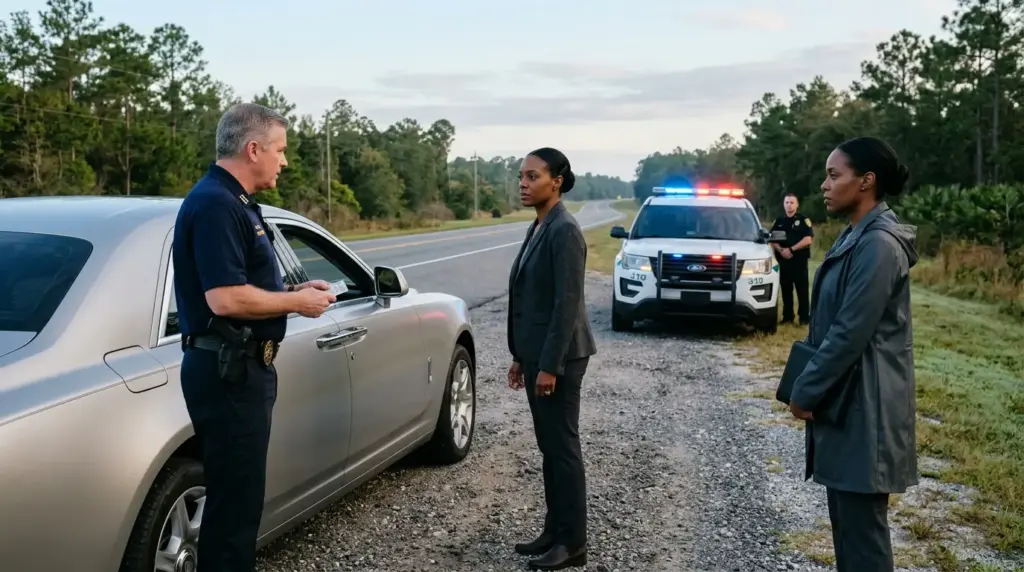
Calhoun straightened. “This is my scene. These women were stopped on suspicion of—”
“Captain,” Merritt said it without inflection, “I need you to step to the rear of your vehicle and remain there.”
“You don’t have jurisdiction to—”
“We do. I’ll show you the paperwork in a moment. Step to the rear of your vehicle.”
The word “paperwork” landed the way it was designed to land. Calhoun looked at the agent. He looked at the vehicles: seven black Expeditions now, agents at each, radios clipped and active, moving with the specific rhythm of people executing a plan that had been prepared before this morning, before yesterday, possibly before this week.
He stepped to the rear of his Durango.
Nadia Voss stood near the front of her car. The interior was in pieces around her: three panels, the seat base, the trim from both rear doors. And the car had a dent across the rear quarter panel from the first crowbar strike, which was when this had all begun.
She looked at the vehicle for a long moment. The expression on her face was not grief exactly; it was something quieter: the recognition that objects can be replaced, and that the act of destroying them is, in the end, more revealing about the person who wielded the crowbar than about the person who owned the car.
She turned to Merritt. “The drive is in the case,” she said. “Calhoun had it opened with bolt cutters. Chain of custody is unbroken on our end. Renata logged placement this morning at 0647.”
Merritt nodded. “We’ll take custody of the case and its contents. The module fragments go with chain documentation. Already bagged.” He paused. “The secondary transmission completed at 0419. Quantico confirmed receipt at 0422. The data is intact.”
Nadia looked at him. “Good.” She said it the way a person says a word when the word is not a relief, but a confirmation of something they already knew. She had known it since the moment Calhoun’s crowbar came down on the housing. The green light had gone red; the data had already left.
Priya Holden was standing near the rear of the Rolls-Royce when a federal agent approached her: young woman, late twenties, natural hair pinned back, blazer over dark slacks. The agent showed credentials. She asked quietly about Priya’s secondary recording device.
Priya’s hand moved to her vest. “How did you know about the upload log?”
The agent said simply, “We received footage starting at approximately forty-one minutes into the stop. Timestamp matches. We need your formal statement about the chain of custody for the recording.”
Priya looked at the scene around her: at Calhoun, standing at the rear of his Durango; at Sharp, who had set the crowbar down and was now speaking with another agent with the tight, careful diction of a man choosing every word; at Okafor, who had his arms folded and was staring at the asphalt.
She looked at the agent. “I’ll give you whatever you need,” she said.
The woman in the church hat was still on the opposite shoulder. So was the retired JSO officer in the cap. So were nine other civilians who had, over the last thirty minutes, accumulated on that stretch of road shoulder—the way people accumulate at the margins of history, drawn not by any single thing, but by the cumulative signal of something going wrong in public. Some of them were still recording. Some had stopped and were just watching.
The woman in the red jacket, the one who had sent the forty-three-second video to the attorney on Beach Boulevard, was standing apart from the group with her arms folded. She watched the federal agents work. She watched Nadia Voss standing in her damaged charcoal blazer beside her damaged Rolls-Royce. She watched Calhoun at the rear of his truck. She said nothing. She had said what needed to be said forty minutes ago in a video that was now in three separate locations, none of which were accessible to anyone in this precinct.
Merritt convened a brief field conference near the lead Expedition: himself, two senior agents, and a woman in civilian clothes who carried a tablet and wore a lanyard with a DOJ identification badge. The conference lasted four minutes. Merritt did most of the listening. He asked two questions. He received answers.
He walked back toward Calhoun. “Captain Calhoun.” He held a single sheet of paper, a printed document folded once. He offered it. “Federal warrant issued this morning at 8:46 a.m., authorizing the seizure of electronic and physical evidence from vehicles and personnel at this location in connection with a federal investigation under case designation Voss v. Calhoun, United States District Court, Middle District of Florida.”
Calhoun took the paper. He unfolded it. He read the case designation. His name was in the case title. He read it again. “This doesn’t—” he started. His voice had a texture it hadn’t had an hour ago: something rougher, something that was working harder than usual to maintain its register. “This doesn’t change what happened here. I had reasonable suspicion. I had—”
Captain Merritt said it the same way he’d said it before: flat, not unkind, simply precise. “I need you to read the remainder of the document.”
The document was three pages. The first page was the warrant. The second page was a summary of the investigation: twenty-two months of work, forty-six documented incidents, eleven vehicles seized under disputed civil asset forfeiture proceedings, three LLCs incorporated in Florida with connections to an auction company in Fernandina Beach, and a financial analysis showing that proceeds from thirty-one asset seizures over a four-year period had moved through those LLCs and into accounts with connections to six members of the Duval County law enforcement community. One of those six names was Ford Calhoun.





