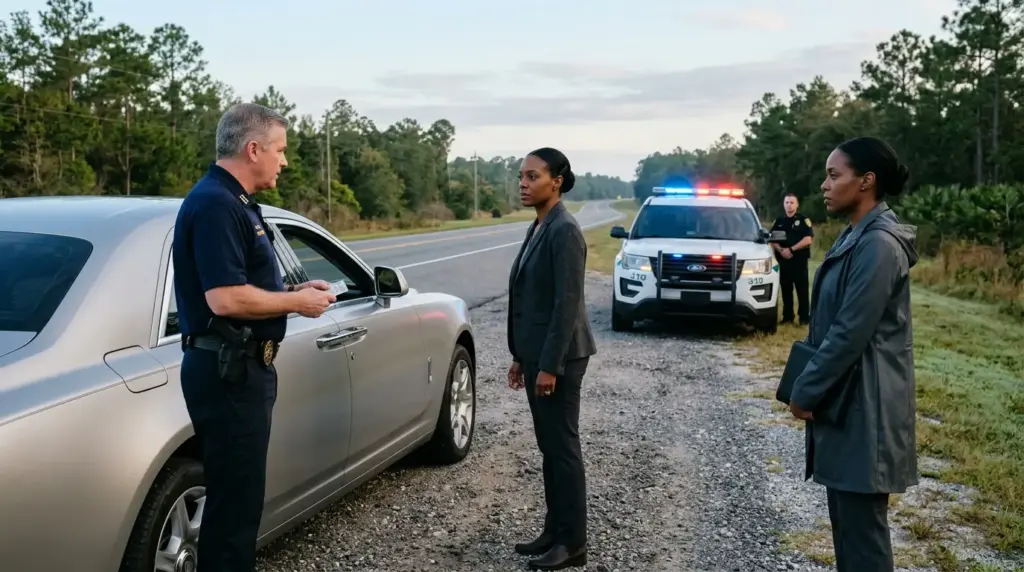
She said nothing. She moved to the rear of the vehicle as instructed and watched.
The search began.
Okafor moved through the front seats, glove compartment, center console, sun visors. He found the vehicle’s original title documents in a small leather cardholder containing nothing but business cards—all blank-faced, all the same off-white color with a single line of text that he didn’t read carefully. He set the cardholder on the roof of the car.
Sergeant Devlin Sharp arrived in a third vehicle at seventeen minutes into the stop. He was Calhoun’s preferred officer for certain kinds of work: the work that required someone who could tear through a space without hesitation and make the destruction look like diligence. He was built compactly, sharp-featured, with the particular energy of a person who mistakes speed for thoroughness. He went immediately to the rear compartment.
It was Sharp who found the module.
It was integrated into the underside of the rear seat panel. Not hidden in a way that screamed contraband, but fitted, recessed—the kind of installation that required expertise. It had a small antenna line that ran to a micro-port in the rear interior wall and a power draw from the vehicle’s secondary battery. Sharp had to know what he was looking at to find it, which meant either he’d been told what to look for, or he’d found enough of these to recognize the shape.
He called Calhoun over.
Calhoun crouched. He looked at the module. He looked at Nadia. “Want to tell me what this is?”
“I want you to not touch it,” Nadia said.
“That wasn’t a request.”
“Neither was mine.”
Renata, standing eight feet away with Okafor’s hand on her arm, watched this exchange with the focused attention of someone running a calculation. Her jaw was set, her breathing was controlled, but something moved behind her eyes: a recognition, a recalibration of exactly how far this was going to go before it stopped.
Calhoun reached for the module.
“Captain,” Nadia’s voice cut through cleanly, “that device contains encrypted federal records. If you remove or damage it, you will have destroyed federal property under active evidentiary seal.”
Calhoun’s hand paused. His hand paused for exactly four seconds. Then he reached in and wrenched the module free.
It came out with a sound of torn wire and cracked housing. A small indicator light, green until that moment, went red, then dark.
Calhoun held it up and turned it in the light. The casing had split along one seam. “Federal records,” he said. “Sure.”
He set it on the car roof. Then he picked up the crowbar that Sharp had been using on the door panel, and he brought it down on the module. Once. Twice. On the third swing, the housing shattered.
What Calhoun did not know, what he could not have known because he had destroyed the only visible evidence of it, was that the module had completed its encrypted transmission at 4:19 a.m. The data it carried had been received by a secure federal server in Quantico, Virginia, timestamped, logged, and assigned a case reference number. The destruction of the module had accomplished nothing except to add one more item to a list that was already very long.
Nadia looked at the broken module on the roof of her car. “The data already transmitted,” she said.
Calhoun looked at her. “What did you say?”
“Four hours ago.”
He stared at her for a long moment. Then he turned to Sharp. “Find the case.”
The locked case was in the forward storage compartment: a slim, matte-black, hard-sided unit, the kind used by field agents for document transport. It had a combination lock and a secondary tamper-evident seal. Renata had set it there that morning before they left the hotel. She had logged its placement, as she always did, with a timestamp notation in her portfolio.
Sharp carried it to Calhoun.
Renata said, “That case is sealed under active federal authority. Opening it without a federal warrant constitutes obstruction under—”
Okafor’s hand closed on her shoulder and turned her, not gently, away from the conversation. She was repositioned, physically moved three feet to the left, her back now partially to the scene. Her portfolio was taken from under her arm. She watched Okafor hold it. She did not fight him for it.
Calhoun cracked the lock with a bolt cutter Sharp produced from the patrol unit. The tamper seal tore. Inside: a sheaf of documents in tabbed folders, a sealed evidentiary envelope marked with a case identifier, and an encrypted drive—small, flat, matte, the kind that costs $1,200 and looks like a thumb drive for people who work in environments where losing a thumb drive has consequences measured in careers.
Calhoun flipped through the documents. Most were redacted, but the tabs were labeled, and the labels, to a person paying attention, told a particular story: one involving asset tracking, auction records, shell company registrations, and a series of financial transactions routed through three LLCs incorporated in the state of Florida over the previous twenty-two months.
He closed the folder. He looked at the two women. He looked at the drive in his hand.
“Obstruction,” he said to Okafor, not to them. “Detain them both.”
Okafor reached for his cuffs. He moved toward Nadia, the decision made, the calculation complete in his mind, reduced to a single mechanical action.
Nadia turned her wrists slightly, preemptively—the practiced movement of someone who has seen this motion begin and knows exactly how it ends.
Okafor grabbed her arm above the wrist. She didn’t struggle. She let him turn her, let him move her hands behind her back. She stood against the side of her car with her wrists secured behind her while Calhoun watched from eight feet away, arms folded, satisfied with the architecture of this moment.
Renata made no sudden movement.





