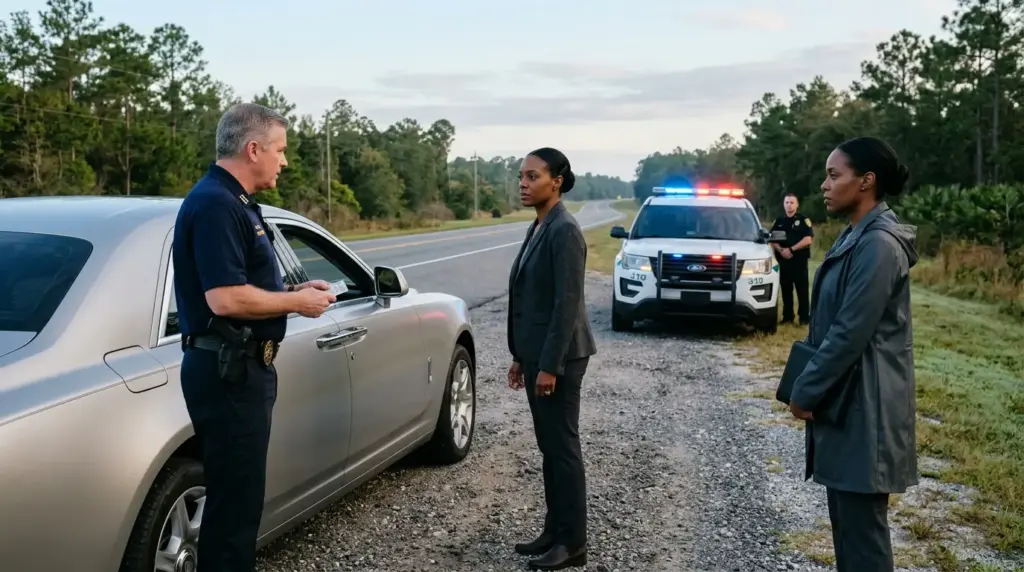
Back at the scene, a truck had turned off the highway and was pulling onto the shoulder 300 yards south. It was a black Ford Expedition. Then another, then four more, moving in tight convoy formation—their windows blacked out, their speed precisely controlled: the specific speed of vehicles being driven by people who know exactly where they are going and exactly how long it will take to get there. They were not from the Jacksonville Sheriff’s Office. Their plates were not Florida plates.
Calhoun saw them from the door of his Durango. He took one slow step forward, then another. He watched the convoy approach. He watched it slow. He watched the lead Expedition pull to a stop twenty feet behind the patrol cars, blocking the scene without touching it.
The rear door of the lead vehicle opened. A man in a dark suit stepped out. He did not look at Calhoun. He looked at the two women at the roadside. His expression shifted—a particular shift, visible even from thirty feet away, from professional neutrality to something that was not quite alarm, but was very close to it. He straightened his jacket. He walked directly toward Nadia Voss.
Calhoun watched him. His hand was at his belt—not on his weapon, but near it: the instinctive positioning of a man who is suddenly unsure of the geometry of a situation.
“This is a secured scene,” Calhoun called out. “I’m going to need to see identification.”
The man in the dark suit did not break stride. He reached Nadia. He looked at her wrists. He looked at Okafor, who was now holding the handcuff key, but had not been told to use it.
The man in the suit said one sentence. He said it quietly enough that only the people immediately around him could hear it. But Priya Holden was three feet away and she heard it, and she would later write it down word for word in a statement that would be entered into the record of a federal proceeding as Exhibit 31.
Okafor unlocked the cuffs.
Nadia brought her hands forward and held them for a moment, steady, deliberate, before lowering them to her sides. She did not rub her wrists. She did not look at Calhoun. She looked at Renata.
Renata had stopped writing. She had put the notepad back in her pocket. She was watching Calhoun with the focused, settled attention of a person who has been waiting a very long time for a very specific moment.
That moment was approximately twelve minutes away.
Calhoun took three steps toward the convoy. More agents had exited the vehicles: six, eight, now ten. And they were moving with the coordinated, unhurried efficiency of people executing a plan that had been prepared days ago. Two of them went to the patrol car. Two went to Sharp’s vehicle. One knelt beside the broken module on the roof of the Rolls-Royce and photographed it, photographed the crowbar, photographed the splintered interior panels piled near the rear wheel. One of them opened a small case and began collecting fragments of the destroyed housing, placing each piece in a labeled evidence bag.
Calhoun stopped. He looked at the evidence bags. He looked at his own hands. Something changed in his face: not yet fear, but the first signal of it. The recognition that the situation he believed he controlled had revealed itself to be a situation he was never inside of to begin with.
He looked at Nadia. She was standing fifteen feet away, speaking quietly with the agent in the dark suit. Her hand was inside her blazer. She was reaching for something.
Calhoun watched her hand come out. She was holding an identification credential. She held it briefly—not toward Calhoun, not as a display, simply in the act of presenting it to the agent beside her, who already knew what it contained. A professional formality, a completion of a process already in motion.
But in that brief moment, the credential was visible. Calhoun could not read it from where he stood. He took two more steps forward. He read it.
His mouth opened slightly. He closed it.
The crowbar was on the roof of a car that cost $1.5 million, beside the destroyed remains of a device that had finished transmitting its data to a federal server four hours before he ever touched it, surrounded by the documented records of every decision he had made in the last forty-seven minutes.
The woman he had put in handcuffs, whose car his sergeant had partially dismantled with a pry bar, whose property he had seized, whose cuffed wrists Priya Holden had watched with a hand pressed against a recording device still transmitting to a server he did not know existed, was looking at him now with the particular quiet of a person who was not angry.
She was not angry. She was thorough. And the distance between those two things, Ford Calhoun was only now beginning to understand, was the most dangerous distance in the world.
“Tell me you got eyes on everything.”
The agent in the dark suit—mid-forties, close-cropped, gray at the temples, a jacket that fit the way jackets fit on people who wear them for functional reasons rather than aesthetic ones—spoke quietly into a slim radio as he walked the perimeter of the scene. He was doing a count: vehicles, personnel, evidence already on the ground, the crowbar, the fragments of the destroyed module now photographed and bagged, the three broken panels of interior trim stacked near the rear wheel of the Rolls-Royce, the bolt-cut lock on the hard-sided case, the tamper-evident seal torn and lying on the asphalt ten feet from the car.
He finished his circuit. He stopped beside Renata. “Ms. Voss,” he said it the way people say a name when the name carries institutional weight they’re choosing to acknowledge formally in a moment that calls for formality, “are you injured?”
“I’m not,” she said. “My sister had her wrists restrained. She’s not injured either.” She paused. “The vehicle sustained significant interior damage. The module was destroyed by Captain Calhoun personally, using a crowbar. That’s on the secondary unit footage.”
The agent nodded once. “We have it.”
Calhoun had not moved from the spot where he’d read the credential. He was standing with his weight shifted slightly back: not a retreat exactly, but the postural equivalent of a man who has just discovered the floor he’s been standing on is twelve feet thinner than he thought.
Sergeant Okafor was beside him. Sharp had stopped working on the car. He was standing with the crowbar loose at his side, watching the federal agents move through the scene with the focused attention of a man who was recalibrating his immediate future.
Thad Merritt, the agent who had spoken to Renata, walked toward Calhoun now. Unhurried.





