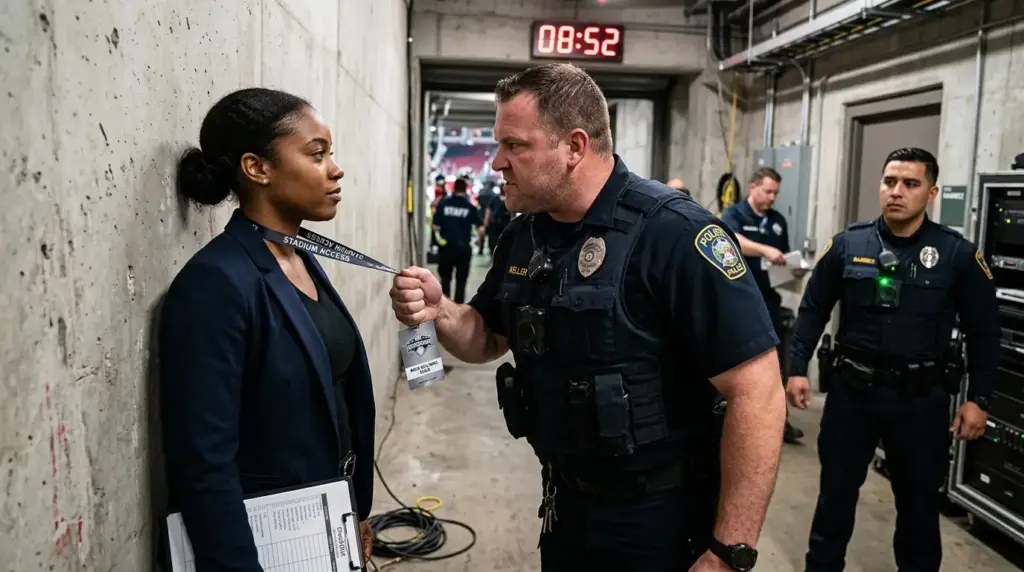
He lowered his voice. “He told the supervisor I’m trying to save myself by lying.”
Daniel looked up, but Maya lifted one hand before he spoke. “Are you?” she asked.
Ramirez absorbed the question. “No.”
“Then write what happened. Not what makes you look brave. Not what makes him look worse. What happened?”
He nodded. “I should have stopped him at the wall.”
“Yes.” The answer landed hard, but Ramirez did not flinch. Maya added: “And after that: I kept the camera on, I challenged the scan, I opened the cuffs. Put it in that order: the failure first, then the correction.”
Ramirez’s face changed—not relief, responsibility. “Yes, ma’am.” He turned to leave, then stopped. “Commissioner?” Maya waited. “When Grace put my camera on the Jumbotron, I thought my career was over.”
“It may change. That’s not the same as over.”
Daniel watched him go. “You’re hard on him.”
Maya returned to the table. “He was late, but not useless.”
“No, that matters, too.”
Patricia Voss spoke from the phone: “Commissioner, State Event Safety can have a team on site before midnight. Civil Rights Liaison in the morning. Digital Forensics can start remotely if we give them secure access.”
“Give them read-only access tonight. Physical collection under chain of custody.”
“Understood.”
Grace stepped closer to Maya and set a folder on the table: Initial Complaint Index. Maya did not open it yet. “How many?”
Grace exhaled. “31 under Reed’s review authority. 17 closed as insufficient evidence. 11 involved Black or Latino fans, staff, vendors, or credentialed workers. Six include some form of pass dispute.”
Daniel shut his eyes.
Maya opened the folder. The names were listed in neat rows: last name, first name, date, incident type, disposition, reviewing official. Reed’s name appeared again and again.
Then she saw it: Williams, Andre.
Her hand stilled on the page. Grace noticed. “I’m sorry.”
Maya did not answer. The conference room fell away for a moment. She saw Andre at the kitchen table, still wearing the team hoodie after the school had already pulled him from the roster. He had stared at the wall while their mother argued on the phone with a dean who kept saying pending review. Andre had not cried; that had been the worst part. He had only folded the scholarship letter and slid it back into the envelope as if the paper deserved more care than the people had given him.
Maya closed the folder. “Preserve all 31.”
Daniel said, “We’ll notify the league board after preservation.”
He nodded. “After preservation.”
Grace’s phone buzzed. She read the message and looked up. “The car wash owner also has audio from the exterior payment kiosk. It may have captured part of Reed’s call if the window was down.”
Daniel stared. “You’re kidding.”
Grace shook her head. “He says it’s poor quality, but it exists.”
Maya’s voice stayed calm. “Preserve it. Do not enhance it in-house. Send it to Digital Forensics.”
Patricia said over the phone: “I’ll add audio analysis to the order.”
Maya looked at the complaint folder again. “Add prior false credential allegations, too.” The legal director typed faster now.
A knock came at the door. Harold stepped in. “Commissioner, Mr. Reed’s attorney is on the phone. He’s demanding to know whether Reed is free to leave.”
Maya looked at Daniel. Daniel answered: “He is suspended, not detained. If he leaves, he leaves without devices, access cards, keys, or contact with staff witnesses.”
Harold nodded. Maya added: “And document the time he leaves.”
Harold left.
Daniel leaned against the table. “He’ll say we trapped him here.”
“Then the cameras will show otherwise.”
“You trust cameras a lot.”
“No,” Maya said. “I trust preserved records more than memory under pressure.”
He accepted the correction.
The stadium roared above them again. This time the sound lasted longer: a goal, maybe. Somewhere upstairs, people were standing, shouting, hugging strangers, living inside the game. Maya did not move toward the sound. Her game had shifted to paper, timestamps, access logs, and names that had waited too long to be read aloud.
Grace looked at the clock on the wall. “Final whistle is about 40 minutes away.”
Maya picked up a pen. “Then we have 40 minutes to draft the directive.”
Daniel turned to his legal director. “Start the document.”
The man looked at Maya. “Title?”
Maya opened the folder again, this time without letting Andre’s name stop her hand. “Independent Security Integrity Review,” she said. “Hawthorne National Stadium, effective immediately.”
The legal director typed it. Maya leaned over the table and began dictating the scope. Her voice did not rise; it did not break. It carried the weight of every person who had been told there was not enough evidence when the evidence had been ignored, mishandled, or buried.
By the time the match reached halftime, the first draft was complete. By the time the second half began, 31 complaint files were frozen. By the time the crowd above started chanting for the final push, Marcus Reed had left the building without his phone, his laptop, his badge, or the authority he had spent years hiding behind.
And by the time the final whistle blew, Maya Williams had signed the order that opened every locked file with his name on it.
The order changed the way people walked through the building. Before Maya signed it, staff moved around Marcus Reed’s name with caution; after she signed it, they moved through his authority like it had already been removed from the walls. Access cards were disabled. Workstations were sealed. Complaint files were frozen. Anyone who had reported directly to Reed was told not to discuss the incident except with independent investigators or counsel.
By midnight, Hawthorne National Stadium was nearly empty. The field lights were still on, but most of the crowd had gone: cleaning crews worked the aisles, broadcast cables were being packed, and food vendors counted registers. Outside, traffic moved slowly through Atlanta streets, horns tapping in tired bursts.





