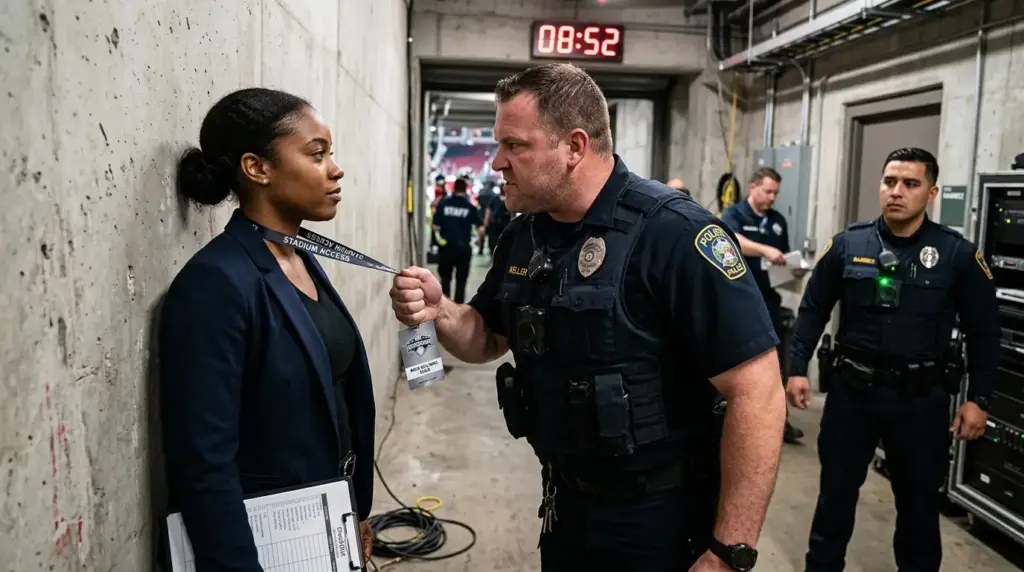
By mid-morning, the independent review had become a formal multi-agency investigation: Reed’s home devices were requested through legal process; Keller’s prior incidents were frozen; every person on the Inspector Risk email chain was ordered not to delete messages; Andre’s file was separated for conflict review, but attached as motive evidence.
When the investigators stepped out, Daniel remained seated. He looked exhausted. “I used to think a safe stadium meant nothing happened,” he said.
Maya gathered the papers. “A safe stadium means when something happens, the truth can still get out.”
Grace stood by the monitor, waiting for the next instruction. Maya looked at the screen one last time: Reed’s draft email sat open, plain and damning—a cover story written before the harm. That was the part she could not shake. Not because it surprised her; because it sounded too familiar. For Andre, the cover story had come after the damage; for her, Reed had written it before. The system had become faster; so would she.
By noon, Marcus Reed’s name was no longer spoken like a title; it was spoken like an entry on a timeline: State Event Safety took the conference room, Digital Forensics took the control consoles, the Civil Rights Liaison took the complaint files, and legal counsel took Reed’s emails, draft statements, and search history. By lunch, the building had become a place where every closed door needed a witness before it opened.
Keller sat in Security Office Three with a union representative beside him and a lawyer on speakerphone. His uniform looked the same, but he did not: the weight had gone out of his shoulders; he no longer filled the chair—he sat inside it.
Angela Morris led the interview. Maya was not in the room; she had removed herself from any questioning that involved her detention, watching only through the official observation feed with Patricia Voss and a State Event Safety investigator named Coleman, who had the patient face of a man who trusted records more than speeches.
On the screen, Angela placed a printed still from Ramirez’s body camera in front of Keller: Maya against the concrete wall, Keller’s forearm across the tunnel, the credential visible.
Angela asked, “At this point, had you scanned the credential?”
Keller looked at his lawyer’s phone on the table. The lawyer said, “Answer only what is asked.”
“No,” Keller said.
Angela placed the next still down: Maya’s wrists behind her back. “At this point?”
“No.”
Another still: the first cuff closing. “At this point?”
Keller’s jaw tightened. “No.”
Angela placed the fourth still down: the broken credential on the floor. “At this point?”
“No.”
Angela sat back. “So, the credential was not verified before contact, before physical restriction, before handcuffing, or before the radio report describing it as possible fraud?”
Keller said nothing. His union representative shifted beside him.
Angela pressed play on the body cam clip. Keller’s own voice filled the small room: “Cleaning crew doesn’t wear silver credentials.” Then later: “Where’d you steal this?” Then: “Fake enough for me.”
Angela stopped the video. “What made it fake enough?”
Keller rubbed his mouth. “It looked wrong.”
“How?”
“It was unusual.”
“In what way?”
He did not answer. Angela waited; silence did not rescue him. Finally, he said, “She was in the wrong area.”
Coleman, watching from observation, spoke under his breath: “No, she wasn’t.”
Patricia typed a note.
Angela asked, “How did you determine she was in the wrong area?”
Keller looked down. “The call said unauthorized.”
“The call also said ‘possible.’ Your policy requires verification before detention when a credential is presented. Did you follow that policy?”
“No.”
“Why not?”
Keller’s eyes flicked toward the camera in the corner. “I made a judgment call.”
Angela placed one last still in front of him. It showed Daniel Brooks holding the microphone, asking Maya for permission to begin the match while she was still cuffed. Angela said, “Would your judgment have been different if you had known she was Commissioner Williams?”
Keller closed his eyes. His lawyer said quickly, “Do not speculate.”
Keller opened them. “Yes.”
The room went quiet. Angela did not move. “Why?”
Keller stared at the still. “Because she had authority.”
Angela’s voice stayed even: “She had authority before you knew it.”
He looked up, trapped by the simplicity of that.
In observation, Maya stood very still. Patricia glanced at her, but said nothing.
Angela continued: “So, the failure was not that you did not know her title; the failure was that you did not follow procedure until you believed the person in front of you mattered.”
Keller’s face tightened. “You’re twisting it.”
“No,” Angela said. “Your camera untwisted it.”
That ended the interview faster than any accusation could have.
By mid-afternoon, Keller was placed on administrative suspension pending termination proceedings and referral for possible charges related to unlawful detention and false reporting. His service credentials were collected; his access to event work was revoked immediately. He left through a staff exit with his lawyer, passing the same corridor where he had forced Maya against the wall. This time, no one moved out of his way.
Marcus Reed’s interview came next, but Reed did not speak: he arrived with counsel, sat straight-backed, and refused to answer every substantive question. He did not deny the car wash footage, he did not explain the Gate 18 chain, he did not explain why he had searched Andre’s file before searching Maya’s profile, and he did not explain the draft cover story written before the false call. He only repeated, “On advice of counsel, I decline to answer.”
Angela let him say it again and again. Then Coleman placed the evidence sequence on the table in front of him:
-
Search: Andre Williams
-
Search: Maya Williams
-
Email: Outside Inspection Risk
-
Admin command: Gate 18 locked
-
Draft: Inspector interference cover story
-
False call from vehicle location
-
Keller detention
-
Admin attempt: Modify Gate 18 log
Coleman pointed to the final line: “This is not a misunderstanding, Mr. Reed. This is a route.”





