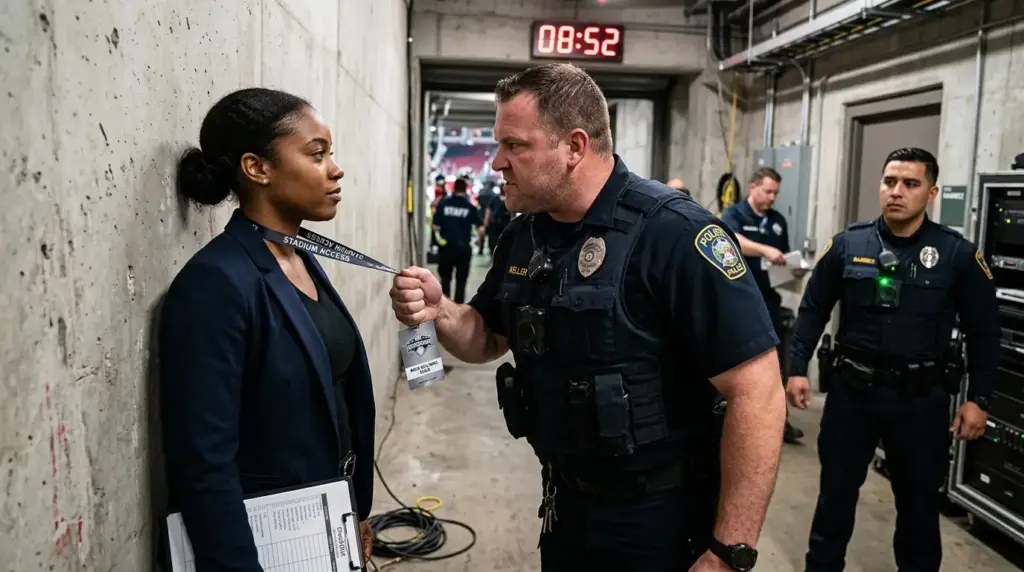
Maya closed her eyes for one breath—not in fear, in calculation. If Gate 18 stayed locked and the opening sequence began, crowd movement on the east side would start before anyone had corrected the exit pattern. 80,000 people did not have to panic all at once for a bad decision to become permanent. One blocked route was enough. One false assumption. One man deciding he already knew what he was looking at.
The exact same bureaucratic machinery that crushed Andre was operating in this tunnel. Keller wasn’t just holding handcuffs; he was drafting a lie that would become institutional truth within minutes. Maya kept her eyes locked on the crimson indicator of Gate 18. She had to let the trap close completely on Keller before she could dismantle his entire system.
“Subject is detained,” Keller continued into the radio. “Possible fraudulent access credential. Refused to identify until after detention. Possible interference with restricted operations.”
Ramirez looked at him. “That’s not what happened.”
Keller lowered the radio. “What did you say?”
“She didn’t refuse to identify. You didn’t give her a real chance to identify. And we still haven’t scanned the badge.”
Maya heard the tremor beneath Ramirez’s words. Not fear, exactly; cost. He knew there would be a price for saying even that much.
Keller stepped toward him, leaving Maya cuffed against the wall. “You better think carefully before you start narrating my stop.”
Ramirez swallowed. “My camera is already narrating it.”
The tunnel went quiet around them. Not completely—radios still hissed, footsteps still moved behind doors, the stadium above still rumbled—but inside that small space, Keller and Ramirez understood that something had shifted.
The clock blinked: 6 minutes and 58 seconds.
Keller bent and snatched Maya’s fallen credential off the floor. He held it between two fingers as though it were dirty. “There,” he said. “Happy?”
Ramirez reached for his scanner. Keller pulled the credential back.
“I didn’t tell you to scan it.”
“You just picked it up.”
“To secure evidence.”
Maya spoke without turning around. “Evidence is logged before it’s moved, Officer. You’ve just contaminated a federal crime scene.”
Keller’s face hardened. “You don’t get to dictate procedure to me.”
“I’m not dictating,” Maya’s voice stayed even, ice-cold. “I’m observing. Keep writing your report.”
“Control, where’s my return?” he barked into the radio.
No answer came back immediately.
Up in the control room, Grace Whitman bypassed standard protocols. The anonymous tip had been too clean, detailing Maya’s clothing down to the fabric of her blazer, like a pre-written script. Her fingers flew across the console, pulling up Ramirez’s live body cam feed on one screen and the administrative access log for Gate 18 on the other.
Grace pulled up the camera feed from Ramirez’s body cam. Maya was cuffed. Keller was standing too close. The credential was in his hand, unscanned. Grace’s eyes moved to another screen: Gate 18, locked. Her stomach tightened.
Behind her, Marcus Reed said, “Keep that feed internal.”
Grace did not turn around. “It is internal.”
“I mean, keep it off every main board. It’s a security feed, and security feeds stay in security.”
Grace glanced at the access log for Gate 18. The last administrative command had come from Marcus’s credentials. She did not react. She had learned years ago that the first rule of finding trouble was not letting trouble know you had found it. She opened a protected backup window and copied the Gate 18 log.
Marcus stepped closer. “Grace.”
She kept typing. “I’m verifying the detained subject.”
“I already told Keller to handle it.”
“That’s not verification.”
He leaned over her shoulder. “We are five minutes from kickoff. Do not turn a minor credential issue into a stadium problem.”
Grace finally looked up at him. “A locked exit is a stadium problem.”
Marcus’s expression went flat. “The exit is being handled.”
“By whom?”
“By me.”
“That’s what concerns me.”
For one second, Marcus forgot to look calm. Then the name return appeared on Grace’s screen: Maya Elaine Williams. Grace read the first line, then the second, then the clearance status. Her hand stopped over the keyboard.
On the tunnel level, Keller was still holding the radio. “Control,” he said, “I asked for a return.”
The clock blinked: 5 minutes and 18 seconds.
Grace reached for the main audio switch. Marcus saw the movement. “Grace, don’t.”
She opened the broadcast override panel.
“Grace,” Marcus said, sharper now, “I am ordering you to stand down.”
She did not answer him.
On every monitor tied to the internal stadium board, the regular pre-match feed flickered. In the tunnel, Ramirez looked up as a low electronic pulse moved through the speakers. Keller frowned. “What the hell is that?”
Above the field, the Jumbotron cut to black. For one breath, the entire stadium lost its picture. Then Ramirez’s body camera filled the giant screen.
The image was raw, close, and unforgiving: Maya cuffed against the concrete wall, Keller gripping her credential, the loose cable on the floor, the red clock counting down behind them.
Grace’s voice came through the main radio channel, steady enough for everyone to hear the effort it took: “Unit 7, stand by.”
Keller went still.
Grace continued: “Name returns clear. No warrants, no credential issue.”
Ramirez stopped breathing for a second.
Grace read the next line: “Maya Williams is the commissioner for stadium safety and integrity. She is the final kickoff authority for this championship match. Confirm copy.”
The tunnel did not move; neither did Keller. His fingers loosened around the credential as if the card had become hot in his hand. The color drained from his face slowly, leaving him staring at Maya as though the woman he had cuffed had changed shape without moving at all.
Maya turned her head just enough for the body camera to catch her profile. Her voice was quiet: “Is Gate 18 open?”





