The center sat behind a grocery store and a small church with a hand-painted sign out front. A few pickup trucks were already in the lot; one city bus hissed at the corner, doors opening for a woman in scrubs carrying a lunch bag. Maya parked and sat for a moment. She had faced Keller in a tunnel, she had ordered a championship match delayed, she had looked Marcus Reed in the eye while his plan came apart—none of that made this easier.
Andre built a quiet life after the scholarship disappeared: he coached adult league players at night, ran youth leagues and free public fitness programs for seniors in the morning, and fixed broken equipment because the city took too long to send maintenance. He did not talk about what he lost unless someone else brought it up first; even then, he smiled as if the subject belonged to another man. Maya had always hated that smile.
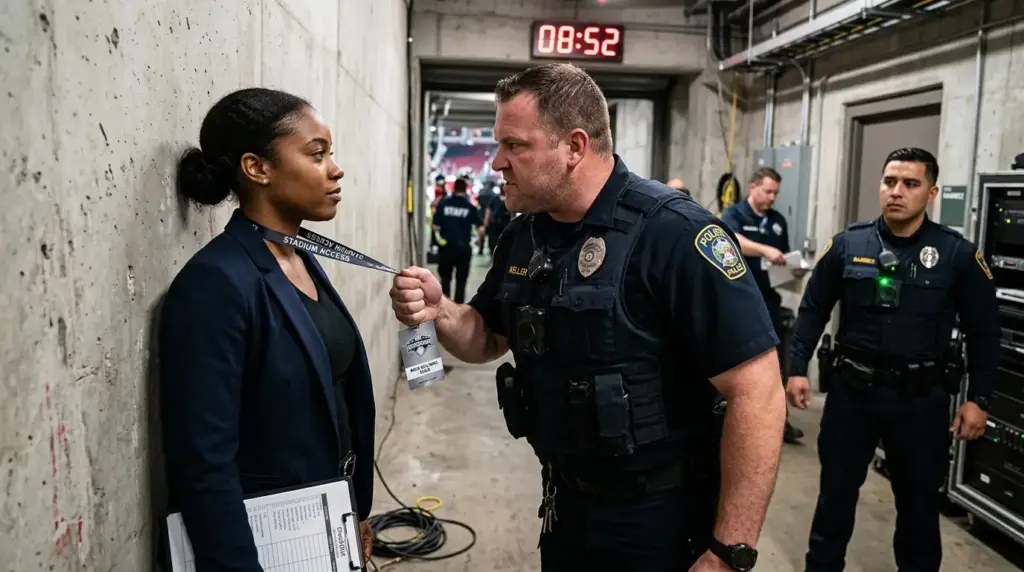
Inside, the recreation center smelled of floor polish and old coffee. A television mounted near the front desk played a muted morning news program. On the screen, Maya saw a frozen image from Ramirez’s body camera: Keller beside her in the tunnel, the red clock behind them, her hands still cuffed. The headline called it a stadium security scandal.
The woman at the front desk looked from the screen to Maya, then stood up too quickly. “Ma’am,” she said, unsure whether to say more.
Maya held up one hand. “I’m just here to see Andre Williams.”
The woman’s expression softened. “Gymnasium.”
Maya nodded and walked down the hall.
Andre was alone in the gym, pushing a rack of folding chairs toward the wall. He was 32 now, broader than he had been at 20, slower in the left knee when he turned. He wore an old navy sweatshirt and gray athletic pants. A whistle hung around his neck, though there was no class yet. He saw Maya in the doorway and stopped.
For a few seconds, brother and sister said nothing. Then Andre glanced toward the hallway television. “So, that was you.”
Maya did not pretend not to understand. “Yes.”
“They put you in cuffs.”
“Yes.”
His eyes dropped to her wrists. “I’m fine,” she said.
Andre gave a quiet laugh with no humor in it. “You always lead with the lie that keeps everybody else comfortable.”
Maya walked farther into the gym. “I am physically fine.”
“That’s better.” He pushed the chair rack against the wall and locked the wheels. “You drove here after that?”
“I needed to bring you something.”
Andre’s face changed at once—not fear, guarding: the kind of look a man learned when papers had ruined him once before. “Maya, if this is about reporters, I don’t want any part of it.”
“It isn’t.”
“If they want me to talk about what happened back then, I’m not doing that on camera. I’m not letting strangers turn my life into a five-minute segment between traffic and weather.”
“I know.”
He studied her. “Then what is it?”
Maya took the envelope from her pocket. Andre looked at it, but did not reach for it. She held it out. “It’s a certified copy from the stadium record archive: your access scan from that night.”
He went very still. Maya kept her voice steady: “It says your pass was valid. Entry authorized.”
Andre’s hand stayed at his side. The gym lights hummed overhead. Finally, he said, “Say that again.”
“Your pass was valid. Entry authorized.”
Andre looked away. For years, Maya had imagined this moment: she had imagined anger, tears, maybe relief; she had not imagined how quiet it would be. Andre did not move. He did not curse. He did not break down. He only stood in the center of an old gym before dawn, hearing that the truth he had carried alone had existed in the system the entire time.
Maya stepped closer and placed the envelope on the nearest folding chair. “I didn’t want to call you with it,” she said. “Not after midnight. Not after what happened. You deserve to see the paper.”
Andre stared at the envelope. “They had it?”
“Yes.”
“The whole time?”
“Yes.”
His mouth tightened. “And Reed closed it anyway?”
“Yes.”
He nodded once, then again, like his body was trying to absorb a fact his heart had known for years. “I told them,” he said.
“I know.”
“No, Maya.” His voice cracked for the first time. “I told them right there. I told the officer. I told the coach. I told the school. I told that review board. I said, ‘Scan it again. Look at the record.'”
Maya’s own throat tightened. “I know.”
Andre finally picked up the envelope. He opened it carefully, almost gently, as if the paper might vanish if handled too fast. He read the page; his eyes stopped on the line: Access valid. Entry authorized.
He sat down on the bottom row of folded bleachers. Maya sat beside him. For a while, neither spoke.
At the far end of the hall, someone opened a door. The building’s pipes knocked once. The morning news anchor’s voice drifted faintly from the lobby, still talking about the stadium, the commissioner, the cuffing, the delay.
Andre looked at the paper again. “This doesn’t give it back.”
“No.”
“The scholarship, the team, the years after.”
“No.”
He folded the page and opened it again. “Then why does it feel like I can breathe?”
Maya looked at the polished gym floor. “Because the lie doesn’t get to own the rest.”
Andre covered his mouth with one hand. Maya waited. When he spoke again, his voice was low. “Mom needs to see this.”
“I’ll take you to her.”
He shook his head. “No, I’ll take it. I want to be the one.”
Maya nodded.
Andre looked at her wrists again. “Did he hurt you?”
“No bruises.”
“That’s not what I asked.”
She met that honestly. “Yes.”





