Patricia opened her briefcase and took out a draft notice. “State Event Safety confirmed a lead investigator. Civil Rights Liaison confirmed morning arrival. Digital Forensics has a secure portal ready. We’ll transfer copies of the Reed files by 5:00.”
“Make it 4:00,” Maya said.
Patricia paused, then wrote it down: “4:00.”
Daniel’s phone buzzed. He glanced at it, then looked at Maya. “The board wants a call at 7:00.”
“They can have one at 7:30.”
“They won’t like that.”
“They will survive disappointment.”
Grace almost smiled.
A knock came at the records room door. Ramirez stood outside with a paper cup in his hand. “Sorry. I was told to wait, but Ms. Avery said you were still here.”
Maya nodded him in. He entered, careful not to look at the files too long. “They took my formal statement.”
“Did you review it?”
“Yes, ma’am.”
“Did they change your wording?”
“No.”
“Good.”
He held out the paper cup. “Coffee? It’s bad.” Maya looked at it. Ramirez added, “But it’s hot.”
She accepted it. “Thank you.”
He glanced at Andre’s file before he could stop himself. “That’s your brother?”
Maya’s hand tightened around the cup. Grace gave Ramirez a warning look, but Maya answered: “Yes.”
Ramirez looked down. “I’m sorry.”
Maya said, “For what?”
“For tonight. For the way Keller spoke to you. For not stepping in sooner. And for whatever happened to your brother, if it was anything like tonight.”
Maya studied him: he was not asking to be forgiven; that mattered. “And when Keller says you betrayed him?” she asked.
Ramirez looked tired. “He already did.”
“What did you say?”
“Nothing.”
“Why?”
“Because he wasn’t wrong that I was with him.”
The room stayed quiet. Ramirez continued: “I keep thinking about the first second when he moved in. Before the cuff. Before the radio. There was a second where I knew it was wrong, and I made myself wait for it to become wrong enough.”
Maya set the coffee down. “That is where most damage lives,” she said. “In the wait.”
Ramirez nodded once, hard. Patricia looked up from her notes; Daniel looked at the floor; Grace kept her eyes on the files.
Maya said, “Write that down for yourself, Officer. Not for the report. For the next time.”
“Yes, ma’am.”
Ramirez left quietly. After the door closed, Daniel said, “He may become a good officer.”
Maya looked at the door. “Maybe. If he lets this hurt long enough to change him.”
Patricia cleared her throat. “Commissioner, there’s another matter: media outlets are requesting the body cam footage.”
“No release tonight.”
Daniel nodded. “Agreed.”
Patricia said, “The Jumbotron feed was already seen publicly. Clips are everywhere.”
“Clips are not evidence,” Maya said. “Evidence has context.”
Grace said, “Some posts are calling Keller a lone bad officer.”
Maya looked at the 31 folders. “That is convenient.”
Daniel’s face tightened. “For the club, too.”
“Yes.” He did not defend himself; Maya appreciated that more than another apology.
Grace’s tablet chimed. “Forensics preliminary update: they pulled a clearer audio segment from the car wash kiosk. Not enough for a full voice match yet, but the cadence and phrase usage line up with Reed’s internal call recordings.”
Patricia reached for the tablet. “Send it to the portal.”
“Already done.”
Maya rose again and walked to the table. She stopped at Andre’s folder, but did not open it. Instead, she turned to Daniel. “Tomorrow, when the board asks how to protect the club, tell them this: the club is protected by telling the truth before someone else proves it.”
Daniel nodded. “I will.”
“And when they ask how much exposure we have, tell the truth.”
“No,” Maya said. “First ask how many people were exposed to us.”
Daniel absorbed that, his shoulders dropping a little. “Understood.”
Patricia finished signing the transfer notice. “Commissioner, the independent review is active. From this point, you are a witness regarding the detention and a referring authority regarding safety.”
“That’s how it should be.”
“You’ll need to give your own statement.”
“I will.”
“When?”
Maya looked at the clock on the wall. “After Andre is notified.”
Grace softened. “You’re calling him tonight?”
“No. I’m going to see him.”
Daniel checked the time. “It’s after 2:00.”
“He works early.”
Grace asked, “Where?”
Maya picked up the copy of the valid scan record from Andre’s packet. “A community recreation center on the south side.”
No one spoke for a moment. Maya folded the page into a clean envelope: not the whole file, just the line that mattered first: Access valid. Entry authorized.
Patricia watched her. “That document is part of the record.”
“This is a certified copy. It should be logged.” Maya handed it to her. “Then log it.” Patricia did, then returned it.
At 3:12 in the morning, the first transfer batch went out. At 3:20, Grace confirmed the Reed files were mirrored in the secure portal. At 3:30, Daniel signed the club’s cooperation order. At 3:41, Patricia sent the formal notification to State Event Safety. At 3:50, Maya left the records room with the envelope in her hand.
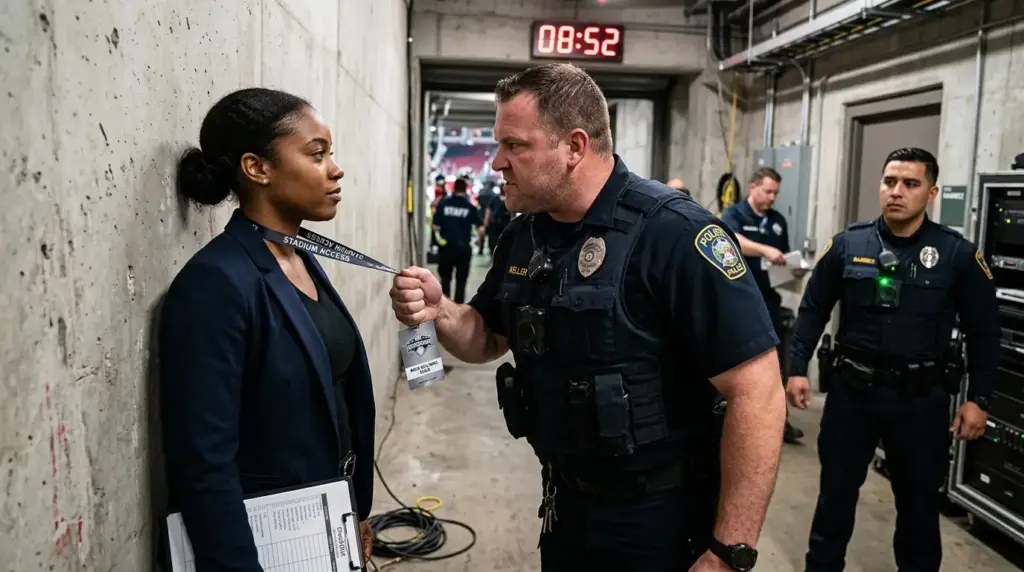
The service tunnel was almost empty when she passed through it again: the loose cable was gone, Gate 18 was open, Keller was nowhere in sight. The place where her credential had fallen had been marked, photographed, and cleaned. She stopped for only a second—not to relive it, but to measure what had changed.
Then she walked out toward the loading dock, where the first gray line of morning was beginning to show over Atlanta. In her pocket, her phone buzzed with messages she had not answered. In her hand, Andre’s truth waited on paper. And for once, the paper was on his side.
The community recreation center opened before sunrise because older men liked to walk the indoor track before the heat settled over Atlanta. Maya arrived at 4:38 in the morning with the envelope inside her coat pocket and no credential around her neck.





