In the control room, Marcus Reed stood between two senior supervisors with his hands away from the console. His arms were tightly crossed, his posture stiff as he stared blankly at the dark terminal display. He looked at Grace. “You understand this will come back on you.”
Grace did not look away from her screens. “Most things do when they’re documented.”
“You think she’ll protect you?”
“I think the logs will.”
Marcus’s eyes moved toward the side monitors. Too late; Auxiliary Station Two was already isolated. Gate 18’s command history had already been copied. The attempted modification had already been flagged. His mistake had not been touching the system; his fingers twitched against his sleeve. The system he thought he owned had locked him out completely.
Downstairs, the sweep reached completion. Grace announced it over the main channel: “All primary and secondary east side exits confirmed open. All flow paths verified. Safety sweep complete.”
Daniel exhaled. “Commissioner?”
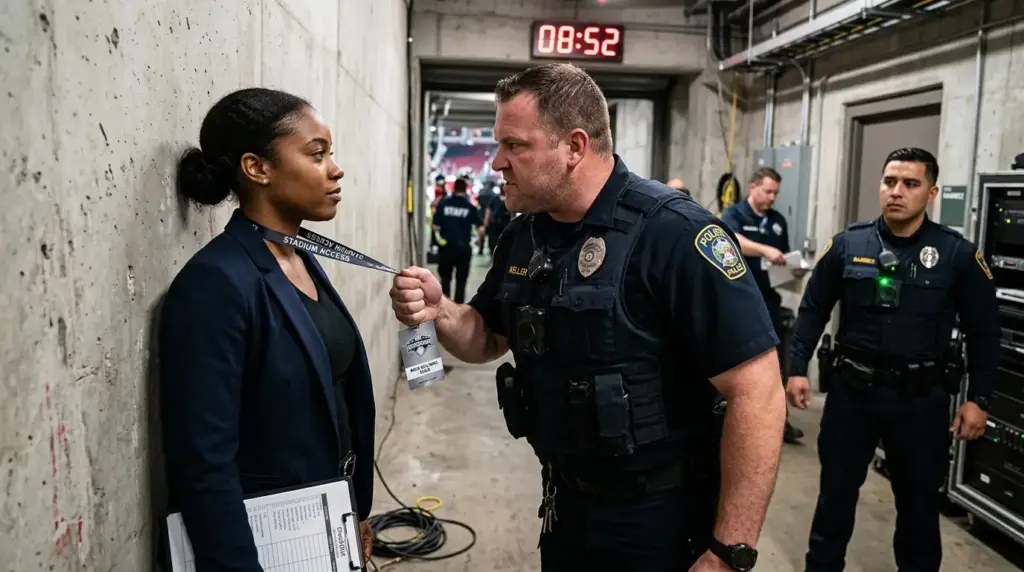
Maya did not answer immediately. She looked down at the torn credential in her hand. The card had her name printed cleanly across the front, but the strap was cleanly severed. Without a word, she firmly pressed the damaged plastic into Daniel’s palm.
He hesitated. “You want me to take this?”
“I want it photographed, bagged, and logged with the rest.”
He nodded and accepted it with both hands, careful now in a way Keller had not been.
Keller watched the exchange, then muttered, “All this over a misunderstanding.”
Maya faced him. “No,” she said. “A misunderstanding is when two people look for the truth and miss each other. You never looked.”
The tunnel went quiet again. Ramirez’s camera caught Keller lowering his eyes.
A voice from broadcast control came through Daniel’s earpiece. He listened, then said, “The legal office is asking whether the match can begin after the delay.”
Maya looked to Grace’s camera feed, then to the open status board: Gate 18 was green, the sweep was complete, the logs were locked, the public had been told to remain seated. The building was stable. But the match could not resume as if nothing had happened.
“Daniel,” she said, “you will make one statement before kickoff.”
“What statement?”
“You will tell the public the delay was caused by a safety verification, that all exits are now clear, and that an incident involving stadium security is under review. No names except mine. No blame before the evidence review. No cover story.”
Daniel nodded. “And then?”
“Then the match may begin.”
He lifted the microphone again, gripping it firmly as he waited for Grace to open the live audio channel. His voice carried across the stadium:
“Ladies and gentlemen, thank you for remaining in place. The safety verification is complete. All exit routes are confirmed open. The championship match will begin shortly. An incident involving stadium security is under formal review, and Commissioner Maya Williams has cleared the stadium for play.”
A low murmur rolled through the building as 80,000 spectators absorbed the announcement. Maya stood motionless, her eyes scanning the green status indicators on the monitors.
Daniel lowered the mic and looked at her. “Commissioner Williams, do we have permission?”
Maya gave one short nod. “Yes. Begin the match.”
The message moved through the system. Referees were called back. Teams were held for a reset. Broadcast prepared a revised open. Stadium staff stayed at their posts. Gate 18 remained open. Keller remained under watch. Ramirez remained recording. Grace remained at the console.
And Maya Williams, who had been mistaken for someone who did not belong, stood in the tunnel until the first whistle sounded above her. Only then did she turn away from the field and toward the real work.
The first whistle did not end the incident; it only moved it indoors while the crowd above returned to the championship match. The lower level of Hawthorne National Stadium shifted into an active investigation: doors were held open for investigators, security staff surrendered radios, and supervisors who had been loud before kickoff now spoke in careful sentences. Every hallway camera, every access panel, every body cam, every gate log had become part of the night’s record.
Maya walked beside Daniel Brooks through the operations corridor, her blazer straightened, but her neck still bare where the credential strap had snapped. She had no interest in the field now. The game was finally safe enough to begin; that was her singular focus until the administration answered for the security failure.
Daniel kept pace, his phone buzzing nonstop in his hand. “The league office wants a private call,” he said.
“They can wait.”
“The governor’s office called.”
“They can wait, too.”
Daniel looked at her. “The network is asking whether you’ll make a statement at halftime.”
“No.”
“They’re going to keep asking.”
“I’m not here to feed a broadcast.”
He put the phone away.
They reached a glass-walled conference room near the control center. Inside, Grace Whitman had already sent three copies of the locked data to the external archive. Ramirez stood rigid near the far wall, his body camera still securely attached. Keller sat frozen at the table, flanked by two senior supervisors who kept a direct watch on his hands. His radio, notebook, and service tablet lay in separate evidence bags.
Marcus Reed was not in the room. Maya noticed immediately. “Where is Reed?”
Grace answered from the doorway: “Held in the control office with Harold Price and another supervisor. He asked for counsel.”
“Good. No one interviews him without counsel present, and no one lets him near a keyboard.”
Daniel glanced at Harold through the glass. “Done.”
Maya entered the conference room, her sharp presence instantly drawing Keller’s eyes before he guiltily dropped his gaze back to the table. She did not sit.





