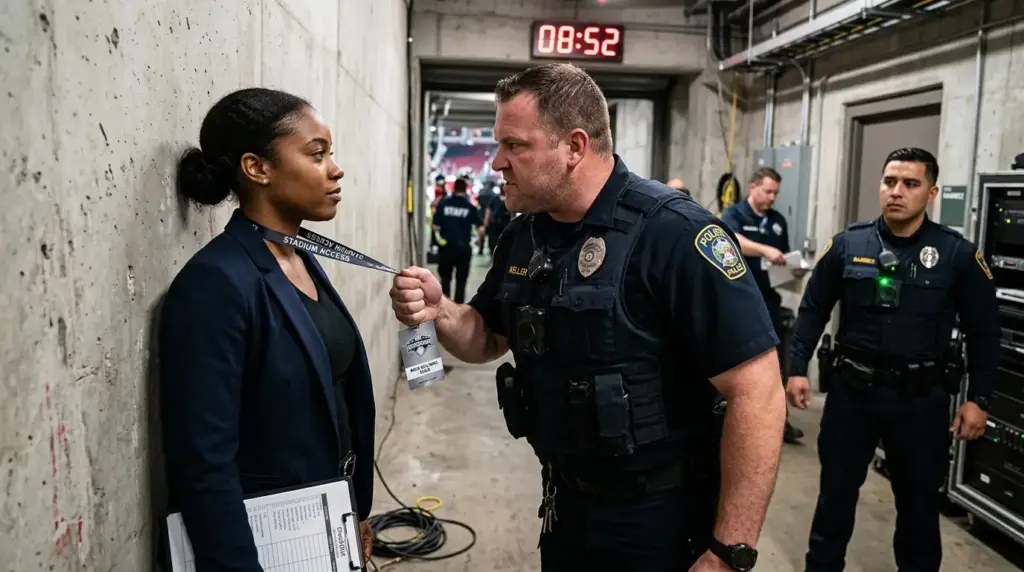
On the red clock, the countdown continued. But for the first time all night, the match was no longer in charge. Maya was.
Grace Whitman did not take her eyes off the control panel. Marcus Reed stood three feet behind her, close enough for her to feel the pressure of his silence. The order had been given. The logs were locked. The body camera feed was still live. Gate 18 was still red on the board.
She keyed the radio: “East Operations, this is control. I need physical confirmation at Gate 18. Not a screen confirmation; I want eyes on the gate.”
A voice came back fast: “Copy, control. Moving now.”
Marcus said, “You’ve created a public incident.”
Grace kept typing. “No. You created a locked exit.”
“You don’t know what you’re talking about.”
“I know your account locked Gate 18.”
That stopped him. Not long, just enough. Then Marcus leaned over her shoulder. “Administrative holds happen all the time before kickoff.”
“Not on a primary exit.”
“It was temporary.”
“Then why did you try to edit the log after Commissioner Williams called it out?”
Marcus did not answer.
On the main monitor, Maya stood in the tunnel with the torn credential in her hand. Ramirez remained beside her. Keller stood a few steps away, his face entirely drained of color as he remained paralyzed under the gaze of 80,000 people. The stadium announcer had gone silent. The broadcast team had no script for this. There was only the body camera feed, the red clock, and the sound of radios starting to wake up across the building.
Grace switched channels: “All section supervisors, hold crowd movement. No promotional cue, no opening ceremony. Keep aisles clear and await further instruction.”
Daniel Brooks, still in the tunnel with the stolen microphone clipped awkwardly in his hand, lifted it toward his mouth. “Grace, can they hear me?”
“They can,” she said.
Daniel looked at Maya. “What do you want me to say?”
Maya did not hesitate. “No emergency language. No panic words. Tell them there is a safety delay and ask everyone to remain in place. Calm voice. No promises about timing.”
Daniel nodded. He turned toward the camera, but Maya stopped him.
“Not to the camera,” she said. “To the people.”
Daniel understood. He faced the tunnel opening where his voice would carry through the stadium system.
“Ladies and gentlemen,” he said, steady but stripped of every trace of ceremony, “we are pausing kickoff for a safety verification. Please remain in your seats and keep all aisles clear. Stadium staff are confirming an access route. There is no need to move. Thank you for your patience.”
Above them, the sound changed. The restless roar softened into pockets of voices, then into a lower, confused murmur. People did not like delays, but they understood a calm voice better than a flashing alarm.
Maya listened to the shift in the building’s acoustics, instantly analyzing the frequency of the crowd’s movement. Fast footsteps meant fear; sudden silence meant shock. What echoed down the tunnel now was irritation and uncertainty. But the threshold of panic had been successfully averted.
“Good.” She looked at Ramirez. “Your camera stays on.”
“Yes, Commissioner.” The word came out with respect, but also with apology. Maya heard both.
Keller bent slightly and reached for his fallen radio.
“Leave it,” Maya said.
His hand stopped. “That’s department property,” he muttered.
“It’s evidence.”
He straightened, anger returning because shame had nowhere else to go. “You can’t just take over a police action.”
Maya held up the torn credential. “This stopped being your police action when you detained final safety authority without verifying identity, ignored a locked exit, mishandled a credential, and tried to move me out of camera range after your superior ordered you not to.”
Keller swallowed. “I didn’t know who you were.”
Maya stepped closer—not enough to threaten him, only enough to make him hear her without the microphone. “My title was never the test. Your procedure was.”
He looked away first.
Grace’s radio crackled: “Control, East Ops. I’m at Gate 18.”
Maya turned toward the nearest wall speaker. Grace said, “Report status.”
The man on the radio was breathing hard: “Gate is physically locked. Chain through the interior crash bar. Padlock in place. This is not a software issue.”
Grace’s fingers froze over the keyboard. Daniel said, “A chain?”
Maya’s expression did not change, but something in her voice sharpened: “Cut it.”
East Ops answered: “We need bolt cutters.”
Daniel turned to one of his officials: “Maintenance!” The official ran.
Marcus shifted behind Grace, his reflection in the monitor showing his sudden pivot toward the side door leading to the auxiliary control station. Grace instantly slammed her hand onto the private comm line: “Security supervisor at the door, physically block Mr. Reed from leaving.”
The heavy click of the door lock echoed, forcing Marcus to an abrupt halt.
“Slowly.” He turned back. “Excuse me?”
Grace did not look at him. “You heard me.”
“You work for me.”
“Not tonight.”
The control room door opened. Two senior stadium supervisors stepped in. They were not police; they were older men in navy jackets, the kind who had worked enough packed events to know that locked exits were not paperwork. One of them, Harold Price, stepped directly into Marcus’s path, placing a firm, unyielding hand over the terminal console lock.
“Sir, step away from the consoles.”
Marcus laughed once. “You cannot be serious.”
Harold did not laugh with him. “I’ve been in this building since it opened. I am very serious.”
In the tunnel, the clock blinked: 3 minutes and 26 seconds. Maya watched the number drop, but it no longer controlled the night. Kickoff would not happen—not until the building was safe.
A maintenance worker arrived at Gate 18 with bolt cutters. The radio picked up metal scraping against metal. East Ops said, “Cutting now.”





