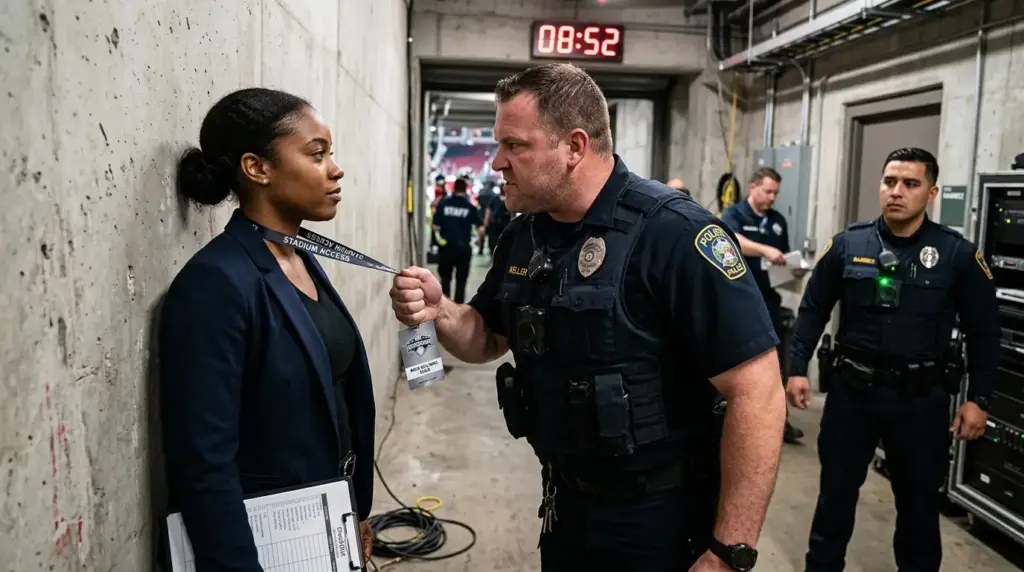
Downstairs, the conference room was still awake. Maya stood before the whiteboard where the timeline had grown across three panels: the first panel held the stadium incident; the second held Gate 18; the third held the complaint files.
Andre’s name was on the third panel now: Williams, Andre. Credential dispute, removal, scholarship impact, closed, insufficient evidence. Reviewer: M. Reed. Maya had written it herself.
Grace entered carrying two cups of coffee and a plain paper bag from the staff cafeteria. “Turkey sandwich, no mayo. You looked like someone who would hate mayo.”
Maya glanced at the bag. “That obvious?”
“You’ve been ordering people around for four hours without eating. I made an educated guess.”
Maya took the coffee first. “Thank you.”
Grace set the sandwich beside the folder. “Digital Forensics received the car wash files. They confirmed the timestamp integrity. Audio is poor, but they think there’s enough to compare speech patterns.”
Daniel Brooks sat at the table, jacket off, sleeves rolled, tie loosened. He looked less like a club president now and more like a man cleaning up damage in his own house. “What about Reed?” he asked.
Grace said, “He left at 11:42 p.m. with his attorney. No devices, no access card. He refused to answer questions.”
Maya nodded. “That is his right.”
Daniel looked at her. “You say that like you don’t mind.”
“I mind what he did. I don’t mind him having rights. That’s the difference between process and revenge.”
Daniel absorbed that, then looked down at the table.
Ramirez appeared in the doorway with a written statement in one hand. His face looked drained. He had changed from public shame into private reckoning, and it showed in the way he held the paper. “Commissioner,” he said, “my statement.”
Maya pointed to the evidence clerk seated near the door. “Give it to Ms. Avery.”
Ramirez handed it over. He did not leave. Maya waited.
He said, “I wrote the part about not stepping in sooner.”
“Good.”
“I wrote that Keller blocked you with his body before he had verified anything.”
“Good.”
“I wrote that he pulled your wrists behind your back and cuffed you before any scan.”
“Good.”
Ramirez looked down. “I also wrote that when he told me to watch the tunnel, I obeyed.”
Maya’s expression stayed steady. “That happened.”
“Yes, ma’am.”
“Then it belongs in the statement.”
He nodded, but his jaw worked like he had more to say. Maya took a breath.
“Officer Ramirez, you cannot undo the first minute by telling the truth about the next nine. But you can make sure the next report is not another locked door.”
Ramirez blinked hard once. “That’s what I’m trying to do.”
“Then keep doing it when the hallway gets quiet.”
He understood: the hard part would not be tonight. Tonight there were cameras, lawyers, supervisors, and a commissioner standing in front of him. The hard part would come later—in locker rooms, parking lots, roll calls, and small looks from men who preferred silence because silence protected them.
Ramirez left without another word. Grace watched him go. “He’ll pay for crossing Keller.”
Maya opened the paper bag and took out the sandwich. “Maybe.”
“You don’t sound surprised.”
“I’m not.”
“Does that ever get easier?”
Maya looked at Andre’s name on the board. “No. But sometimes people stop calling it the price of doing the right thing and start calling it the cost of the wrong thing lasting too long.”
Daniel’s phone buzzed. He read the message and leaned back. “The first headlines are up.”
Maya did not reach for her own phone; Grace did. Her face tightened as she scrolled. “Some are calling it a racial profiling scandal. Some are calling it a stadium safety failure. One says: ‘Handcuffed Commissioner Delays Championship.'”
Daniel said, “That one sounds like they missed the point.”
“No,” Maya said. “They found the easiest point.”
Grace lowered the phone. “Do you want a media response tonight?”
“Short statement. Written. No interview.”
Daniel reached for a pen. “What should it say?”
Maya answered without hesitation: “‘Tonight’s delay occurred because a required safety exit was locked and final clearance had not been met. During that delay, a credentialed official was wrongfully detained before verification. All records have been preserved and an independent review has been ordered. The focus now is safety, accountability, and the truth.'”
Daniel wrote quickly. “Anything else?”
“Yes: do not call it unfortunate.” He looked up. “‘Unfortunate’ is rain,” Maya said. “This was conduct.”
Grace gave a small nod. “I’ll draft it.”
Avery, the evidence clerk, approached the table with a sealed envelope. “Commissioner, this came from records: complaint file copies are frozen. Original files remain in archive. This is the Andre Williams index packet only, as requested.”
Maya looked at the envelope for a moment; she did not take it. Daniel stood. “We can give you the room.”
“No.” Her voice was quiet, but final.
She took the envelope and opened it. Inside were copies of the old complaint summary, the incident report, the credential scan record, and the disposition memo.
The scan record was the first thing her eyes found: Andre Williams, access valid, entry authorized.
Maya held the page still. There it was: not emotion, not memory, not family loyalty—data. Valid. The report that ruined him had said the opposite.
She turned to the disposition memo: Reviewer: Marcus Reed. Finding: Insufficient evidence. Corrective action: None.
Maya read the line twice. Grace stood very still. Daniel looked away, giving her privacy without leaving the room.





