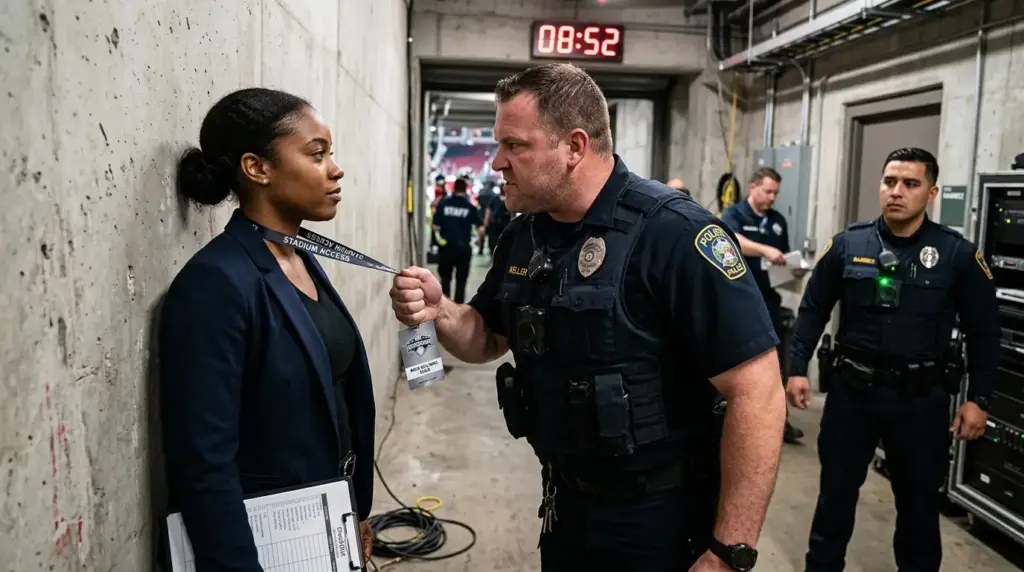
His eyes hardened. Maya said, “But he did not get the last word.”
Andre glanced toward the lobby television. “Looks like the whole country heard the last word.”
“Not yet.” He looked back at her. “There will be an independent review,” Maya said. “Your file is part of it. You will not be pushed into speaking publicly. You will have counsel if you want it. You will have time.”
Andre gave a small, tired smile. “Listen to you: still protecting everybody else while you’re running on gas station coffee and fury.”
“It was stadium coffee.”
“That’s worse.”
For the first time that morning, Maya almost smiled. Andre folded the document and slid it back into the envelope. “Do you remember what Dad said after the school called?”
Maya did. Their father had stood in the kitchen doorway, looking older than he had the day before, and said, “A man can survive losing a chance. It’s losing his name that hollows him out.”
Maya said it softly: “He said they took your name.”
Andre nodded. “Feels like you brought part of it back.”
The words struck harder than praise. Maya looked down at her hands. “I wish I had done it sooner.”
“You were 21.”
“I was old enough to know it was wrong.”
“We all knew it was wrong. Knowing wasn’t the part they listened to.”
That was the wound: not ignorance, not confusion—a truth spoken into a system that had already decided which voices counted.
The front desk phone rang somewhere down the hall; the first walkers would arrive soon: older men with knee braces, retired women in bright sneakers, people who came every morning because routine was how they kept hold of themselves.
Andre stood and tucked the envelope under his arm. “I have a class in twenty minutes.”
“You’re still teaching?”
He looked at her. “People are coming.”
Maya understood: work was not always avoidance; sometimes it was dignity.
Andre walked her to the gym door. Before she stepped into the hall, he said, “Maya.” She turned. “When they ask you what justice looks like, don’t let them say it’s just punishment.” She waited. He tapped the envelope against his chest. “Sometimes it’s correction. Sometimes it’s somebody finally changing the record.”
Maya carried that sentence with her back through the hall, past the muted television, past the woman at the front desk, and out into the morning.
The city was waking now: traffic thickened, a delivery truck backed into the grocery store, the church sign rattled slightly in the wind. Maya sat in her car and closed the door. For the first time since Keller’s hand had closed around her arm, she let herself lower her head—not for long, only long enough to breathe without being watched.
Then her phone buzzed. “Grace.”
Maya answered: “Commissioner.”
Grace said, “The review team is on site. And there’s something you need to see in Reed’s archived emails.”
Maya started the engine. “What is it?”
Grace’s voice tightened: “He knew about Andre before last night. He searched both of you.”
Maya looked through the windshield at the brightening road. “Preserve it,” she said.
“Already done.”
“I’m on my way.”
By the time Maya returned to Hawthorne National Stadium, the sun had cleared the edge of the city, and the building looked different in daylight: the night had made it feel like a sealed machine; morning made it look exposed. Delivery trucks waited near the loading docks; two news vans sat beyond the service gate.
A security guard who had not been on shift during the incident checked Maya’s name twice, then stepped back so quickly his clipboard almost slipped from his hand. “Commissioner Williams,” he said, “go ahead.”
Maya paused. “You checked the list?”
“Yes, ma’am.”
“And my ID?”
He held it up. “Yes, ma’am.”
“Good.” She walked past him without another word.
Inside, the operations corridor was no longer controlled by club staff alone: State Event Safety investigators had set up tables outside the conference room; Digital Forensics had sealed the control room with numbered tape; a Civil Rights Liaison, Angela Morris, stood near the evidence board with a folder under one arm and a face that gave nothing away.
Grace met Maya at the door. “You were gone less than an hour,” Grace said.
“I drove fast enough to be concerned about myself.”
“Coffee?”
“Not yet.”
“That bad?”
“Worse. Show me the emails.”
Grace led her into the conference room. Daniel Brooks was already there with Patricia Voss and two forensic analysts. The whiteboard timeline had been photographed, copied, and expanded: the word bait remained in the center panel; under it, someone had added pre-event search activity. Maya saw Andre’s name before anyone spoke.
Grace pulled up the archived email on a monitor. “This was sent yesterday afternoon from Reed to his deputy director. Subject line: Outside Inspection Risk.”
Maya stood behind a chair, but did not sit.
Grace read aloud: “‘We may have a league integrity inspector moving through restricted zones under technical cover. Do treat unaccompanied credentialed personnel with caution. Do not escalate publicly unless access behavior creates cause.'”
Daniel frowned. “That sounds careful.”
“Keep reading,” Maya said.
Grace scrolled. A second email appeared, sent six minutes later to a private stadium security group that included Keller’s supervisor, but not Keller. Grace read: “‘Flag any unknown personnel matching outside inspector profile, especially if moving alone near tunnel, broadcast, or gate control areas. Unauthorized technical impersonation remains a concern.'”
Angela Morris spoke for the first time: “He planted vocabulary.”
Maya nodded. “So when the false call came in, it sounded like something already discussed.”
Grace clicked again. “Then Reed searched ‘Maya Williams’ in the credential system. Timestamp: 4:17 p.m. Another search followed: ‘Andre Williams.'”
Maya’s expression did not move, but the room felt the change in her silence. Daniel stepped closer to the screen. “Why would Andre be in our archive?”
Grace answered: “Old complaint file.”
Angela Morris looked at Maya. “Your brother?”
“Yes.”





