“Because I was afraid he’d turn on me.” He swallowed. “Also because it was easy to laugh when it wasn’t happening to me.”
I didn’t know what kind of answer would make him feel absolved. I didn’t think that was my job. “Thanks for saying what you saw,” I said.
He nodded. “I should’ve done it before.”
“Yeah.”
He stayed a second longer, then left. I watched him walk through the library doors and realized that accountability could be quiet and uncomfortable instead of enormous and theatrical. Jonah had not made a speech in the cafeteria. He’d gone into an office and said one true thing that might cost him something.
I stayed in the library until I couldn’t make myself read anymore. I opened the notes I’d kept on the history packets. Some pages were diagrams with arrows connecting dates; some were lists of questions Brett had asked me to answer for him. I’d never thought of them as evidence. They were the clutter of my ordinary school life, mixed with doodles and reminders to buy milk. A few pages showed only my own work. Others had a small B at the corner where I’d separated the work he wanted from the work I needed to submit. I didn’t imagine those marks could settle an investigation. They did show me how far I’d allowed his demands to invade the rest of my day.
I remembered one evening before winter break when I had been filling in responses about the French Revolution while Mom slept on the couch after a double shift. The television was on low volume. Noah used to love guessing the ending of the mysteries she watched; without him, Mom sometimes let episodes play while she was too tired to look. Brett had demanded his answers by sunrise. I had made a mistake on my own quiz the next morning because I had been awake until two finishing his questions. The teacher had written You know this material; slow down beside the grade. I had folded the paper and put it away. I was still angry at the boy who had taken those hours, but I also felt angry at myself for treating the theft as something normal.
Ms. Flores found me at the library doorway, on her way to supervise an afternoon study period. She had a folder under one arm. “You don’t have to go through old work alone,” she said when she saw my notebook spread across the table. “I can help sort out the part that belongs to class.”
“What if you find out I did more of his assignments than I remembered?”
“Then we’ll be honest about that,” she said. “Pressure changes how we understand responsibility. It doesn’t make the work disappear.”
I asked whether she would fail me for confessing. She told me she couldn’t promise an outcome before looking at the specific work and school procedures, but she would not treat a student reporting threats as if threats were an inconvenience to be set aside. She would ask Brett about his own submissions and consider what she could actually corroborate. I knew she wasn’t giving me a free pass. She was giving me a way to participate in the truth without needing to be perfect.
“I’m pretty good at this subject,” I said, which sounded boastful the moment it left my mouth.
“I know,” she said. “You were before any of this.”
Something in me unclenched. My grades had become another thing Brett could take credit for by forcing me to produce his work. Ms. Flores knew the difference between my class discussions and packets with somebody else’s name. She couldn’t prove all the months of coercion from that difference. But she saw a person who existed outside the report, and I hadn’t realized how much I needed that.
I went with her to the study room long enough to finish a short response to a primary-source passage. It was not a dazzling essay. I crossed out two sentences and rewrote one awkward argument. When she collected it, she said, “That’s yours.” I almost told her the words were obvious. Instead I let the statement stand.
The small exercise did not repair the social damage waiting in the annex or make Brett harmless. It showed me that I could still do the work that belonged to me while adults dealt with the work I’d been forced to do for him. That separation felt useful. There were several parts of this mess, and none of them would be solved by pretending they were the same part.
Late that afternoon Ms. Patel asked me to return briefly. She said the principal now had the original video copy and Jonah’s direct account for review. Coach Miller had been asked to clarify his earlier summary. My pulse lifted, then settled when she finished the sentence.
“His response so far,” she said carefully, “is that he became aware of the physical fight when the two of you were going down to the mat. He has not agreed that he saw the beginning of the confrontation.”
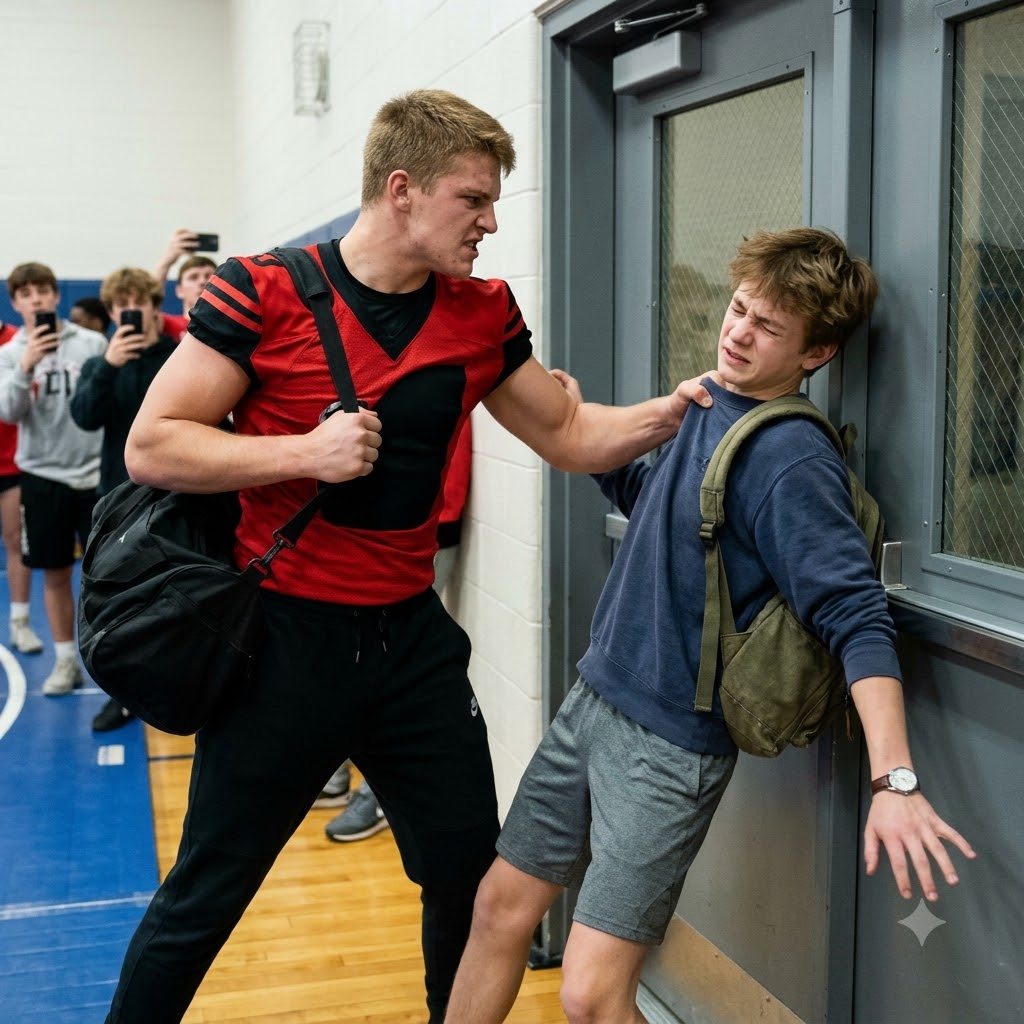
I pictured the paused video: Coach by the board, Brett standing at the hardwood, my shirt twisted in a fist. A camera could show where Coach was looking. It could not climb inside his head. I understood that, but the gap between what the room showed and what he admitted still felt enormous.
“So the part where I was holding my hands open,” I said, “he says he didn’t notice?”
“He’s describing his recollection. The principal will compare it with the other information. Nobody has asked you to accept it as the final version.”





