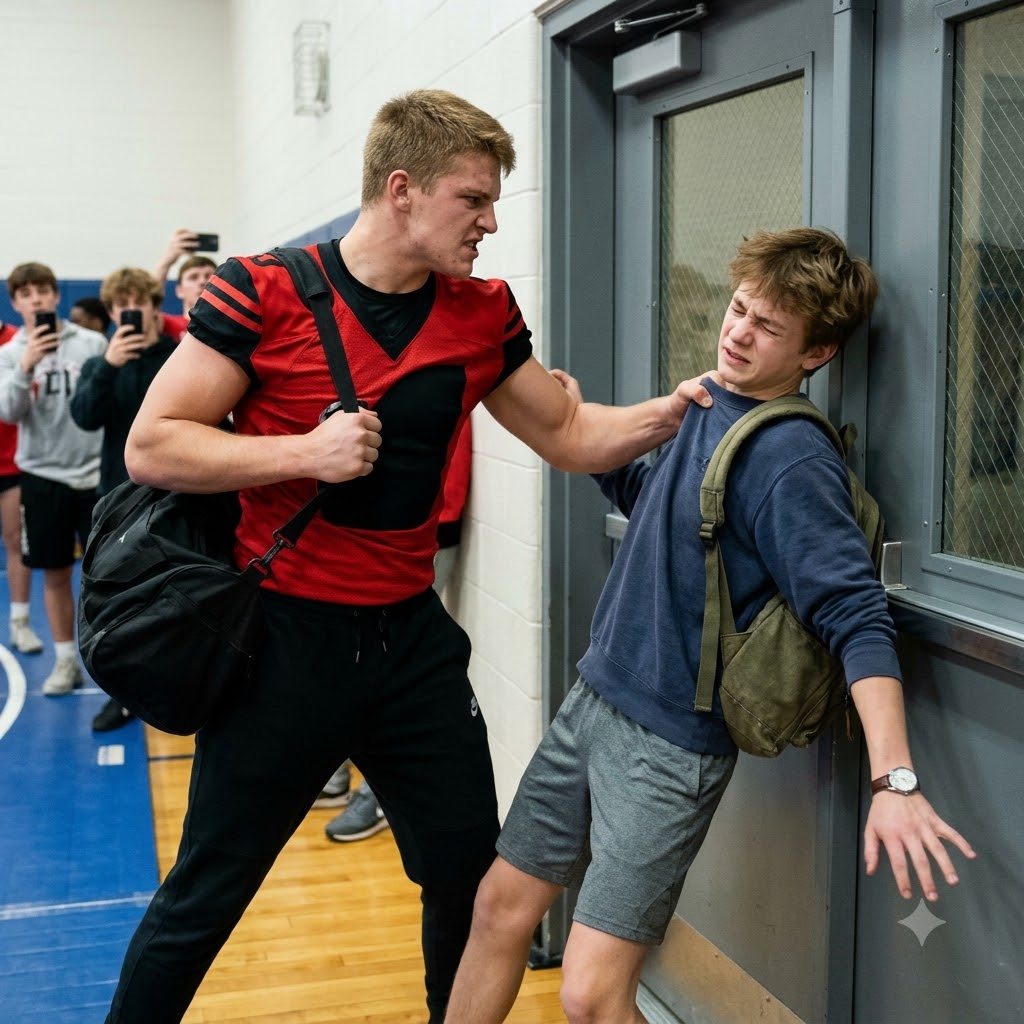
“Then why did everybody act like he was untouchable?” I asked.
“I can’t answer for every student or adult,” Adler said. “I can answer for what happens in this office and what we change when a report reveals a failure.”
Mom spoke up. “He lost months of peace. I’m not asking you to announce an outcome before the review. I am asking why the first response from the supervising adult was to call it a mutual fight.”
Adler listened while Mom repeated what the notice had done to our evening. She didn’t defend the word. She said the school should have distinguished an initial activity restriction from an established finding more clearly, and the administrative record would show that the original description was disputed and under review. That admission didn’t erase the two days I’d spent hearing people repeat the phrase. It did stop the adults in the room from pretending language was harmless just because it appeared in a form.
I asked whether the other students would be required to watch the video so they would know I hadn’t attacked Brett. Adler said no. Showing minors an upsetting confrontation to settle gossip would create more problems, not fewer. She could direct staff to stop rumor-spreading that crossed into harassment and could correct false disciplinary statements about me within appropriate school channels, but she couldn’t turn my private experience into a mandatory assembly.
I hadn’t been sure what answer I wanted. Part of me imagined all sixty students in the annex finally being forced to watch the exact beginning. Another part remembered Maya’s face when she chose to submit the file privately. My name was already being used as entertainment. I didn’t want the school’s correction to require a bigger audience.
“Then I don’t want it made public,” I said. “I want it made right.”
Adler wrote that sentence down. I couldn’t tell whether she liked it or merely thought it was relevant. For once, it was enough that the words belonged to me.
At the break, Mom and I walked to the vending area. She bought us water even though both of us had bottles. I sat on a bench and watched the football players coming down the far corridor with their bags. Jonah was among them. He didn’t look at us, and I didn’t call out. I had asked him for one honest statement. I didn’t get to ask him to make an enemy of every teammate for the rest of the afternoon.
Mom had brought the scholarship letter, folded at the corner from the day it arrived. It described how the Access Foundation helped students participate in activities they otherwise might have to skip. It said nothing about a provisional label being automatic grounds to end the award. I had imagined that condition for myself because uncertainty filled any empty space with the worst possibility.
“Do you remember opening this?” Mom asked.
“Yeah. You kept checking the return address like the letter might be somebody else’s.”
“I did.” She rubbed the crease smooth. “You earned the opportunity because you worked hard and because there was a need. What somebody did to you shouldn’t decide whether you belong here.”
“I still don’t know what the foundation will say.”
“Neither do I. We’ll ask them with accurate information when the school’s decision is in writing. Worrying is not the same as knowing.”
She made that distinction sound easy. It wasn’t. But it was what I’d asked Maya and Jonah to do: say what you know, not what somebody will be angry if you leave out.
When we returned, an athletics administrator had joined Adler. He explained that the shared practice restriction would remain until a formal safety decision could be issued. He also described an optional peer-resolution form that sometimes allowed students involved in an altercation to return to supervised activities sooner after acknowledging shared responsibility and agreeing not to repeat the behavior. He said the form wasn’t a final disciplinary finding and didn’t have to be signed. The offer was meant to be practical.
I read the first sentence twice. It said, Both students acknowledge participating in an avoidable mutual physical dispute.
“That’s not accurate,” I said.
The administrator leaned forward. “It may be a way to return to training while the larger review continues. You’re not being forced to accept it.”
“Could the sentence say that he initiated physical contact and I defended myself?”
“That wouldn’t be a mutual-resolution form,” he said.
“Then I can’t sign it.”
My mouth was dry. I wanted Friday’s meet so badly that I could picture myself changing into the singlet in the locker room, pulling my shoes tight, stepping onto a clean mat under officials who didn’t know Brett. I wanted one ordinary bout where the only question was whether I wrestled well. The paper offered me a path toward that feeling, but it started by asking me to agree that the beginning had been mutual.
Mom didn’t answer for me. She glanced at my face, then said to the administrator, “He has told you what he can honestly agree to.”
Adler took the form back. She said the formal review would continue and the temporary restriction would remain, in part because the supervision plan had not yet been finalized. She understood it meant I would miss the meet. She couldn’t erase that cost by promising a decision they weren’t prepared to make. I asked that my refusal to sign not be described as refusing to cooperate. She agreed to record that I’d given a detailed account and declined an inaccurate joint statement.





