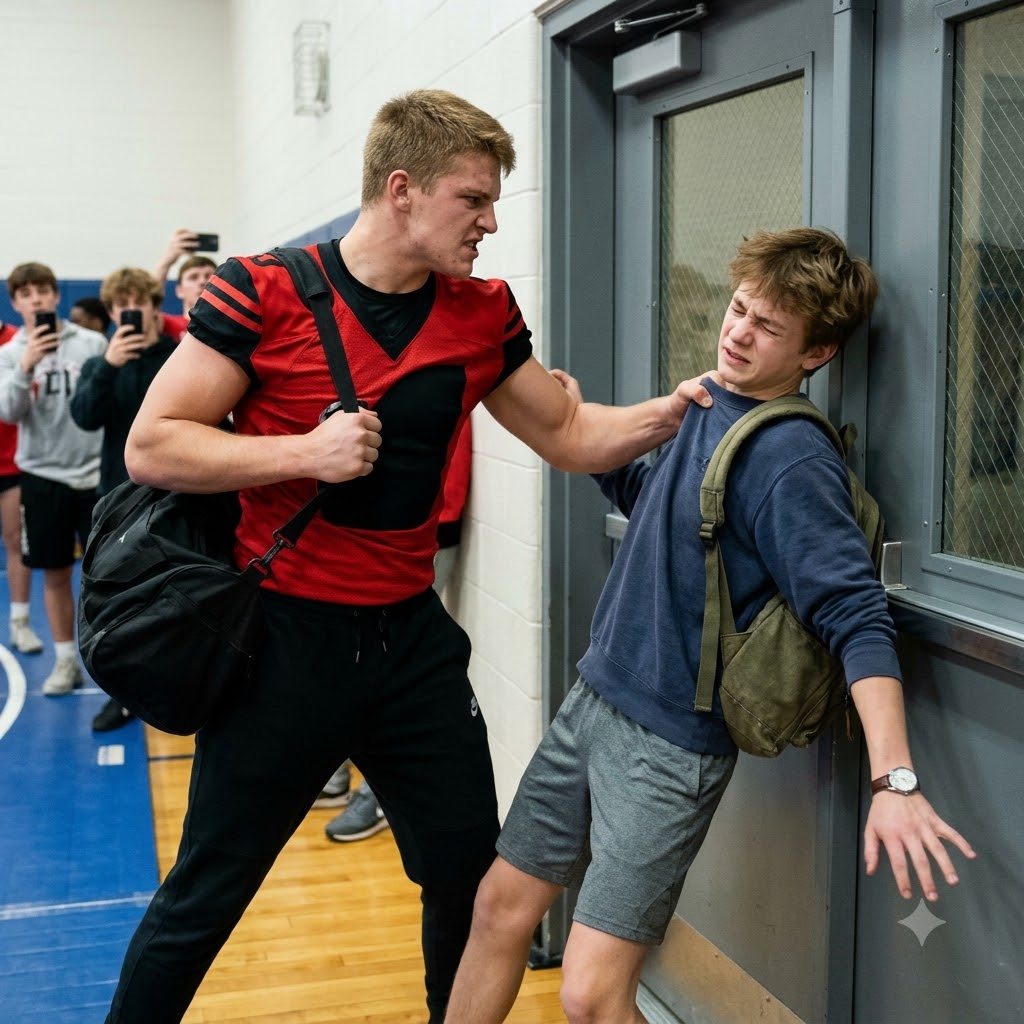
Principal Adler met us in the same office where I had described the pin. Ms. Patel was present again. This time there was a final incident summary and an attached safety plan. Adler placed them on the table where all three of us could read them. She said the school had considered the video, my statement, Brett’s response, Jonah’s limited firsthand account, Coach Miller’s clarified statement, the assignment records, and the physical damage to the watch. She said they’d distinguished direct observations from reports they couldn’t independently verify.
I could hear the old printer in the hallway making its irregular clicking sound. It was such a small, ordinary noise to accompany the moment I’d been waiting for.
“The finding for the February tenth incident,” Adler said, “is that Brett initiated the physical aggression, damaged your property deliberately, and threatened you. Your brief restraint occurred in response to that immediate threat. The review found that you released him when directed and did not continue an assault.”
I looked down at the page. The paragraph did not call me brave. It did not call me a winner. It used the words defensive response and not a mutual initiation of violence. I read those words again while Mom gripped the edge of her chair.
“The original incident category has been corrected,” Adler continued. “Your file will contain the revised account rather than a mutual-fight finding. The preliminary entry is retained only in the school’s internal review history with an explanation of why it was replaced. It will not be used as a disciplinary finding against you.”
“Can I have a copy?” I asked.
“Yes. This is your copy.”
I put my finger on the corrected paragraph. For three months I’d been told to be quiet, and for six days I’d been afraid that telling the truth would be turned into proof against me. A paragraph couldn’t repay the time. It could stop the school’s version from adding more harm.
Adler explained that Brett would serve three school days in an in-school disciplinary assignment under Greybridge’s student conduct procedure. He would complete academic work under supervision rather than using other students. The football program was removing him from its current off-season student-captain function pending its normal leadership review. That did not erase his past honors, and no one pretended it did. He would be assigned to conditioning in a different location, with no direct contact or messages through teammates directed at me. Violations could be reported to Patel or an administrator and addressed separately.
I didn’t ask what Brett had said when he was told. Adler had reviewed his response fairly, but she wouldn’t share his private disciplinary file with me. I didn’t need access to every detail to know the relevant boundaries. The same privacy that kept my watch breaking from becoming a schoolwide video spectacle applied to him too.
The academic issue, Adler said, had been referred to Ms. Flores for a separate classroom integrity process. She had verified what she could about the assignments, including my February tenth submission, and would address Brett’s work and my disclosure without inventing certainty about every packet since November. I was not being punished for reporting coercion. I would be expected to keep completing my own work, and any review of older submissions would give me a chance to explain. I understood the distinction better now than I had when I first spoke to her.
Then Adler turned to the part I’d been avoiding. Coach Miller had acknowledged that he saw Brett gripping my shirt and failed to intervene when the danger was visible. The district was reviewing his supervisory conduct through its staff process. During that process, he would not supervise the wrestling annex alone. Another qualified adult would be assigned to the room whenever students trained. Adler couldn’t tell us whether a personnel process would end in a warning, retraining, or something else; she didn’t promise a dramatic firing to satisfy us. She did confirm that my return to practice would not require me to rely on his judgment by himself.
Mom let out a slow breath. “He told Evan it was mutual before anyone even asked about the watch,” she said.
“That initial wording was inadequate,” Adler answered. “It has been corrected. We’re also addressing how initial incidents are categorized so temporary separation isn’t mistaken for a fault finding.”
I thought about another kid reading the same phrase in a portal one day. I hoped the change would help. Hope was not evidence, and I had learned not to confuse the two. But hearing the principal describe a specific change was better than watching another adult examine a whistle.
The safety plan had dates, locations, and names. Brett would use the football conditioning space on the other side of the building. I would return to the annex with a second trained supervisor present, and departures would be staggered while the no-contact plan remained in effect. I could report a message from a teammate if it was clearly being sent on Brett’s behalf, but a classmate looking at me in the cafeteria wasn’t automatically a violation. Patel would check in during the first weeks and we could revise the arrangement if it failed. The plan was not a bubble around my life. It was a set of adults accepting responsibility for rules they’d put on paper.
“Can I wrestle again?” I asked, although I could see the answer near the bottom of the page.
“Yes,” Adler said. “Your temporary restriction ends today. The Friday meet has passed, and we cannot recover it. You can attend the next eligible team activity under the revised supervision plan.”
I was angry about the meet for one more second. Then I realized it was possible to be angry about something lost and relieved about what remained, all at once.





