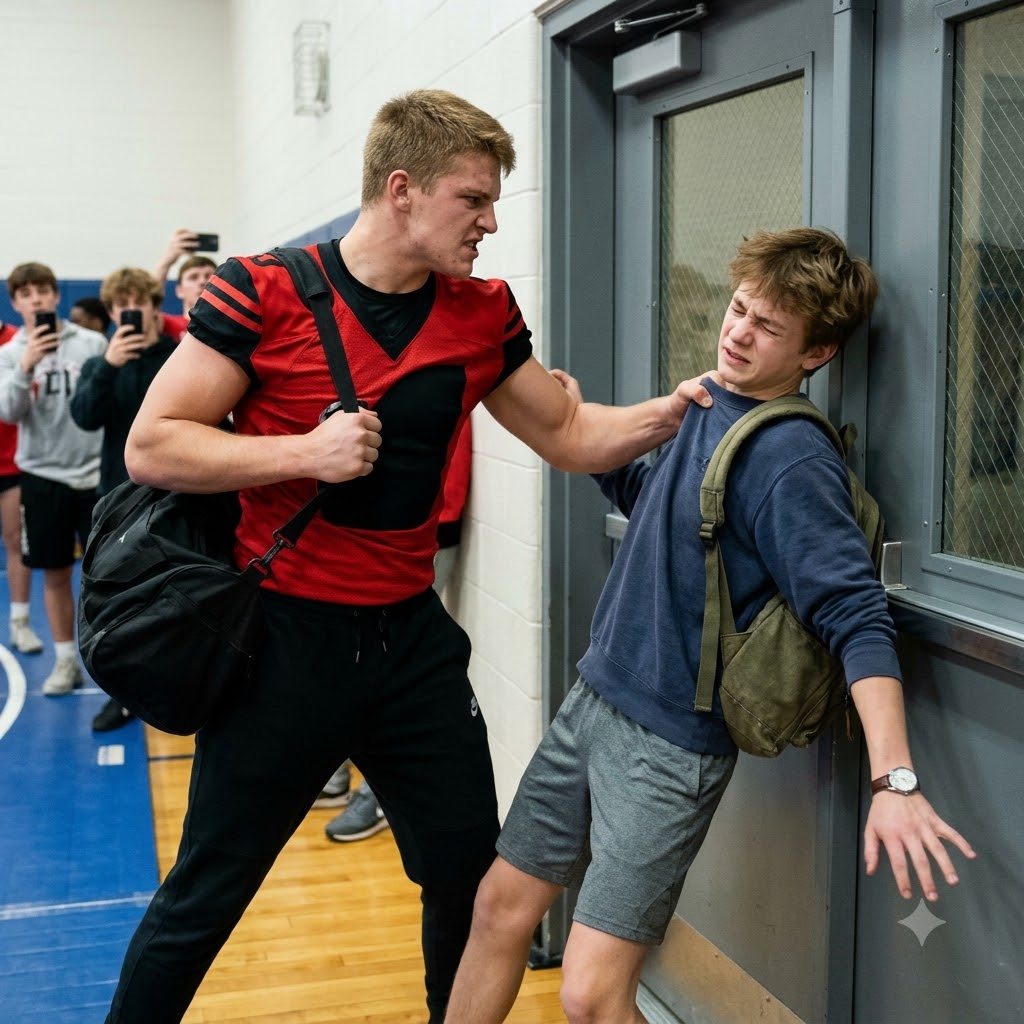
I went back to the library and stared at my open history book. I had spent three months being afraid that the powerful boy would get to choose the story. Now a grown man with a whistle was choosing his part in it, and it mattered just as much. The video had changed what people could ignore, but it had not made them honest automatically.
By the time the last bell rang Friday, the meet schedule was taped to the athletics office window. My name had been penciled beside the weight class earlier in the week. Someone had drawn a line through it, lightly enough that I could still read every letter. The team bus was supposed to leave at four. The local meet started at six. I was already dressed for a meeting instead of practice, holding a folder that had grown too thick for the elastic band around it.
Ms. Patel found me looking at the paper. “The principal can see you and your mother now,” she said.
“Am I off the team?”
“You’ve been kept out of the shared activity while we finish gathering facts. That isn’t the same thing.”
“I know the sentence. I don’t know what it means at four o’clock.”
She didn’t try to defend the timing. “It means you may lose today’s meet. I’m sorry that’s a cost of the delay.”
I folded the schedule so I couldn’t see my name, then unfolded it because I didn’t want to pretend the line wasn’t there. I left it in the window where it belonged.
Before the meeting, Patel asked me to talk through what I was hoping for. I said I wanted the school to record that Brett started the physical threat, to keep him away from me during conditioning, and to let me wrestle. Then I stopped. There was something else I was ashamed to say.
“I want people to stop calling me dangerous for defending myself,” I admitted.
“People may take longer to change their minds than a file takes to correct,” she said. “What can we make clear and specific now?”
I asked for the no-contact instruction in writing. I asked for different conditioning locations and different arrival and departure times, at least until the team could supervise properly. I asked not to be required to work alone with Coach Miller while his account was disputed. I asked that another adult be present for wrestling activities when I returned. Each request felt more practical than wishing for a public apology. I could imagine actually checking whether it happened.
Patel helped me put the requests into clear sentences without turning them into demands for a punishment I wasn’t entitled to choose. She said the school could assess the conduct and choose consequences; I could explain what safety required from where I stood. That division bothered me. It was also the first fair division of responsibility anybody had offered.
Mom was waiting outside the principal’s office. She had brought a folder of scholarship papers because I had been asking her the same question for two days. She took one look at my face and put the folder aside. “You don’t have to be brilliant in there,” she said. “You only have to tell them what happened.”
“It’s easier to be brilliant,” I said.
She smiled sadly. “I know. Noah used to say the same thing before a job interview.”
We went in together. Principal Adler had two pages of notes on the desk. Ms. Patel sat near the door. An assistant principal joined for part of the discussion to record the school’s process. Brett and Coach were not in the room with me. I was grateful for that. I didn’t want to explain my own fear while the boy who had caused it watched my face.
Adler said they had reviewed Maya’s recording and had begun comparing it with the separate accounts. She explained the difference between what they could confirm about Wednesday’s confrontation and what still needed careful inquiry about prior intimidation and academic work. The recording showed Brett taking and crushing the watch, gripping my shirt, and raising his right fist. It also showed the brief pin and my release. Those facts were no longer being treated as two boys’ interchangeable accusations.
“But this doesn’t establish every earlier date you reported,” Adler said.
“I know. I never said it did.”
She asked me to describe the equipment-cage incident again. I told her the general week, how my ribs felt afterward, and that no teacher had been standing behind the cage. She asked if I’d sought medical care. I hadn’t. I remembered putting a folded sweatshirt against my side at night and telling Mom I had pulled something in practice. I hated how small those lies sounded when I said them aloud.
“There may be limits to what we can substantiate about that episode,” Adler said. “That does not mean we should ignore your account when deciding how to protect you.”
I looked at Mom. She was making notes instead of looking angry. She had told me at breakfast that rage was making her forget ordinary details, and she wanted the record to be accurate. I had never seen her work so hard at staying calm. I tried to do the same.
The principal asked about the pin. My stomach tightened. This was the moment I had feared since I first read mutual altercation. It would have been easy to describe myself as having no choice, as if I were a machine that automatically responded to a threat. But I had made a decision. I wanted them to understand it without pretending I hadn’t.





