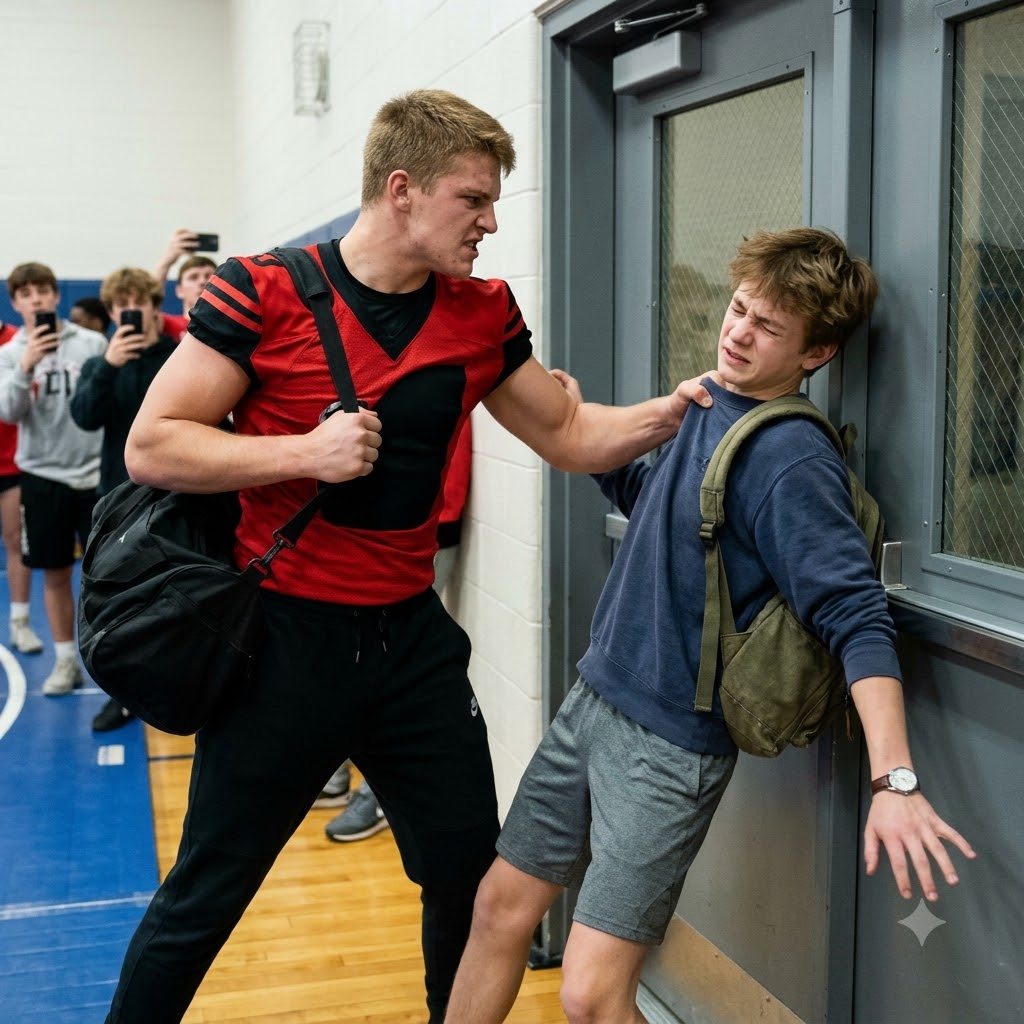
When I said that wasn’t how homework worked, his arm came out across my chest. It wasn’t a punch. It was enough to put me against the lockers in front of boys who pretended not to notice. I handed over my notes the next morning. A week later I was filling out his packet. That was the system, as ordinary to him as passing a football.
At first I explained to myself that doing the work bought me time. I was fifteen, a transfer student with a foundation scholarship that helped cover equipment and transportation, and a mother whose shifts changed every week. Brett was seventeen, the football captain, the name everybody knew. He made a point of mentioning that Dr. Whitaker, the district superintendent, was his godmother. He talked about the connection as if it gave him a key to every locked office in the school.
I didn’t know whether he believed that. I only knew other boys went quiet when he said it.
In December he shoved me into the benches because I turned in a packet late. In January he backed me against the wall padding and pushed until I had trouble taking a full breath. Behind the equipment cage, out of Coach’s view, he’d bruised my side and broken one strap on my backpack. A few kids had laughed afterward. A few had watched their sneakers. I had let every incident pass without throwing a punch because I knew what the report would look like if I did.
There were days when that choice felt smart. More days when it felt like making myself smaller one inch at a time.
Wrestling had been the one part of Greybridge that didn’t ask me to explain where I came from. When I first joined in September, Coach Miller had lined us up by experience and told us to start with stance and balance. I was not the strongest boy in the room or the fastest. I could listen, though, and repeat something until my body understood it. I liked the fairness of that. If I made a mistake, the mat told me what it was without asking how much my shoes cost.
After a practice in early January, Jonah Price had found me picking up my backpack beside the wall padding. Jonah played football with Brett. Most days he laughed on cue, but he’d once helped me shift a heavy bin without being asked. I remembered the small kindness because there hadn’t been many. Brett came past us with a packet rolled up like a baton and asked why his latest answers weren’t done. I said they would be ready in the morning. He shoved me backward into the padding, hard enough to knock the wind out of me for a second.
Jonah had seen it. His mouth opened. Then Brett called him over to help carry a bag, and he went. On the way out, Jonah glanced back. He wasn’t laughing. I didn’t mistake that glance for help. Still, I remembered it because it was proof the shove had happened in a place other than my own head.
That day I’d walked home asking myself what I would have wanted Jonah to do. Put his own place on the team at risk? Tell a coach who might say Brett was only fooling around? At fifteen, questions can make you feel wise even when they are really excuses for being scared. I understood Jonah’s silence too well to forgive it easily.
Later that week, Ms. Flores had stopped me after history class. She’d noticed that I was finishing my own work at the last possible minute instead of arriving early with an argument already marked out in pencil. She asked if I needed an extension on an essay. I told her no. She didn’t pry. I saw her leave the classroom with a stack of folders and wished I had said something useful before the door closed.
The scholarship made my caution feel rational. Greybridge’s Access Foundation covered the activity fee, a portion of school supplies and a small transportation allowance, which Mom saved for days when ice made the walk impossible. It wasn’t free tuition—Greybridge was a public school—but without that help my place in wrestling would have been difficult to keep. I had built the award in my mind into something fragile enough that one disciplinary mark might break it. Nobody had told me that was true. I simply couldn’t afford to find out by experiment.
The weirdest part was that I knew what a safe physical response looked like at practice. Coach had said again and again that control mattered more than showing off. You stopped when told, you respected somebody’s body, and if you couldn’t separate a drill from a grudge you stepped off the mat. Every time Brett pressed me against a bench I remembered those rules and wondered why they seemed to stop working when the boy breaking them wore a captain’s stripe.
Now I had finally acted according to the lessons on the mat, and the first word I heard for it was fight. I didn’t regret keeping his fist away from my face. I did regret that I had never asked a grown-up, in writing, what they intended to do about the first shove. That regret was different from blame. It gave me one choice I could still make.
Coach led me into the short corridor outside the annex while Brett waited farther back near the benches. From there I could see my navy backpack by the west padding, its strap joined with a crooked line of stitches Mom had made at the kitchen table. I asked again about my watch. Coach said he needed to make sure nobody touched the pieces first. Then he called the athletics office on the wall phone.





