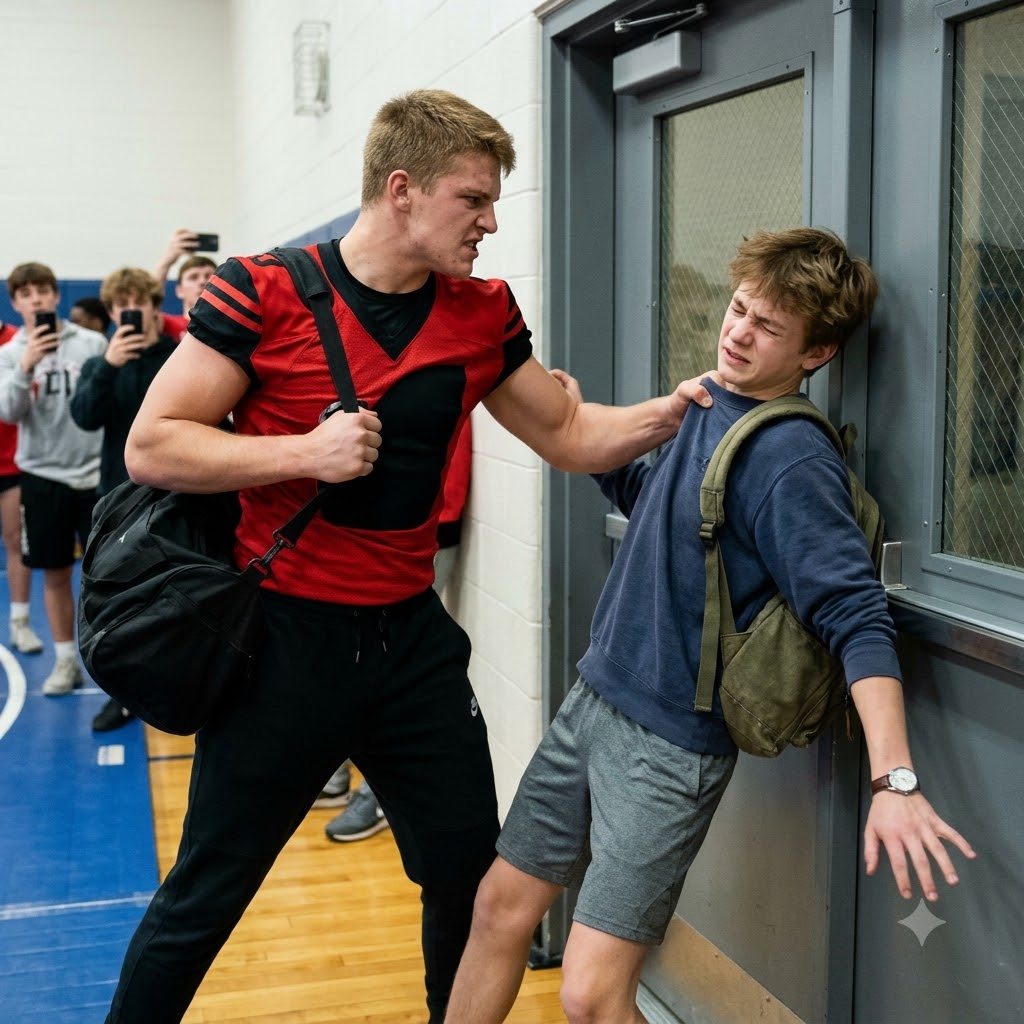
The smell in the corridor was different: floor wax instead of disinfectant, damp wool coats instead of sweat. I found myself thinking about the distance home. Three miles was easy when I could walk with music in one ear and Noah’s watch ticking against my wrist. Three miles with an empty wrist would be something else.
Noah had been twenty when the training accident overseas took him. He wasn’t a movie hero or a secret champion. He was my big brother, who burned pancakes because he’d forget to lower the heat, who could tell which bus was coming by the sound of its engine, who always told me to stop apologizing before I had anything to apologize for. The watch was battered before it was mine. Its crystal had already been scratched, and the second hand sometimes hesitated in cold weather. I liked the hesitation. It made me listen for the next tick.
A voice from inside the annex said, “He got you, man.” Another voice answered, “Shut up.” I couldn’t tell who either belonged to.
Maya appeared at the corridor doorway. She wasn’t smiling. “I saw the start,” she said quietly.
I looked at the black phone she held, then at her. “You mean the watch?”
“Yeah.” She pressed her thumb against the edge of the case. “I was filming.”
The idea of somebody watching Noah’s watch break more than once made my stomach turn. “Don’t post it.”
“I haven’t.”
“Please.”
“I said I haven’t.” She sounded annoyed, but she stayed. “I just thought you should know.”
Coach came back before I could ask anything else. He saw Maya and told her to return to the room. She did, after giving me one quick, undecided look. The phone went into the pocket of her burgundy jacket.
“Go get your things,” Coach said to me. “Then we’re going upstairs.”
“Can I pick up the watch?”
He let me do it with him watching. The pieces were still on the east hardwood, not on the mat where Brett had fallen. I knelt, careful of the splinters of glass. The strap had separated at the buckle. Under one bright light, a silver sliver looked almost intact until I touched it and saw the bent metal beneath. I gathered what I could in my cupped hand. Nothing fit together.
Coach found a plain paper envelope in the office supply drawer near the board. He held it open. I slid the fragments inside, then picked up a last tiny screw I had nearly missed by the baseboard. When I closed the flap, the envelope seemed impossibly light.
“You can list it as damaged property,” Coach said.
I stared at him. Damaged property was the school term for something like a cracked calculator or a missing water bottle. Maybe there wasn’t a form for the only object you had left from someone you loved. Maybe there couldn’t be.
“Brett did it on purpose,” I said.
“That will be part of the report.”
“Will you write that you saw him holding my collar?”
He folded his arms. “Evan, let us handle the process.”
It was the answer he’d given in smaller ways all winter. Let it go. Keep moving. Don’t make noise. I put the envelope inside the safest pocket of my backpack and followed him upstairs.
The athletics office was a square room with a trophy case on one wall and a printer that clicked every thirty seconds without producing anything. Brett sat in one chair, knee bouncing, his maroon shirt stretched across shoulders that almost filled the space between the armrests. When I entered, he looked at me like I was a problem he’d solve later. I sat as far from him as the room allowed.
An assistant athletic administrator whose name I knew only from morning announcements asked us to wait while Coach wrote a preliminary account. Brett was allowed to speak first. He described me as “losing it” over schoolwork. He said he had only tried to calm me down. When the administrator asked about the broken watch, Brett shrugged and said it had fallen during the argument.
I watched Coach write. His pen never stopped long enough to register the word stomped.
“That’s not what happened,” I said.
The administrator raised a hand. “You’ll each have a chance.”
“Will my chance be written down?”
“Yes.”
“Then I want to do it myself.”
Brett made a soft snorting sound. “Of course you do. You’re good at other people’s homework.”
There it was, almost an admission, floating in the office where no one had asked him to make one. The administrator looked at him. “Brett, enough.” It wasn’t a finding. It was something.
I was taken into a smaller adjoining room with lined paper and a pen. I wrote my name, grade, and the date. February 10, 2027. I started with the classroom: the assignment I’d placed on Ms. Flores’s desk under my own name; my refusal to write Brett’s; his decision to confront me at conditioning. Then I described the shove, the watch, the collar, his right hand leaving my shirt, and the moment he leaned forward. I wrote that I’d used what I’d learned at wrestling practice to get him down and held him only until Coach blew his whistle.
On the second page I began to describe November. My handwriting got worse. Some events were clear as photographs; others were clear only in how I had felt walking into the room afterward. I refused to assign dates I wasn’t certain of. The equipment cage incident happened in January, but I didn’t know the day. The strap had broken on a Friday. I could check which Friday later. I wrote those limits down too, because I was tired of people making certainty out of what they hadn’t seen.





