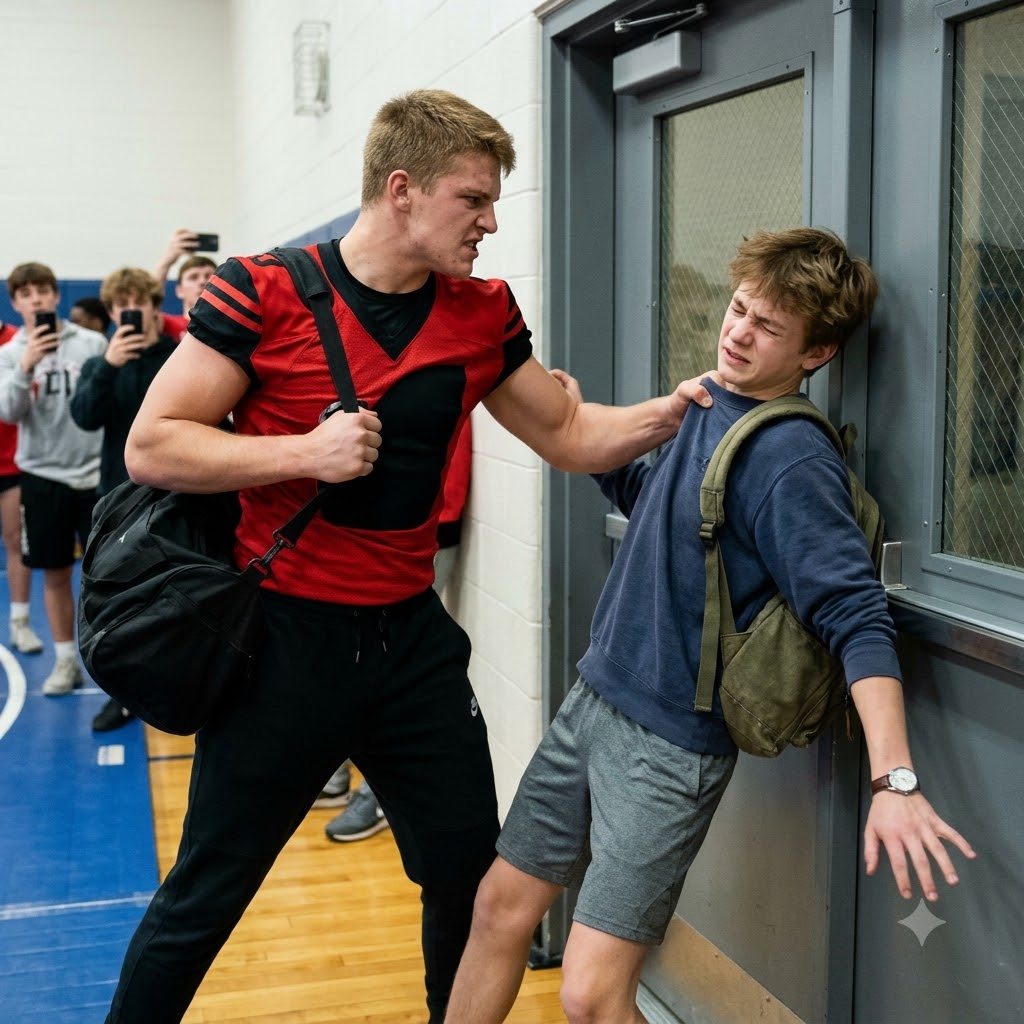
We returned once more to the safety requests. Adler said they could implement no direct contact in school, separate Brett’s off-season conditioning location from wrestling, and designate another trained adult to supervise my return when a final decision was ready. They would notify both families of the terms through the school, not make me carry messages to Brett. They could not guarantee every student would stop gossiping, but they could act on threats or contact reported to staff. She said I would receive a written update early the following school week.
It was an adult answer: specific, imperfect, too slow. I was beginning to trust specific more than comforting.
Outside, the team bus idled by the curb. Through the window I saw a boy from my weight class pulling his headphones on. It might have been someone taking my place. I hoped he wrestled well. I hated that I hoped it. The bus doors folded shut and the engine turned toward the road while I stood with Mom under a sky that had finally begun to spit wet snow.
Maya came out of the athletics wing carrying her gear bag. “You coming?” she asked, then saw my empty hands. “Oh.”
“No.”
She looked at the disappearing bus. “I’m sorry.”
“It’s not your decision.”
“Still.” She shifted the bag on her shoulder. “I told them what I saw. I hope it helps.”
“It already did.”
She nodded, but there wasn’t anything more to say. She hurried toward a car waiting in the pickup lane. I watched until she was inside, then pulled my hoodie tighter.
At home I checked the portal. The interim restriction remained. The incident category had not yet been corrected. My name had been removed from tonight’s active meet list; there was no empty space waiting for me to fill after a late decision. The review wouldn’t be completed until the next school day, after the long weekend.
For ninety-two days I’d tried to save the parts of my life I could by giving Brett what he wanted. Now I was losing a meet because I wouldn’t sign a sentence he wanted the school to believe. I put my phone facedown and listened to the heating pipes knock behind the wall.
At six, somewhere across town, my team stepped onto a mat without me. I sat at the kitchen table beside the envelope of Noah’s watch, knowing exactly which lie might have put me on that bus, and choosing to miss it anyway.
The long weekend did not turn me into a different person. On Saturday I still flinched when a door shut hard at the grocery store. On Sunday I checked the school portal three times even though no one had promised an update. On Monday, when Greybridge was closed for the holiday, I sat at the kitchen table and worked on history with a pencil that kept slipping because my hand was sweaty.
I thought about the meet I’d missed. Maya had sent one ordinary message saying the team had finished respectably and asking if I wanted to hear about the matches. I said yes. She described a close bout and an overtime win by a girl from our weight-class group. She didn’t say everyone had been asking about me. I appreciated the absence of that sentence.
On Saturday, Mom asked whether I wanted to go to the watch-repair shop near the bus stop. I’d already stood outside its window once and walked away. This time I said yes. We took the long route because the snow along the short sidewalk had turned to slick gray ice, and Mom didn’t want either of us falling while we carried something fragile. I nearly pointed out that nothing in the envelope could be damaged much more. The words stopped before they reached my mouth. It was the kind of joke Noah would have made. I didn’t want to make it yet.
The shop was narrow and warm, filled with wall clocks that didn’t all agree on the hour. A repairer behind a glass counter put on a pair of magnifying glasses when I showed him the pieces. He was careful with them, sliding the broken case across a soft pad instead of turning it over in his hands. He said he could examine the damage without promising a repair. When he lifted the crushed face, I saw how the inside had been twisted. Mom watched me rather than the counter.
“Could you make it run again?” I asked.
“Some parts might be usable,” the repairer said. “But the case and mechanism are badly damaged. You’d be rebuilding so much that it wouldn’t really be the same watch. I don’t want to sell you the idea that I can put its history back together.”
I liked him for saying that, though I didn’t like hearing it. Mom asked for a written description of the condition and a rough indication of what a comparable used watch might cost. The repairer said he could provide an ordinary estimate for the property’s loss, not its sentimental worth. We left with a plain receipt and his notes, which Mom offered to give the school if they needed help arranging restitution. The Timex fragments came home with us.
Outside the shop I stopped beneath the awning. Traffic sent cold water spraying across the curb. “What if I hadn’t told Brett that I turned my work in?” I asked. “He wouldn’t have broken it that day.”
Mom adjusted the collar of her coat. “He could have chosen not to break it regardless of what you said.”
“But I knew he’d be angry.”
“You knew he might be angry. You didn’t make his hand take the watch.”
For weeks I had blamed myself for telling Brett no at last, as if the wrong decision had been my refusal instead of his response. I knew Mom was right. I wasn’t instantly able to feel it. I stood with the envelope in my pocket until the cold reached through my shoes, then walked beside her toward home.
We bought milk on the way. In the checkout line she complained about the price of eggs, and I complained about the history assignment I was still trying to finish. It felt almost disloyal to talk about groceries so soon after handling Noah’s broken watch. Then I remembered that most of our memories of him were like that: food, bus routes, the broken handle on a cabinet he kept promising to fix. Grief hadn’t arrived as a dramatic scene three years ago. It had moved into our ordinary rooms and stayed. I could let ordinary life happen around it without leaving him behind.
The watch parts stayed in the paper envelope in my desk drawer. Once, on Sunday evening, I tipped them onto a clean towel. The silver case was bent, the glass broken, and the old blue strap split near the buckle. I tried to fit the largest pieces together, not because I expected them to run but because I wanted to know what remained. Mom came to the doorway and saw what I was doing.
“Want me to sit?” she asked.
I nodded. We spread the pieces on the towel and named the parts we recognized. A tiny screw. A piece of the dial. The strap Noah had darkened with his own sweat. Mom told me that the watch had been cheap even when Noah bought it used, and that he had been absurdly proud of making it last. I smiled at that. It was a truer memory than the moment Brett had stepped on it, and I was relieved to find there were still truer memories to reach for.
On Tuesday morning Mom and I went back to school. We weren’t there to prove that I was a hero. I had spent the weekend worrying that the school might prove nothing at all. What I wanted was a corrected record, a plan that worked, and permission to be a fifteen-year-old kid on a wrestling team without also serving as somebody’s unpaid homework machine.





