At home, Mom’s work shoes were still by the door and the kitchen smelled faintly of the onion soup she’d left in the refrigerator. I ate a bowl standing at the counter because sitting down made the silence too noticeable. I put the envelope in the bread drawer, took it out, and finally left it on the kitchen table beside my three pages of copied notes. I couldn’t bear to hide it from her and couldn’t bear the thought of telling her.
She came in after nine, carrying the cold in with her coat. Her face tightened when she saw me awake. “Evan. Your message said the school called.”
“Yeah.”
“Are you hurt?”
“Not today.” I heard the last word a second too late.
She set her bag on a chair and didn’t touch the envelope. “Tell me the whole thing. Whatever it is.”
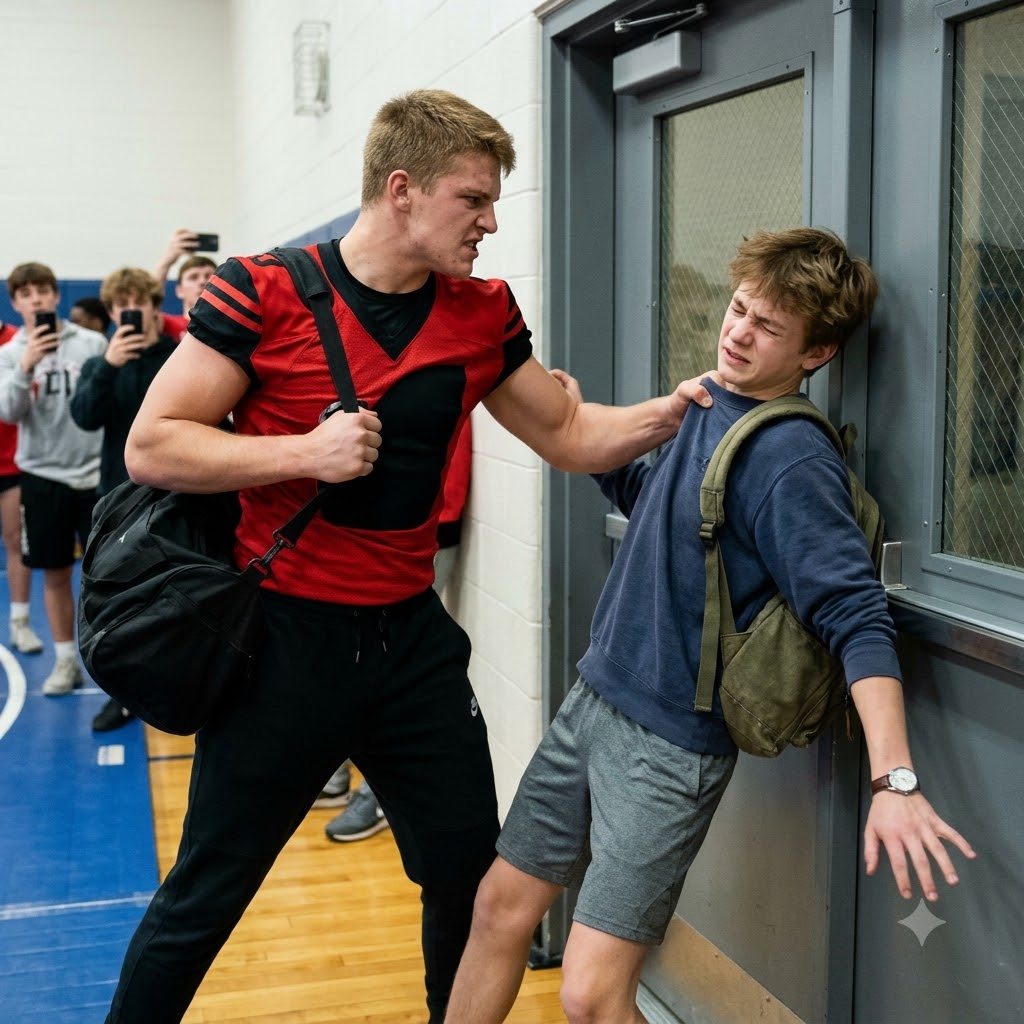
I started with Brett, not the watch. I explained the packets, the locker, the benches, the torn backpack strap. Mom’s gaze went from the stitching on the bag to the side of my face. The longer I talked, the stiller she became. I told her about the equipment cage and the rib that had hurt to breathe around for a week. She asked why I hadn’t said anything. I told her the question I’d been asking myself for months: what if the school believed him instead?
“Then we’d make them hear you,” she said. Her voice shook. “We would have had to find a way. You shouldn’t have been carrying that alone.”
“I didn’t want to make it expensive.”
“Expensive?”
“The scholarship. The wrestling gear. If I got suspended—”
Mom sat down as if her knees had decided for her. “You thought we would lose all of that if you asked for help.”
I nodded. She shut her eyes for a moment. She didn’t give me a speech about money not mattering. We both knew it did. Then she reached across the table and took my hand—the one without the watch.
When I slid the envelope toward her, her expression changed before she opened it. She recognized Noah’s handwriting on the old strap’s inner side, two tiny initials he’d made years ago to mark it as his. I watched her put one finger against the torn leather without lifting it. For a long time she didn’t say anything.
“Can you get it fixed?” I asked, even though I’d seen the crushed case.
“Maybe somebody could make a different watch from pieces,” she said. “But it wouldn’t be this one.”
“That was the only thing I kept.”
“I know.”
She closed the envelope carefully and returned it to me. “It’s still yours. What he did doesn’t change whose it was.”
That was the first thing anybody had said since the annex that made me feel as if the watch and my brother were not merely details of a disciplinary form. I went to bed with the envelope in my desk drawer and slept badly anyway.
Thursday morning, every hallway at Greybridge seemed to know something about me. A boy at the entrance made the motion of a wrestling referee slapping a mat and then looked away when I turned. Two girls behind the drinking fountain were arguing about whether Brett had been “humiliated” or “jumped.” Neither had been in the room. Someone asked if I had really broken his arm. Brett had walked away using both arms. I said so and kept walking.
In history, Ms. Flores was writing the day’s question about the Congress of Vienna when I came in. She looked toward my usual seat and then at the binder I held too tightly. I had spent the busier part of the morning rehearsing a sentence. Now that she was in front of me, it disappeared.
“Could I talk to you after class?” I asked.
She said yes without trying to draw the answer out in the doorway. During the lesson we discussed settlements designed to prevent another war. Normally I liked the strange logic of old political agreements, the way every sentence claimed to make peace while the people writing it prepared for the next struggle. That morning, I couldn’t stop thinking about the words mutual altercation and how neatly they could conceal a difference in power.
I stayed when everyone else left. Ms. Flores closed the classroom door but kept the window in it uncovered. “Ms. Patel has told me there was an incident in athletics,” she said. “You asked to speak to me yourself.”
“Brett made me do his homework,” I said. I hadn’t meant to say it that fast. “Not this one. The one I turned in yesterday was mine. But before that, since November, he kept making me fill out his packets.”
Her expression sharpened. “When you say made you, what did that involve?”
I explained the first demand in the hall, the threat of trouble after practice, and the times I’d written his answers at home while my own work waited. She asked whether I’d used his name on the packets. Sometimes I’d written his name at the top because he stood there and insisted. Other times I’d given him loose pages to copy. The distinctions mattered to her. She wrote them down without turning them into a verdict.
“The packet submitted yesterday under your name,” she said, “is here.” She opened her class folder and showed me the ordinary teacher copy of the submission record. There was my name, the date, and the grade box still empty. “This tells me what you submitted. It doesn’t tell me everything about what happened with prior assignments.”
“I know.”
“We can review the work I actually have and talk to the students involved. I won’t pretend I can know who held a pencil every time just by looking at handwriting.”
She was the first adult to tell me a piece of proof had limits without using those limits to dismiss the whole story. I found I could breathe around that.





