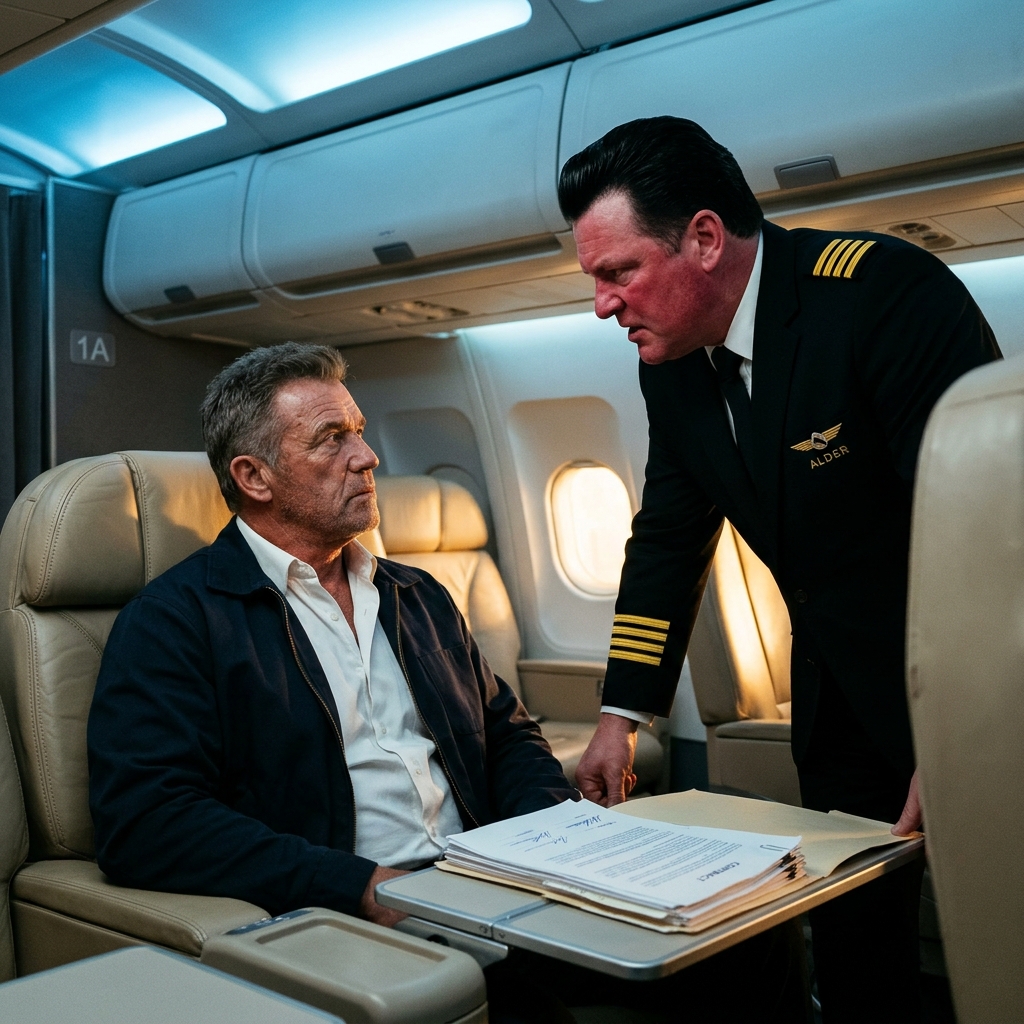
“I haven’t refused any safety instruction, ma’am,” Mercer said. “I am sitting in the seat I purchased. I have not raised my voice. I have not blocked an aisle. The captain demanded I surrender my personal property without citing a regulation. I told him that if he wants me removed, he needs to sign the refusal log.”
Reinhardt slammed his open palm against the galley bulkhead. “I am the captain of this aircraft! I don’t need to debate a passenger in front of my crew! Offload his bags and get the port authority police down here to escort him off!”
Marian did not flinch at the slam. She turned her gaze to Reinhardt, her face hardening into lines of pure granite.
“Captain Reinhardt, you know the procedure. If you invoke pilot-in-command refusal on an off-gate boarding, the paper has to be signed in front of the station supervisor before the bridge is pulled. I will print the refusal form.”
“Print it,” Reinhardt snarled. “I’ll sign it in ink.”
Marian turned to Mercer. “Mr. Mercer, for the sake of the schedule, I have to ask you to gather your personal items and step onto the jet bridge while we process the documentation.”
Mercer did not argue. He did not scowl. He stood up with the unhurried grace of a man who had spent his life waiting for hydraulic fluid to drain into collection pans. He reached up, took his canvas duffel from the bin, tucked the blue operations manual under his left arm, and walked past Douglas Reinhardt into the cold rubber tunnel of the jet bridge.
As he crossed the threshold, Reinhardt leaned toward him, his voice a venomous whisper: “You picked the wrong flight to play expert, old man. Next time, buy a ticket on an airline that lets passengers run the show.”
Mercer did not look back. “We’ll see about the show, Captain,” he said.
The jet bridge door clicked shut, cutting off the warmth of the cabin.
Mercer stood beside the podium at Gate C19. The small gate area was cold, smelling of rain and asphalt. Marian was seated behind the computer terminal, her fingers clattering against the keys with mechanical ferocity. Beside her, a dot-matrix printer wailed, feeding out a multi-part carbon form with red headings: ALDER AIRLINES FLIGHT OPERATIONS — PASSENGER REFUSAL FOR CAUSE.
Mercer set his canvas duffel on an empty plastic chair, drew his cell phone from his pocket, and dialed a single number from memory.
It answered on the second ring.
“Cho,” the voice said, crisp and sharp.
“Andy,” Mercer said. His voice was level, almost conversational. “Are you at the desk?”
“Yes, sir. Working through the Denver schedule for tomorrow. The board car is booked for eight—”
“Cancel the board car,” Mercer said. “Who is the Vice President of Flight Operations for Alder?”
A pause on the line—the distinct, rustling silence of Andy Cho flipping to the organizational chart he kept laminated in his desk drawer. “Captain Marcus Hayes. Thirty years on the line, went into flight management four years ago. Based out of Denver headquarters.”
“Call Hayes on his personal cell,” Mercer said. “Tell him Paul Mercer is standing at Gate C19 at O’Hare. Tell him Flight 108 is at the gate. Tell him Captain Douglas Reinhardt has just issued a formal pilot refusal on seat 1A. And tell him that if he isn’t on a conference bridge with the Chicago station manager within three minutes, I am going to dissolve the Flight Operations Committee before lunch.”
Andy did not gasp. He did not ask what had happened. He had worked for Paul Mercer for twelve years; he knew the exact frequency of his employer’s voice when an engine mount was cracked.
“On it, sir. Three minutes.”
Mercer slipped the phone back into his Carhartt pocket.
Marian tore the carbon form from the printer with a sharp, dry rip. She looked up at him, her eyes dark with genuine regret. “Mr. Mercer, I am truly sorry about this. Captain Reinhardt is… well, he has a reputation on the line. But company policy gives the pilot in command absolute discretion over boarding refusals. I have to process the voucher for the next flight.”
“You don’t have to apologize, Marian,” Mercer said gently. “You’re doing your job. You let the paper do the talking. I admire that.”
Before she could answer, the cockpit door opened, and Reinhardt stepped onto the jet bridge.
He had his flight cap on now, the gold bullion wings gleaming under the harsh fluorescent strips. He walked with the heavy, triumphant stride of a conqueror arriving to collect his tribute. Behind him trailed First Officer Miller, looking like a man who was walking to his own sentencing.
Reinhardt reached the gate counter, plucked the pen from Marian’s hand without asking, and dragged the carbon form toward him.
“Where do I sign?” Reinhardt demanded.
“Line four, Captain,” Marian said, her voice flat. “Reason for refusal must be stated in your own handwriting.”
Reinhardt smirked. In large, aggressive capital letters that looked like iron spikes, he wrote: PASSENGER DISRUPTIVE. UNVETTED TECHNICAL FLIGHT DOCUMENTATION. REFUSED DIRECT SAFETY INSTRUCTION FROM PIC.
He signed his name with a massive, sweeping flourish that took up the entire signature box: D. L. Reinhardt, Check Airman / Captain, B737.
He dropped the pen onto the counter. “There’s your paper. Offload his duffel. We’re closing the door.”
“Wait,” Marian said.
Her desk telephone was flashing—a bright, violent red beacon on the console. It wasn’t the internal gate intercom; it was the emergency line from the Station Operations Center.
Marian picked up the receiver. “Gate C19, Marian.”
She listened for five seconds. Her eyes shifted from the telephone, across the counter, and landed squarely on Paul Mercer.
The color drained from her cheeks until she looked like she had seen a ghost rise through the floorboards. Her fingers tightened around the plastic receiver until her knuckles turned ivory.





