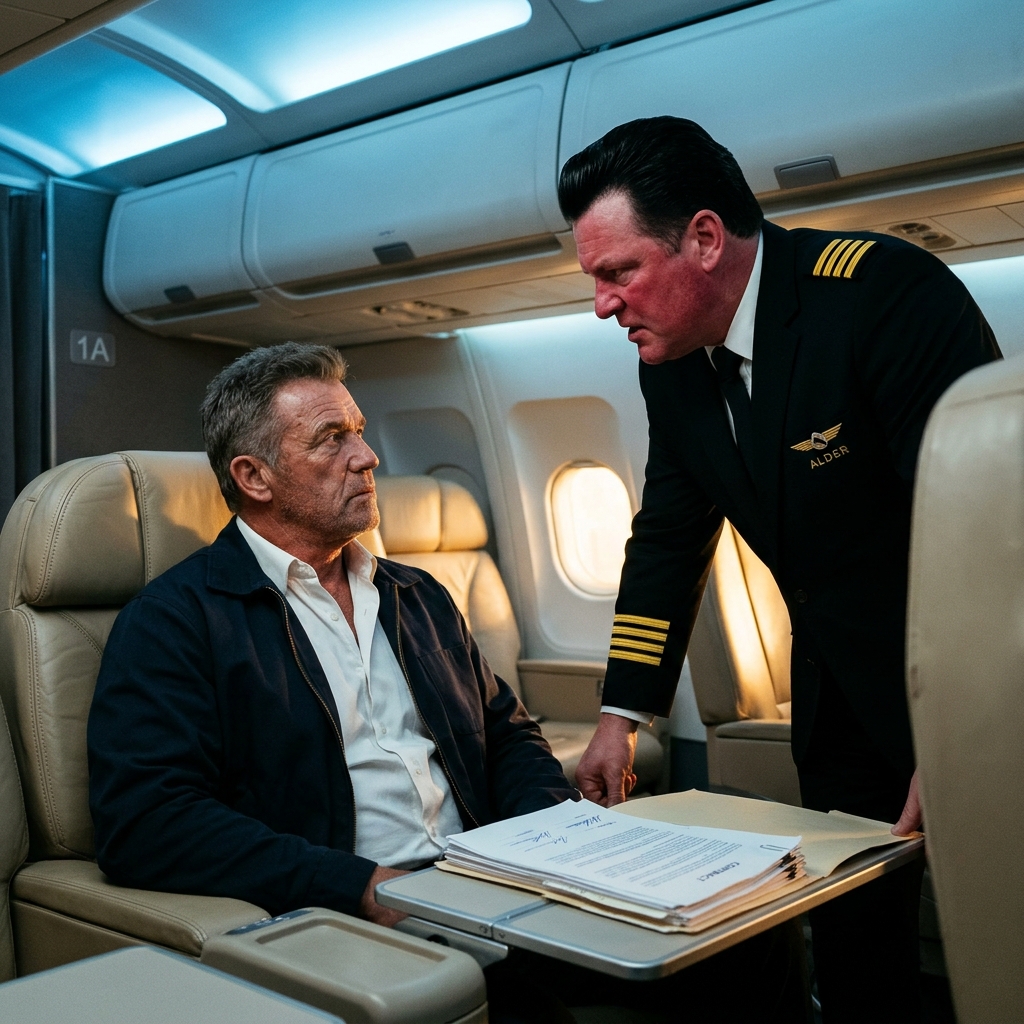
He told the story rarely. He thought about it constantly. It was in his mind on Friday evening, riding down in the elevator with fifty-one percent of an airline in his briefcase, because Gerald Fenn had said the thing that was wrong with Alder was that documents had stopped outranking seniority — which meant that somewhere in his new airline, this weekend, a Kowalski might refuse an airplane and be argued with instead of read.
He intended to find out. Not from an office. Fenn was right about offices.
Ellen’s verdict on the plan, delivered Sunday morning at the kitchen table in the house in Oak Park, with the newspaper spread between them and the coffee going the way of all coffee, was that it was sound, and that it was also familiar.
“You did this with the Tulsa hangar,” she said. “In ’97. Before we bought it. You worked their floor for a month as a contract mechanic and let their chief call you Paul and criticize your safety wiring.”
“My safety wiring was fine.”
“Your safety wiring was adequate, and their chief was right about the routing, and you knew it by the second week. That’s the point of the exercise, as I recall. A man goes and stands where the work is, with his name tag saying nothing, and he finds out what the work actually is.” She folded the newspaper to the crossword, which she did in pen, a habit Mercer had long ago decided was a form of governance. “It’s sound. It’s how you’ve bought everything worth buying. I only observe that you are sixty-three years old, you have just bought an airline, and your plan for the day before you announce it to the world is to take the train to O’Hare and ride in it anonymously like a man casing a bank.”
“One honest flight,” Mercer said. “O’Hare to Denver, Flight 108. I sit in the seat, I eat the pretzels, I watch the crew work, I write nothing down where anyone can see it. One flight where nobody knows my name means anything. Then Monday I become the boss, and every word out of every mouth I meet for the rest of my tenure is adjusted for it. Adjusted words are no use to me, Ellen. I want one hour of unadjusted.”
“And if the flight is bad?”
“Then Monday’s speech writes itself.”
“And if it’s good?”
He considered this. “Then Monday’s speech writes itself too, and better.”
She looked at him over the newspaper with the expression of a woman who had chaired ten thousand meetings and could recognize the exact moment one adjourned. “Seat?”
“1A.” He said it without embarrassment. “I bought it myself. Online, like a citizen. Andy offered to — Andy offered a number of things, and I have permitted him exactly none of them. No car, no escort, no call to the station. He knows the itinerary. You know the itinerary. The transition team knows there’s a memo about Monday and approximately nobody has seen the name in it. That’s the whole list.”
“Ticket under your own name?”
“Mercer, P. Like a subpoena.”
She nodded, and went back to her crossword, and after a moment said, to the paper, “Canvas jacket?”
“Canvas jacket. The boots are polished.”
“Of course they are. You’d polish them to fly cargo.” A pause, filled with pen strokes. “Paul. One question, superintendent to owner. Not wife to husband.”
“Ask.”
“When you’re out there in your canvas jacket with your name tag saying nothing — what are you actually hoping to see?”
He thought about Kowalski’s handwriting, like a fence. He thought about Fenn in the elevator, honest and beaten. He thought about forty years of hangars and the simple arithmetic of them: an airline was a promise kept at altitude, thirty-five thousand feet up, by people who mostly never met the people they kept it for. Alder’s people wanted to keep it. He had read a hundred internal surveys and employee letters during the diligence, and underneath the grievances — and the grievances were real, and many of them were management’s fault — ran a stubborn, unglamorous pride that the surveys couldn’t quite kill. The procedures had stopped insisting. The people hadn’t stopped wanting to.
“I want to see whether the promise is still in the building,” he said. “Underneath the procedures. I want to watch a crew work when they think the cabin is just a cabin.”
Ellen wrote in a word. “Seven letters,” she said. “‘Carrier, informally.'”
“Airline,” he said.
“I know. I was checking whether you’d gone entirely poetic on me.” She reached across the table without looking up and put her hand over his — his left, the one with the scar through the knuckle from a safety-wire pliers incident in 1985, the one that still ached before rain. “Eat something on the plane. You think better fed. And Paul — “
“Mm.”
“— if the day produces one of your documents, write it honestly.”
“It always is.”
“I know,” she said. “That’s why I don’t worry. Eat something.”
He packed the way he had packed for forty years of other people’s airplanes: as an act of respect for the machine. Carry-on only, because a man who had watched a million bags go astray professionally did not check one personally. Canvas jacket, the one with the good pockets. Work boots, polished — not vanity, care; a boot took a shine the way a logbook took ink, by being maintained. In the carry-on, on top, where he could reach it without standing: a 737 systems manual, the big one, the one with the hydraulic schematics he had loved since before some of Alder’s pilots were born. Not as a prop. For the pleasure of it. He read systems manuals the way other men read novels, which is to say slowly, with suspicion of the author, taking the machine’s side in every dispute.





