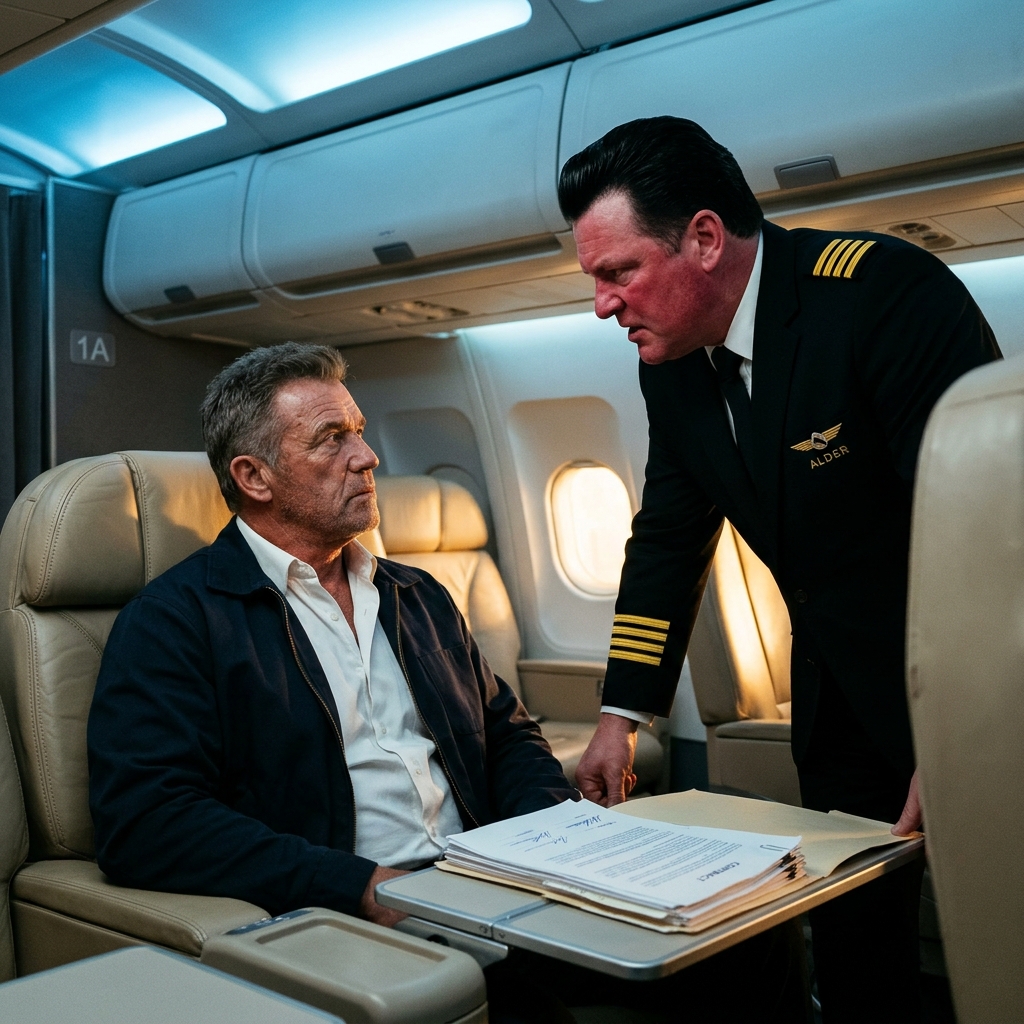
“Captain Reinhardt,” Mercer said. “Step forward.”
Reinhardt’s boots dragged against the concrete. He took three stiff, mechanical steps forward, his face pale as chalk, his eyes fixed on the floor two feet in front of Mercer’s boots.
“Read the document, Captain,” Mercer said.
Reinhardt’s throat clicked. He unfolded the pink carbon sheet with hands that were shaking so hard the paper rattled like dry leaves in the wind.
“Read it aloud,” Mercer said. “To the people who maintain the airplanes you fly.”
Reinhardt swallowed. His voice came out cracked, stripped of all its baritone authority, thin and reedy as an oboe.
“‘Passenger disruptive,'” Reinhardt read, his eyes filling with a dark, burning moisture. “‘Unvetted technical flight documentation. Refused direct safety instruction from PIC. Signed… D. L. Reinhardt, Check Airman.'”
“Now tell them about the APU,” Mercer said softly.
Reinhardt closed his eyes. A single muscle in his jaw jumped violently. “The auxiliary power unit exhaust gas temperature sensor… was drifting high during pre-flight. I bypassed the maintenance review. I cleared the fault code without an inspection.”
A collective murmur—a low, dangerous rustle of indignation—rippled through the seven hundred mechanics and rampers. Two senior inspectors near the nose gear shook their heads, their faces tightening with disgust.
“You signed off a bad sensor because you had twenty-six years on the property,” Mercer said, his voice cutting through the murmur like an axe through wet pine. “You thought your four stripes made you smarter than the thermocouple. And then you tried to throw an old man off your airplane because he was holding an operations manual that reminded you of the book you stopped reading twenty years ago.”
Mercer reached out his hand.
“The wings, Captain.”
Reinhardt froze. His breath hitched in his chest. For three seconds, he looked as though he might fall to his knees on the concrete.
Slowly, his fingers trembling, Reinhardt reached up to his left breast. The small clutch-pins on the back of his gold check-airman wings resisted for a moment, then pulled free from the navy wool with a tiny, ripping sound.
He placed the gold insignia into Paul Mercer’s open, oil-stained palm.
“You’re done as a check airman,” Mercer said, his voice completely devoid of anger, carrying only the terrifying finality of a hydraulic press. “You don’t evaluate another pilot at this airline until you’ve spent six months in the right seat of an MD-80 flying red-eyes out of Bismarck, with a first-year captain auditing your checklists. If you want your four stripes back, you earn them from the people in this room. You earn them by proving that your paper is better than their paper.”
Mercer turned the gold wings over in his hand, feeling their weight, before slipping them into the breast pocket of his canvas chore jacket.
“First Officer Alan Miller,” Mercer called out.
From the second row of the pilot formation, Miller stepped forward, his face rigid, his eyes wide with shock.
“Sir?”
“Flight 108 arrived in Denver four minutes early yesterday,” Mercer said. “You logged the APU fault with line maintenance the second your wheels touched the gate. The replacement box went in last night at midnight. You kept the promise, son.”
Mercer reached into his other pocket, drew out a small brass pin shaped like the Alder Airlines logo, and handed it to the young first officer.
“You’re on the upgrade list for the line check program starting January first. Don’t forget how to listen to the ramp leads.”
“Yes, sir,” Miller whispered, his hand closing over the brass with an intensity that looked like a prayer. “Thank you, sir.”
Mercer turned back to the seven hundred mechanics, rampers, and flight attendants who stood watching him in the cold hangar light. He looked at them for a long, quiet moment, his gray eyes taking in every pair of grease-stained hands, every pair of worn work boots.
“My name is Paul Mercer,” he said simply. “I’m an A&P mechanic out of Dayton, Ohio. I’m the majority owner of this airline. Starting today, we don’t hide behind operational. We don’t sign off ghost faults. And we don’t let a uniform outrank the truth.”
He lifted the blue Boeing systems manual in his left hand, holding it high above his head so that the sodium lights caught the worn blue vinyl.
“The paper is the truth,” Mercer said, his voice echoing out into the cold Colorado morning, solid, unbreakable, and absolute. “Everything else is just an opinion wearing a uniform. Now let’s get back to work.”





