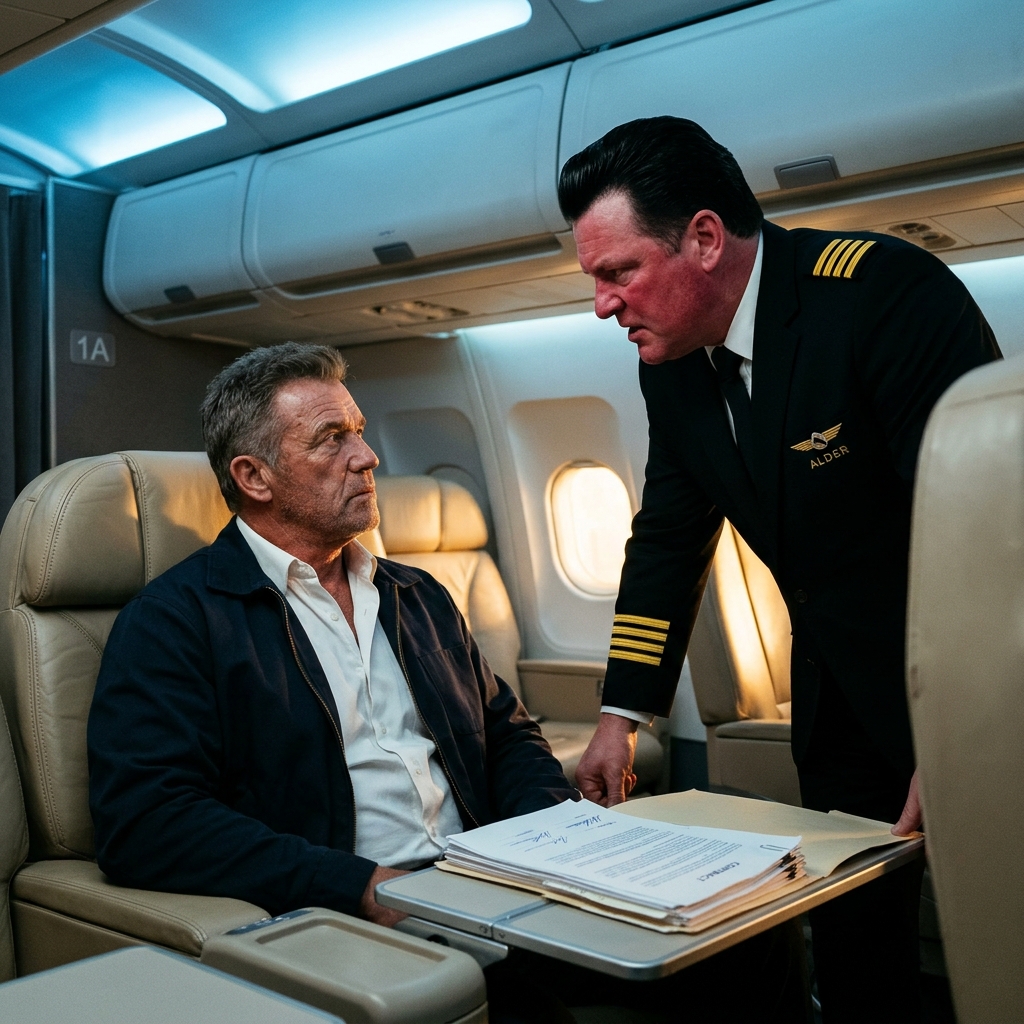
Andy Cho called at seven with the weather in Denver (clear, windy), the aircraft assignment for Flight 108 (a 737-800, tail number ending in 47, eleven years old, no open write-ups — Andy had checked, in the one act of diligence Mercer permitted the office, because Andy checked tail numbers the way other assistants checked spelling), and one last attempt at a car service, offered in the tone of a man fulfilling a contractual obligation to try.
“For the record, sir, the town car — “
“For the record, Andy, the Blue Line. I have a Ventra card and a lifetime of opinions about ground transport. What time does the board say?”
“On time. Gate C19. Boarding at nine-forty for a ten-twenty departure.” A pause of a distinctly executive-assistant character. “Sir. Gerald Fenn’s office called twice this weekend. About the announcement photography.”
“Tell them Monday.”
“I’ve told them Monday three times. They find Monday very abstract.”
“Then tell them Monday is the most concrete day of the week. It arrives whether they’re ready or not.” He could hear Andy writing that down, God help him, probably to use it. “Andy. Thank you. For the discretion. I know sitting on a name is not your favorite sport.”
“It’s becoming a specialty, sir. Have a good flight. Whoever you are today.”
The train ride out was forty-five minutes of the city going past at window height, and Mercer rode it like a citizen, which is to say like a man being given a gift he was too well trained to refuse: time in public, unobserved. A woman across the aisle read a paperback with its cover folded entirely back, a violence he had never been able to commit against a book. Two kids in Alder uniforms — ramp agents, by the boots and the gloves stuffed in back pockets — rode three stops and got off at Rosemont arguing cheerfully about a bid schedule. He listened to them with the pleasure of a man hearing his own language spoken by natives. Their complaints were precise, professional, and aimed almost entirely at a scheduling computer. The people were fine. The tools had stopped insisting. He was becoming repetitive, and he permitted it, because repetition was how you knew a thought was load-bearing.
O’Hare at nine on a Sunday morning was a city holding its breath between banks of departures. Mercer came up out of the station into Terminal 1 and stood a moment with his carry-on at his feet, doing what he had done in every airport for forty years: reading it. Not the architecture. The operation. The place ran on documents believed or disbelieved, and you could see it in the first ninety seconds if you knew where the paper lived.
He saw a check-in line moving at the pace of a single tired agent doing three jobs kindly — the kindness costing her nothing she wasn’t willing to pay, the three jobs costing the line plenty. He saw two Alder departures on the board with delays explained as *operational*, a word he had banned in his own maintenance organization in 1999 for the crime of meaning anything, and he noted the vagueness the way his young self had noted a loose panel fastener: not a failure, a symptom. Somewhere behind that word were two specific airplanes with two specific stories, and a company that had got out of the habit of telling them, even to itself.
The agent who took his boarding pass at the security checkpoint smiled the real smile of a person who liked the morning end of the job. The gate agent at C19, a woman in her fifties with reading glasses on a beaded chain and the contained air of a field commander, processed his boarding group with an efficiency that needed no announcement, and when Mercer stepped up in his turn she scanned his pass, glanced at the name the way she’d glance at weather — professionally, without interest — and said, “Have a good flight, Mr. Mercer,” with no more weight on the name than on the weather.
It was, he thought, one of the most satisfying sentences anyone had said to him all weekend.
He bought coffee from a kiosk where the young man behind the counter was training a younger man, and listened with half an ear to the older one explain the register, the milk, the order of operations — *ticket first, then the drink; the paper tells you what the cup is supposed to be* — and Mercer, who had built a philosophy out of exactly that sentence in another material, tipped two dollars on a four-dollar coffee and carried the small warmth of it to a seat facing the window.
The airplane sat at C19 in the strengthening light, eleven years old and honest about it. He read it the way he read all aircraft: with respect, and from the tail forward. The paint was tired at the radome. The engines’ inlet lips were clean. Through the terminal glass he could watch the turnaround as an audience of one — fuel truck off, catering on, a belt loader that stayed politely at its distance until the loader operator got the wave, cargo doors closed in the right order and dogged down with the handle checked twice by a ramper who then did a thing that made Mercer set his coffee down and watch with his whole attention.
The man walked the length of the cargo compartment sill with his hand trailing on the structure. Feeling. Looking for what the eye, in a hurry, would call fine.





