The gate agent was a woman in her late fifties named Marian, her plastic name badge anchored to her lapel with a gold twenty-year service pin. She was working the podium alone, her reading glasses dangling from a beaded chain around her neck. She had the brisk, unhurried air of an infantry non-com who had seen every possible variation of human misery and remained polite out of sheer professional pride.
Before Mercer could join the line, an older man in an expensive camel-hair coat pushed past the stanchion, his face flushed scarlet, thrusting a cracked smartphone into Marian’s face.
“My app says the gate changed to B4,” the passenger barked, his voice vibrating with that high, brittle indignation common to executives whose schedules have slipped. “Then it said C19. Now the app won’t even refresh! Is this flight going to Denver or am I sitting in Chicago until tomorrow? I have a board meeting at four!”
Marian did not flinch, did not pull back, and did not raise her voice. She reached out, gently took the man’s boarding card from his trembling fingers, and laid it flat on the laminate counter. With her right hand, she keyed four strokes into her terminal. The mechanical dot-matrix printer beside her chattered for two seconds, spitting out a crisp white paper pass.
She took a red pen, drew a single clean circle around the printed departure time, and slid the paper toward him.
“Gate C19, Mr. Doyle,” she said, her voice dropping into a register that was calm, definitive, and impossible to argue with. “Aircraft 47 is at the jet bridge right now. The bags are loading. Here is your seat: 4B. The paper is the truth, sir. The telephone is just an opinion.”
The passenger blinked. He looked down at the circled ink, his chest deflating, his mouth opening and closing once before he managed a clipped, sheepish nod. “Thank you,” he muttered, taking the slip.
Mercer, standing ten paces back, felt something uncoil inside his ribs.
The paper is the truth. The telephone is just an opinion.
God almighty, they still had a few. You could run an empire on women like Marian, if you had the sense to keep the vice presidents out of their way.
When his turn came, Mercer stepped up, his canvas bag slung over his left shoulder. He handed over his boarding pass—MERCER, P.—printed on cheap cardstock at a self-serve kiosk. Marian scanned the barcode. The laser chirped. She glanced at the name, then at his faded canvas jacket and the polished work boots, her eyes flicking up to his weathered face for a fraction of a second without a ripple of recognition.
“Seat 1A, Mr. Mercer,” she said, handing the slip back with an effortless, professional smile. “Front row on the left. Enjoy your flight to Denver.”
“Thank you, ma’am,” Mercer said. He meant it with an intensity that clearly surprised her; she held his gaze for a second longer than usual, sensing the gravity behind the words, before turning with practiced grace to the next passenger in line.
Down the ribbed rubber tunnel of the jet bridge, the air grew sharp with the familiar bite of cold jet exhaust and hydraulic fluid. At the forward galley door, Mercer paused, his hand instinctively coming out to rest against the fuselage skin just forward of the door frame.
Boeing 737-800. Tail number N472AL.
His fingertips read the airframe through the paint. The cold aluminum was smooth, the flush rivets clean, no bubbling along the lap joints that might suggest corrosion from galley spills. He looked down into the narrow gap between the bridge threshold and the cabin sill: the sill plate was scuffed down to bare metal, but the fastener heads were seated true, without the telltale reddish-brown dusting of fretting fatigue. The ground crew was doing their work.
“Watch your step, sir,” the purser said.
Her name was Rachel Brooks, according to her silver badge. She was forty-ish, with hair pulled back into an immaculate regulation twist and dark circles under her eyes that had been carefully powdered over. She had the sharp, assessing gaze that cabin crew develop after ten thousand hours—a rapid, unconscious triage that cataloged passengers within two seconds of entry: nervous flyers, drunks, potential medical emergencies, and people who would struggle with the overhead bins.
Mercer smiled, stepping inside. “Morning. Looks like a full house.”
“Every seat, sir,” Rachel said, her smile tight but warm around the edges. “First row is right there on your left. Let me know if you need help with that duffel.”
“I’ve got it, thank you.”
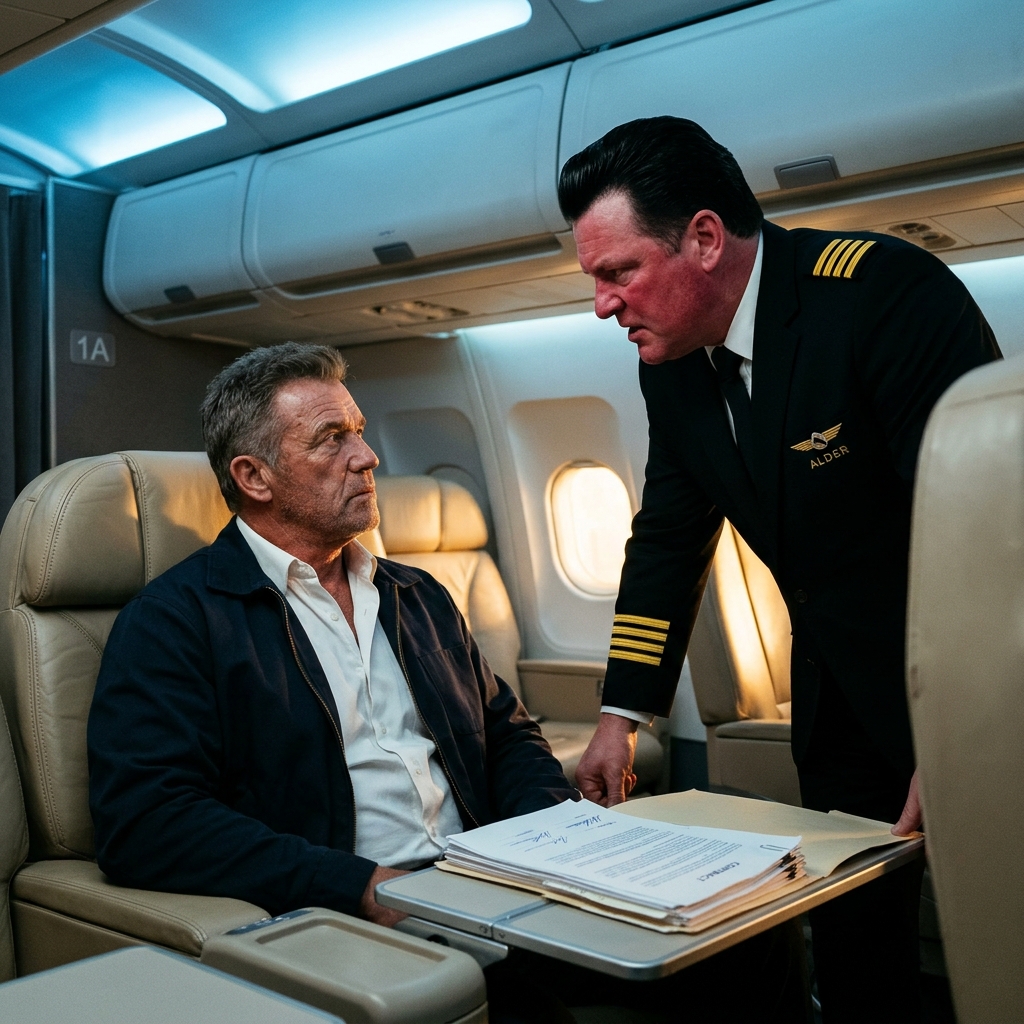
Seat 1A was the blue leather armchair immediately behind the forward bulkhead. Mercer swung his canvas bag into the overhead bin, keeping the thick Boeing systems manual in his hand, and sat down. The leather was worn along the piping, but the seatbelt webbing was crisp, the buckle latch snapping shut with a solid, mechanical clack.
He placed the manual flat on his thighs, his hands resting on the blue vinyl cover.
From this vantage, separated from the open cockpit door by six feet of carpet and a drawn curtain of navy polyester, the flight deck was completely visible. The flight crew was in the middle of their pre-departure choreography, illuminated by the pale greenish glow of the multi-function display units.
Captain Douglas Reinhardt sat in the left seat.
Mercer recognized him before he saw the name on the dispatch sheet. Douglas Reinhardt was a legend within Alder’s pilot union—twenty-six years on the property, senior line check airman, four gold stripes thick as ribbons on his sleeves, and a face that looked as though it had been carved out of salt cured pork. He had an iron-gray crew cut, a nose that had been broken in some long-forgotten college rugby match, and the rigid, unyielding posture of a man who believed the sky was a hostile territory that could only be mastered through sheer personal authority.





