Mercer had taught that walk to a hundred mechanics. *The airplane talks with its skin first.* Somewhere in Alder’s system, somebody had taught it to this ramper, and the teaching had survived whatever the procedures had stopped insisting. The bones were good. He had known it from the diligence. It was different to know it from a plastic chair with coffee: the sort of different that had made him buy the ticket.
While he waited, the gate produced its small human weather. An elderly man in a good coat arrived at the podium at a near-run, breathing hard, waving a phone with a dead screen, convinced — loudly, the way frightened people are convinced — that his flight to Denver had been canceled and rebooked and canceled again. The field commander did not argue with the volume. She took his name, typed once, and turned her screen a careful three inches toward him, so he could read the truth with his own eyes instead of taking it on faith: one flight, this flight, on time, his seat on it, his name spelled the way his mother had spelled it. “There it is, Mr. Doyle,” she said. “In writing. Writing doesn’t get excited.” The old man subsided like a tide going out, thanked her four times, and sat down hard in the row across from Mercer with the expression of a man returned from a country he had not meant to visit.
Mercer watched it with professional tenderness. That was the whole craft, right there, in miniature, at a podium in Chicago on a Sunday morning: a frightened person, a document, and someone willing to let the document speak first. The agent could not have picked him out of a lineup; she had no idea that the man with the coffee and the systems manual had just watched her do, unobserved, the thing he had bought an airline hoping still to find. He found himself wanting to say something to her, and forbade it. Unadjusted words. That was the discipline. A compliment from a stranger in a canvas jacket would land as noise; she would be polite, and forget it, and that was exactly as it should be. He would save his sentences for Monday, when they would weigh what they weighed, and let Sunday belong to people who didn’t know his name meant anything.
The PA offered the flight’s first boarding group, then, like a held door.
They called the flight in groups, the field commander at the podium reading the liturgy in the order written, and Mercer boarded with the first group, because 1A had cost what 1A cost and he had never in his life pretended otherwise than to enjoy a bulkhead’s legroom like the labor leader’s son he was not. Down the jet bridge — the smell of it, kerosene and cold air and the rubber of the accordion walls, a smell that had been home to him longer than any house — and at the aircraft door the purser met him with the greeting her training prescribed and her own warmth amended: a woman in her forties, composed, her eyes doing the swift professional inventory that cabin crew do of every face at the door.
“Good morning, sir. Welcome aboard.”
“Good morning,” Mercer said. “Fine morning for it.”
“Every morning’s fine for it if the coffee holds out,” she said, and stepped aside with the small practiced gesture that turns a doorway into a welcome.
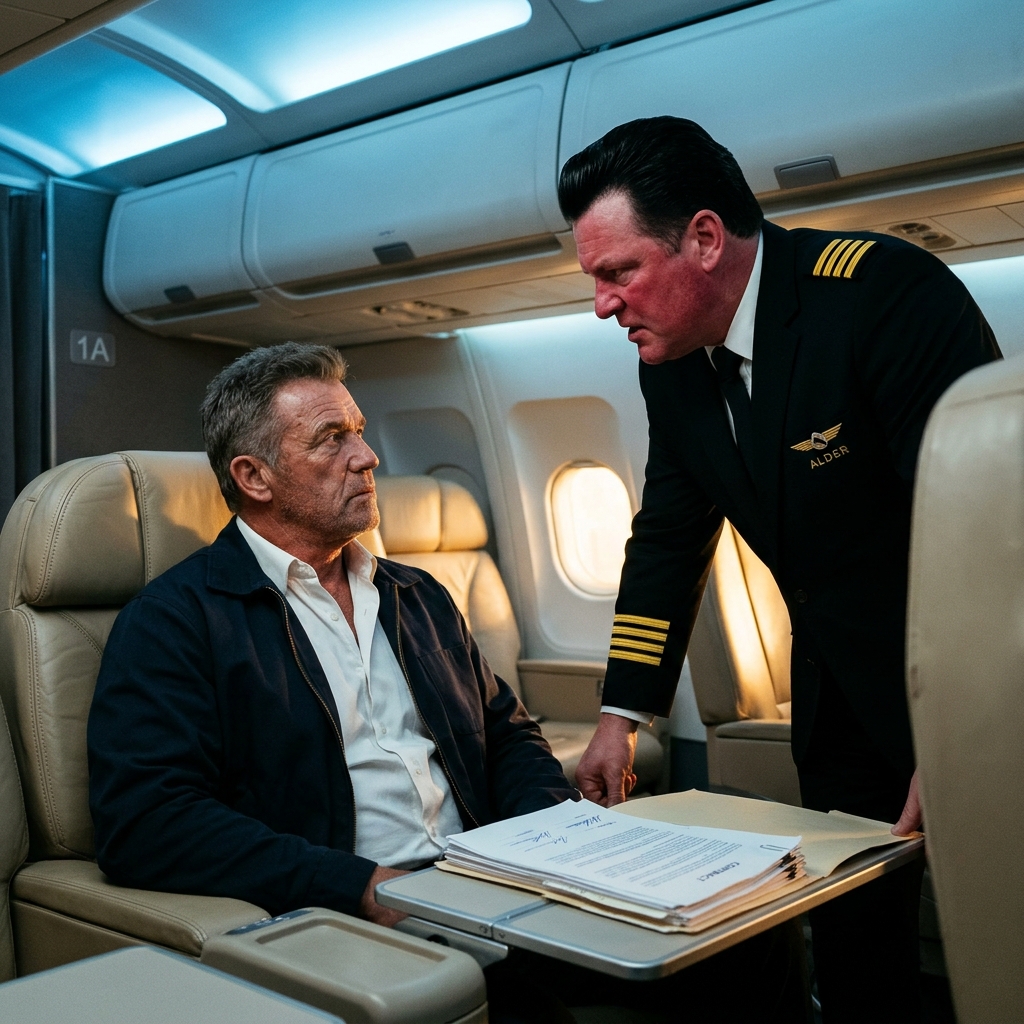
1A was the window, front row, bulkhead at his knees, the whole aircraft arranged behind him like an argument he hadn’t heard yet. He stowed the carry-on — systems manual uppermost, where it belonged — and settled into the seat with the uncomplicated contentment of a man exactly where he had paid to be, on an airplane he now half owned, among people who did not know it and were therefore the only honest company in the world.
Behind him the cabin filled with the ordinary music of boarding: bags, apologies, the soft collisions of strangers arranging to be patient together. Up front, beyond the curtain, he could hear the flight deck at its work — the murmur of a checklist being read by two voices, the click and test of things being asked questions and answering. His own people. His own airplane. In less than an hour they would close the door and take the promise up to altitude, and he would learn what his fifty-one percent actually consisted of.
Mercer folded his hands over the manual in his lap, and looked out the window at his airline going about its morning, and was entirely content.
He did not hear — could not have heard, through the bulkhead and the curtain and the boarding music — the first officer come down the jet bridge at a pace just short of a run, with a dispatch release in one hand and an expression beginning to arrange itself around an opinion. He did not see the captain take the release, and read it, and look up from it through the cockpit window at the gate, at the terminal, at nothing in particular — the way a man looks when a fact has been placed in front of him and he has begun, already, to decide what he thinks of the man sitting in seat 1A.
The captain had begun to form his opinion. The flight had not yet begun to form its answer.





