Beside him in the right seat was First Officer Alan Miller—thirty-two, fresh-faced, with the pale, slightly hollowed look of a regional transfer who had spent five years flying fifty-seat regional jets out of Milwaukee before making it to mainline Boeing equipment. Miller was sweating lightly in his starched white shirt, his fingers flying across the Flight Management Computer keypad, cross-checking departure waypoints against the paper flight plan clipped to the control yoke.
Reinhardt did not use the FMC with any urgency. He sat with his arms crossed over his chest, his cap tipped slightly forward, watching Miller work with the cold detachment of a schoolmaster waiting for an errant pupil to drop his slate.
“Route is O’Hare six departure, Iowa City, Des Moines, Omaha, Lincoln, then the Platte arrival into Denver,” Miller said, his voice clipped, reciting the clearance. “Cruising level three-six-zero. Fuel on board is twenty-four thousand two hundred. Zero fuel weight is one-one-eight-point-four.”
Reinhardt didn’t look at the paper. He tapped the glass of the center display with a thick, blunt fingernail. “Did you check the de-icing holdover tables for Denver?”
“Denver’s reporting forty-two degrees, Captain. Light rain, but the freezing level is well above the pattern.”
“I didn’t ask what the pattern was,” Reinhardt said, his tone flat, dropping through the open cockpit door into the galley like lead shot into a bucket of water. “I asked if you checked the tables. If we get held at the outer marker and the temperature drops two degrees behind that front, you don’t guess. You look at the paper. I don’t fly on guesses, Miller. I fly on numbers.”
“Yes, sir. I have the tables right here.”
A sharp knock rattled the cockpit doorframe.
A ramp lead in an orange high-visibility vest stepped into the galley, clutching an aluminum clipboard. His hair was plastered to his forehead with sweat despite the forty-degree morning.
“Captain? Line maintenance write-up on the APU.”
Reinhardt didn’t turn around. He adjusted the mirror on his side window. “What about it?”
“The auxiliary power unit exhaust gas temperature sensor is drifting high during start-up. We had a transient fault code when we ran the pre-departure test at Gate C12 before tow.”
Miller froze, his fingers hovering over the flight plan. He looked toward the ramp lead, then over his left shoulder at Reinhardt.
Reinhardt slowly unfolded his arms, reached out, and plucked the maintenance log from the ramp agent’s hands. He flipped the carbon pages with a thumb that showed a heavy gold signet ring.
“The APU is running right now,” Reinhardt said, pointing out the forward windscreen at the ramp below. “The cabin has air. The packs are online. The bleed pressure is thirty-two PSI.”
“Yes, sir,” the ramp lead said, shuffling his boots on the galley threshold. “It’s running fine now. But the sensor spiked to seven-hundred degrees during the ignite cycle. Shift supervisor says if it trips again after pushback, you’ll lose cabin cooling during taxi, and if you have to restart it on the roll, it might lock out.”
Reinhardt drew a pen from his breast pocket. He did not call maintenance control in Denver. He did not consult the Minimum Equipment List manual sitting on the floorboard behind his seat.
“The unit was overhauled in Tulsa two months ago,” Reinhardt said, his voice smooth, impenetrable. “I know this airframe. The 47-series birds always run hot on the initial bleed transfer when the ambient humidity is high. It’s an instrumentation ghost. Sign it off under deferred observation. Code three.”
“Captain,” the ramp agent began, his voice tightening. “The book says if the sensor trips outside tolerance twice in twelve hours, we pull the box—”
“The book,” Reinhardt interrupted, his voice dropping an octave, heavy with twenty-six years of unbroken authority, “is written for people who don’t know how to operate an airplane. I’m the pilot in command. I decide if this aircraft is airworthy for departure. You sign the release for gate push, or I call your station manager down here and we can explain to the tower why two hundred people are sitting at C19 while you argue about a thermocouple.”
The ramp agent’s throat moved as he swallowed. He stood there for three seconds, his boots glued to the galley floor, the aluminum clipboard shaking slightly in his grip. He looked at the first officer. Miller kept his eyes locked onto his flight bag, his jaw clenched, staring straight ahead through the glass.
The ramp lead took the clipboard back. “Your call, Captain,” he whispered, scribbling a jagged signature across the bottom of the pink sheet. He tore the carbon copy off, thrust it toward Reinhardt, and turned on his heel, disappearing down the jet bridge without another word.
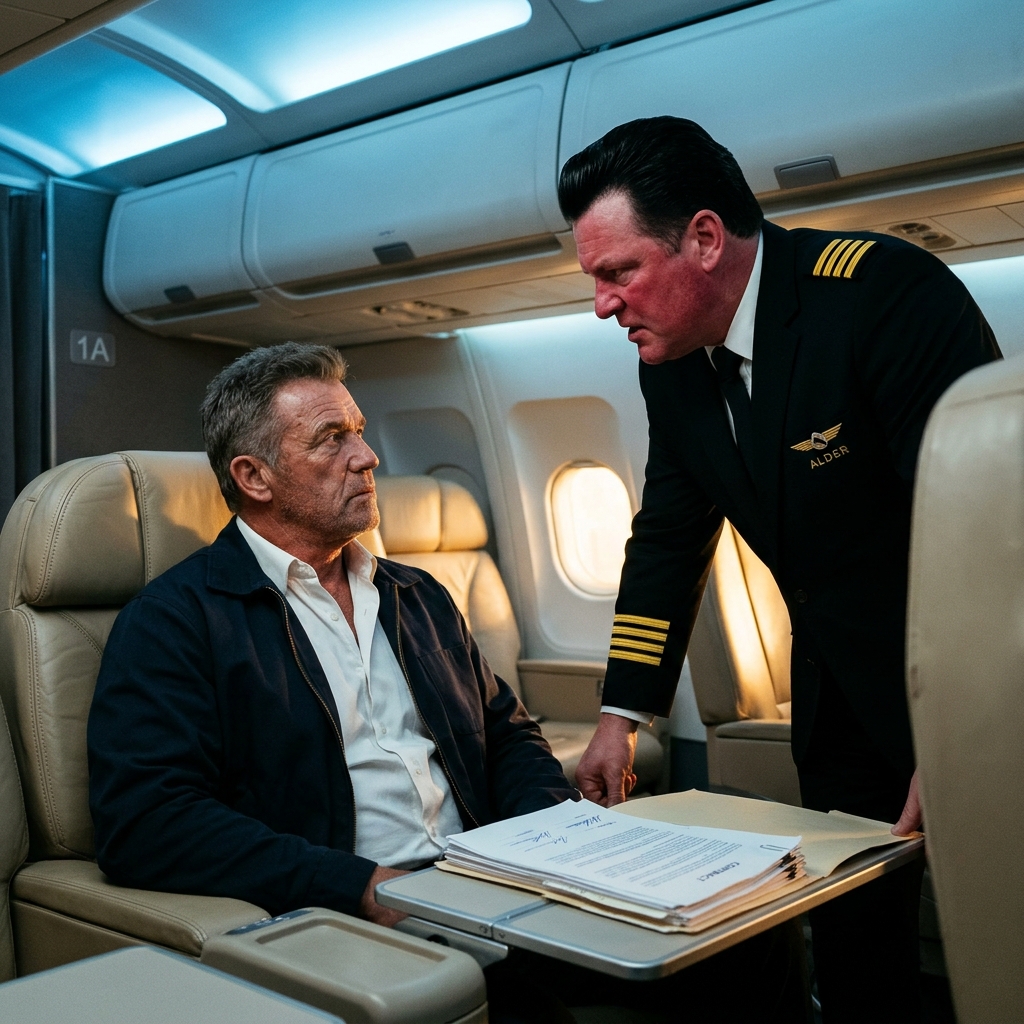
In seat 1A, Mercer slowly closed his hands over the blue cover of the Boeing manual.
His face did not move. He did not shift in his seat. But inside his chest, forty years of hard-won mechanical certainty curdled into something cold and lethal.
Fenn had been right. Seniority was eating the company alive. An auxiliary power unit was not an academic debate; if the EGT sensor was drifting, the thermocouple was either contaminated or the burner can had cracked along the seam. To clear a transient thermal fault with a stroke of a pen simply because you had four stripes on your coat was not airmanship; it was criminal vanity.
Reinhardt folded the pink carbon sheet, creased it with his thumbnail, and tossed it onto the center console between the thrust levers. He didn’t log it in the aircraft journey book. He simply tossed it down like a used diner receipt.
Then the captain turned his head.
Through the narrow opening between the doorframe and the curtain, Reinhardt’s eyes swept across the forward row of First Class. He saw Mercer.





