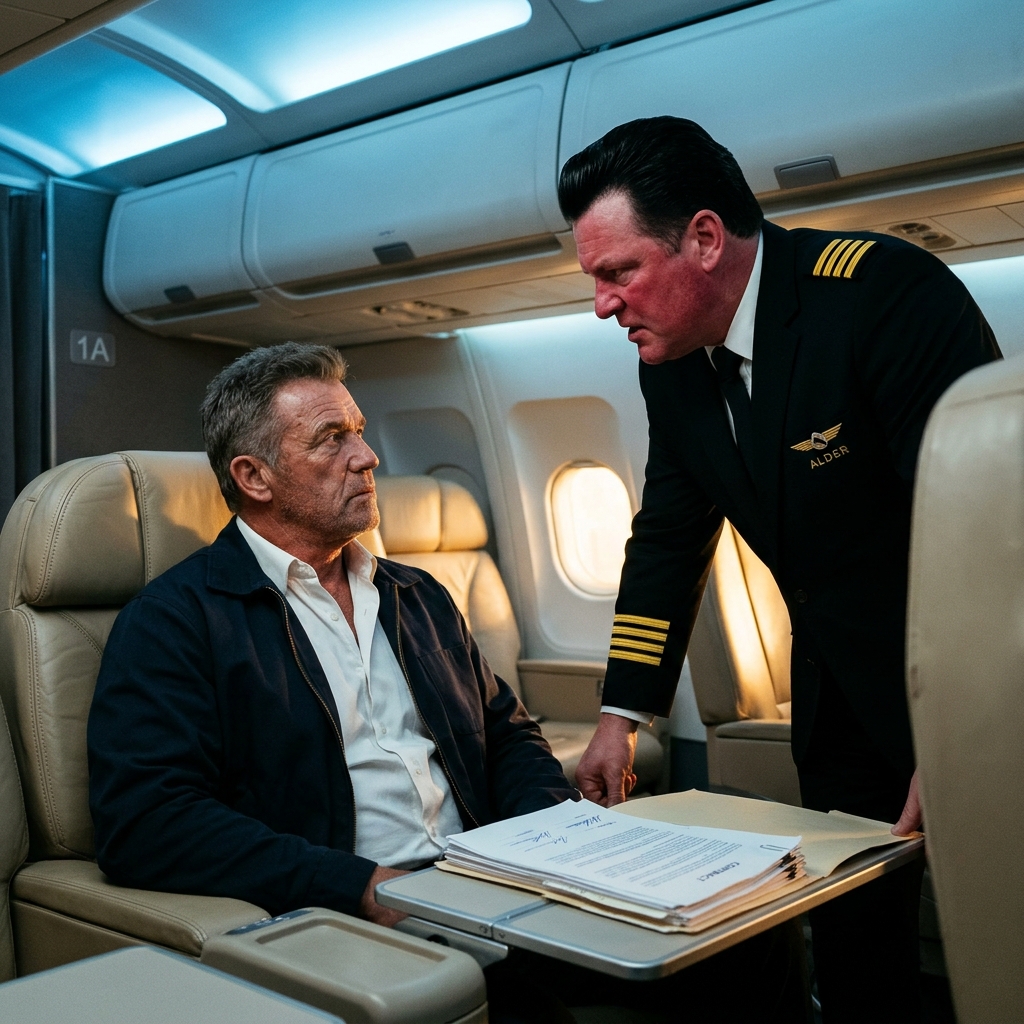
The flight deck of the 737 was still dark in the particular way of a place that had been slept in by machines, and Douglas Reinhardt liked it best at this hour, before the day had put its fingerprints on anything. He came up the jet bridge stairs with his flight bag in his left hand and his hat in his right, the way he had done for twenty-six years at Alder Airlines and four years at the carrier before that, and he paused at the cockpit door — not sentimentally, he would have said, but in the manner of a man checking a room he intended to be responsible for. The seats were cold. The screens were black mirrors. Somewhere behind the panels the airplane was awake in the low, electrical way of a house before its people rise, and Reinhardt set his bag down in the left seat’s footwell, hung his hat on its hook, and began.
His preflight was a liturgy, and he made no apology for the word when younger pilots used it about him, usually in the crew room, usually with respect wearing the clothes of teasing. He worked from the overhead panel down, left to right, top to bottom, in an order he had not invented but had refined across thirty years until it had the finished quality of a signature. Fuel pumps. Hydraulics. Electrics. Air. His hand moved and his voice followed it half a breath behind, quiet, unhurried, naming each switch position aloud — not for an audience, because for the first ten minutes there was no audience, but because he had learned long ago that a thing said aloud had been done twice, once by the hand and once by the mind, and the mind’s copy was the one that stayed with you at altitude when the hand was busy elsewhere.
The last signature went down at 4:40 on a Friday afternoon, in a corner conference room on the thirty-eighth floor of a granite tower on LaSalle Street, and it made almost no sound at all.
Paul Mercer had always liked that about paper. A wrench made noise; dropped onto the wet concrete of an unheated hangar in February, it made a sharp, clattering racket that bounced off corrugated steel and got into your teeth. A rivet gun made a great deal of noise, hammering against an aluminum skin until your wrists hummed for hours after the shift whistle blew. But the truly consequential things in a man’s life arrived quietly, on cold bond paper, in rooms where the wool carpet swallowed your footfalls.
The lease on his first two-bay shed at Dayton in 1989. The second mortgage that had nearly crushed him during the 1994 winter freeze. The marriage license, which Ellen had framed over his embarrassed protests and hung squarely beside the refrigerator, where it had watched him drink black coffee every morning for thirty-one years and where he would have missed it like an amputated limb if anyone had ever dared take it down.
Now this. Forty-one pages, stapled once at the upper left, bound in blue leatherette, followed by eight tabs of technical exhibits detailing airframe cycles, deferred maintenance logs, and pension allocations.
Mercer drew his pen across the buyer’s line. He used the plain blue Parker ballpoint his legal counsel, Marcus Vance, insisted upon, because in the eyes of bankruptcy courts and probate judges, wet blue ink proved a living hand had touched an original.
Across the mahogany table, Gerald Fenn signed for the sellers. The departing chief executive of Alder Airlines set his silver rollerball down with exquisite slowness, then slumped back against the glove-leather chair like a laborer who had spent six years hauling wet river gravel up an endless flight of stairs and had just dropped the hod.
“Well,” Fenn said, the word wheezing out through dry lips. “That’s done.”
“That’s done,” Mercer agreed.
The architecture of the sale was clean enough to state in a single breath, which was the only way Mercer permitted his business to be constructed. Mercer Aviation Group—the maintenance, repair, and overhaul empire he had assembled over four decades, bolt by bolt, until it spanned twenty hangars across Dayton, Tulsa, and San Salvador—was taking a fifty-one percent controlling interest in Alder Airlines through a clean holding company. The remaining forty-nine percent stayed with the legacy stakeholders: two institutional pension trusts, an anxious regional bank out of Milwaukee, and a scattered tail of eleven hundred current and former employees who had bought stock during the carrier’s golden years in the late nineties.
Mercer took operating control. He took the board, the capital budget, and the absolute authority to hire and fire the managers who hired and fired everyone else. The pension trustees got an owner who actually knew what an engine fire tasted like, and the bankers got forty million dollars in liquid working capital injected into an escrow account at Northern Trust. The attorneys understood the trade best of all, which was why their itemized invoice would arrive by courier before noon on Monday.
Alder was a thirty-year-old carrier flying out of Chicago. It ran an aging fleet of seventy-two Boeing 737s into forty-odd secondary cities across the Midwest and the Mountain West, running its operational hub out of Denver and keeping its administrative headquarters in a glass-and-brick box near O’Hare. It had good bones. Mercer had spent eleven months crawling through its technical entrails with the predatory thoroughness of an FAA field auditor: dispatch reliability records, fleet-wide cycle-to-age ratios, avionics service bulletins, and the precise, damning trail of Minimum Equipment List deferrals.
The airframes were sound. The skin had been washed, the spar caps were intact, and the heavy checks in Tulsa had been done by the book. But the flesh was exhausted. A decade of defensive, boardroom management had taught two thousand pilots, mechanics, and dispatchers that the corporate definition of survival was adequate. And an airline that aims at adequate, Mercer knew down in his marrow, is simply an airline quietly rehearsing for the day it kills someone politely.
Fenn walked him out to the elevator vestibule. Behind them, through the frosted glass, four junior associates were already busy sliding closing documents into red-rope accordion folders, billing fifteen dollars a minute for the privilege of packing. Fenn looked all of his sixty-six years—graying at the temples with that particular parchment-dry pallor that comes from living under fluorescent troffers and drinking lukewarm diet soda out of vending machines. He was an honorable man who had spent six years being slowly digested by his own committees. Mercer had respected him enough to pay a fair price instead of carving him up in chapter eleven.
“Communications has a package ready for Monday morning,” Fenn said, his hand resting on the marble casing of the elevator shaft. “Press release goes out over the wire at six central. A photo call in the hangar at Denver. Your profile: the line mechanic who bought the fleet. It’s a good piece, Paul. God knows it’s the only clean piece of press we’ve had since the fuel-hedging disaster.”
“We’ll do the announcement,” Mercer said, his voice quiet, steady, carrying the gravel of forty winters on the tarmac. “Denver, nine sharp. The senior staff meets at ten. Then I start listening.”
Fenn let out a dry, rattling laugh that had no humor in it. “Listening. Let me offer you one last piece of executive diligence, Paul, free of charge, since my equity cashed out ten minutes ago and I don’t owe anyone an answer. The mechanics are fine. The dispatchers are fine. What isn’t fine is the uniform.”
Mercer lifted his eyes. “The flight deck?”





