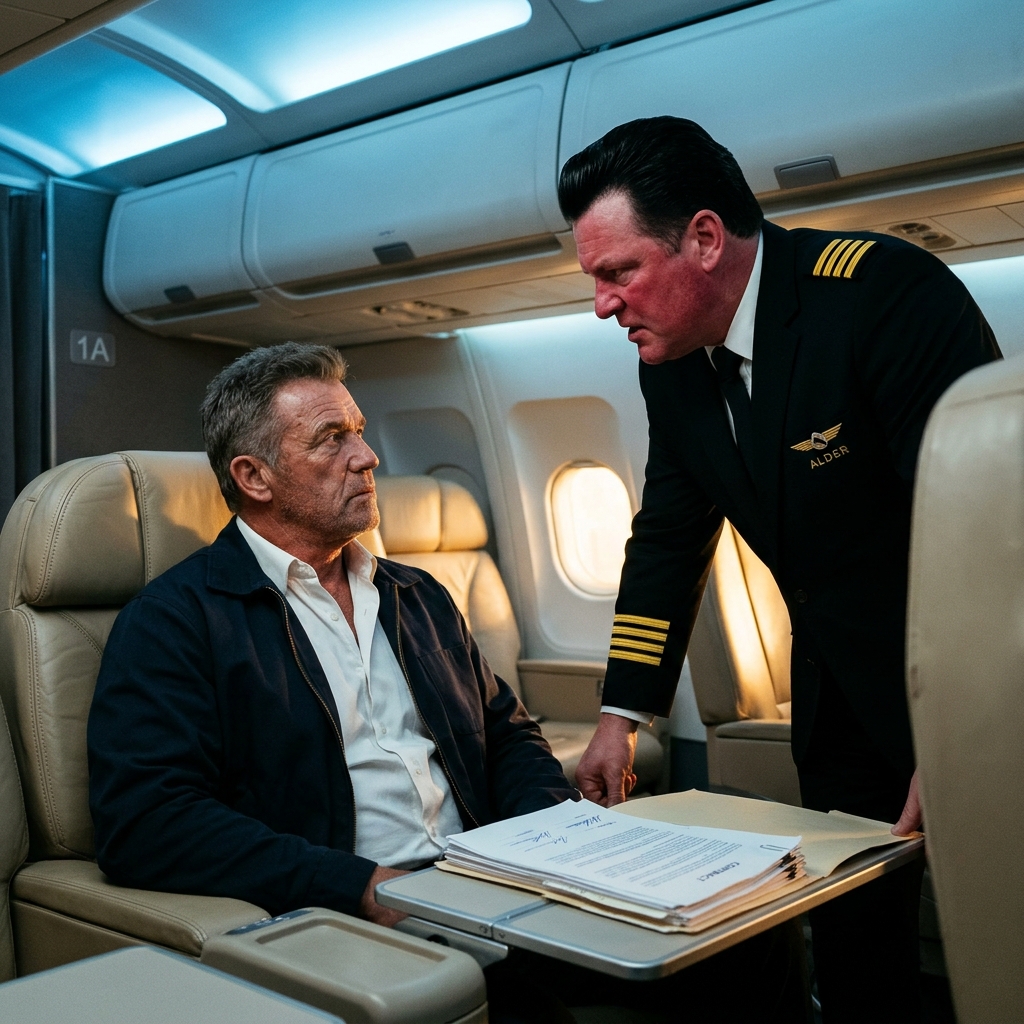
“The flight deck,” Fenn said softly. “We built an empire on seniority thirty years ago, and then we let the seniority rot into an autocracy. At this airline, a fourth stripe outranks the flight operations manual. A captain with twenty years on the property doesn’t get his fuel calculations audited; he gets his fuel calculations cleared. If an inspector questions a departure log, the union files a grievance over flight-deck sovereignty. I tried to dismantle that from the corner suite for six years. You want to know what I found out?”
“Tell me.”
“You can’t fix it from an office. The moment you walk onto the property with an executive badge, the truth packs its bags and goes home. The paper gets sanitized, the ramp managers put on their clean coveralls, and every captain gives you a ten-thousand-hour smile.”
The elevator chimed, a bright, electronic tone, and the stainless-steel doors parted. Fenn offered a dry palm. “Good luck, Paul. You bought a promise. I just hope you can find anyone left who remembers the words.”
“They remember,” Mercer said, closing his rough hand over Fenn’s. “Someone just has to make them read the page.”
The train ride out to O’Hare on Sunday morning was forty-five minutes of cold blue autumn light sliding over gray row houses and industrial sidings.
Mercer rode the Blue Line in an eight-year-old Carhartt canvas chore jacket, its brown duck fabric faded to the color of wet timber, the cuffs lightly frayed where they met his wrists. His heavy Red Wing boots were clean, polished with neutral wax until the leather showed a dull, honest luster; a work boot took a shine the same way an aircraft spar took grease—not for show, but to keep the weather out. Under the seat between his knees, he held an olive-drab canvas bag. Tucked in the top zippered compartment, where his fingers could find it without unbuckling the flap, was an original 1998 Boeing 737-300/800 Flight Crew Operations Manual, its thick vinyl binder heavy with circuit diagrams and hydraulic schematics he had committed to memory before half the current line pilots were out of primary training.
Ellen had watched him dress that morning over the kitchen table in Oak Park, her fountain pen poised over the Sunday crossword.
“You’re doing the Tulsa dance,” she had noted without looking up. “1997. You took three weeks of contract graveyard shifts on the line before you signed the lease, just to see if their chief inspector was actually inspecting the hydraulic lines or just signing the yellow tags.”
“Their chief was skipping the secondary O-rings on the return valves,” Mercer had replied, buttering half a slice of rye toast. “Saved seven minutes an engine and cost three thousand dollars in hydraulic mist every forty cycles.”
“And you made him replace forty-two seals by hand before you let him keep his job.” She had turned the page with a crisp snap of paper. “I don’t object to the field work, Paul. You’re sixty-three. You own the fleet. And you’re taking a commuter train to your own airport to ride coach like a private investigator.”
“First class,” he corrected mildly. “Seat 1A. I paid four hundred and twelve dollars of my own money on the public website. Andy wanted to flag the reservation. I told him if he touched the company manifest, I’d have him working tool-crib inventory in San Salvador by Wednesday.”
Ellen had lowered her glasses, her gray eyes sharp, steady, and utterly unimpressed by the seventy-two aircraft he now owned. “What are you looking for, Paul?”
He had paused, his thumb rubbing the scar across his left knuckle—the silver seam left behind by a slipping pair of safety-wire pliers thirty-five years ago.
“I want to see what they do when they think nobody is keeping score,” he said. “Fenn says the uniform has forgotten the document. If an airline stops believing its own paper, the metal is just an accident waiting on an altitude.”
Now, coming up the escalator from the subway station into Terminal 1, the familiar smell took him by the throat: vaporized Jet-A, cold concrete, industrial floor wax, and the dry, recirculated heat of a massive public terminal. It was a smell that had meant home to him since he was nineteen years old, carrying a tin toolbox into the night shifts at Dayton.
He stood near the departures monitor, leaning against a round concrete pillar, watching his airline breathe.
To the untrained eye, Alder Airlines looked like any other regional operation: crowds shuffling through the stanchions, blue carpet worn bald near the ticket counters, gate agents in navy-and-gold blazers tapping into monochrome terminal monitors. But Mercer did not look at the crowd; he looked at the seam where the public world met the machine.
At Gate C17, a counter agent was dealing with a queue of twenty passengers whose flight to Des Moines had been hit with a two-hour maintenance delay. On the digital board, the reason read: OPERATIONAL.
Mercer felt a small, hard knot form behind his breastbone. Operational. He had purged that word from Mercer Aviation Group in 1999. Operational was a cowardly word; it was an administrative curtain drawn across a mistake. It meant an airplane wasn’t flying, and the people responsible didn’t have the courage to tell the passengers whether it was a blown generator, a sick captain, or a late fuel delivery. A company that hid behind operational was a company that had stopped trusting itself to tell the truth.
He moved away, walking with the slow, economical gait of a mechanic who knew that rushing on an active ramp only led to broken shins. At Gate C19, his own flight was boarding: Alder Flight 108, nonstop to Denver Stapleton-Front Range, scheduled for a 10:20 departure.





