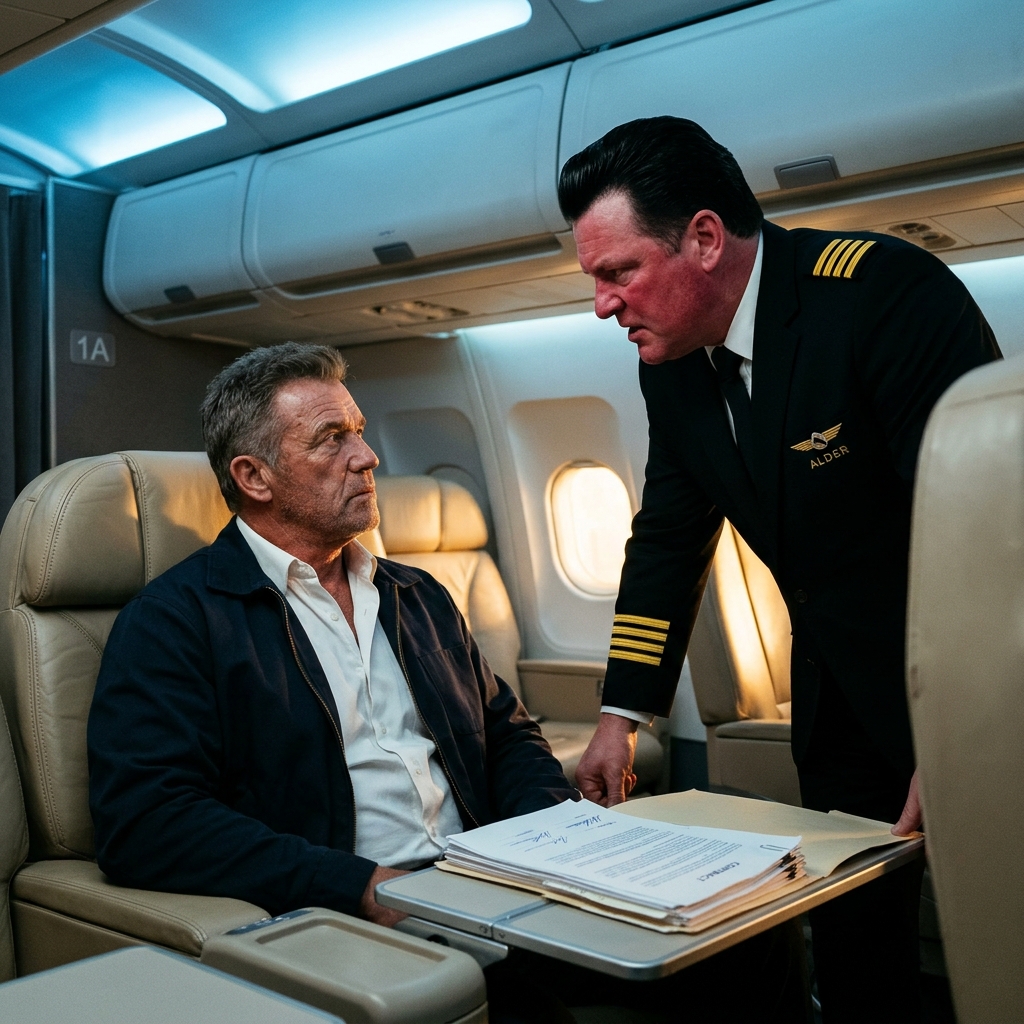
“And third,” Mercer said. “The leadership meeting tomorrow morning in Denver? We aren’t holding it in the executive conference room on the ninth floor. We are holding it in Hangar Three, at seven-thirty sharp. In front of the line mechanics. Captain Reinhardt will be there, in his full uniform. And he will bring this pink carbon sheet with him.”
Mercer laid the receiver gently on the counter.
He didn’t hang it up. He turned to Marian, reached into his pocket, and withdrew his wallet. He pulled out a crisp, folded twenty-dollar bill and laid it next to the keyboard.
“Marian,” he said with a warm, genuine smile. “Could you direct me to the nearest coffee shop that serves black drip coffee in a paper cup?”
Marian stared at him, her eyes wide as saucers, before she slowly pointed toward the main concourse. “Two doors down on the left, Mr. Mercer. Across from Gate C15.”
“Thank you,” Mercer said. “Keep the twenty for the trouble with the printer.”
He picked up his canvas duffel bag, slung it over his shoulder, and turned toward the concourse.
He did not look at Douglas Reinhardt. He did not look at First Officer Miller. He walked with the steady, measured pace of a man who had built his life on things that were true, leaving the captain of Flight 108 standing alone in the cold fluorescent glare of the gate, clutching a piece of paper that had just cost him his kingdom.
The Monday morning air in Denver was thin, sharp, and bitter with the smell of unburned kerosene and ozone.
Hangar Three sat at the far western boundary of the airfield, a massive cavern of corrugated steel and exposed iron beams that could swallow four 737s at once without touching the wingtips. Outside, a light mountain wind was scouring the tarmac, driving gray plumes of exhaust from the taxiing jets across the wet asphalt.
Inside, seven hundred men and women stood on the polished gray concrete.
They wore blue coveralls, orange safety vests, ramp boots, and mechanics’ aprons. The entire graveyard shift had stayed over, their faces grease-smudged and hollow-eyed, leaning against mobile toolboxes and hydraulic jacks. Along the perimeter, sixty line pilots and forty flight attendants stood in formation, their gold stripes and navy blazers looking strangely delicate against the massive, hulking steel of a stripped 737 fuselage resting on hydraulic stands in the center of the bay.
At the front of the hangar, sitting on an overturned wooden packing crate beneath the nose of an engine nacelle, sat Paul Mercer.
He wore the same faded Carhartt canvas chore jacket. His Red Wing boots were clean. On his knees, he held the thick blue Boeing 737 operations manual, its vinyl cover scratched and dulled by forty years of work.
Beside him, standing rigidly at parade rest, was Gerald Fenn, looking ten years younger in a civilian tweed overcoat, his hands thrust deep into his pockets. Next to Fenn stood Marcus Hayes, his face set in a grim, nervous mask, clutch-holding a thick black leather binder containing the airline’s executive audit.
And ten feet to the left, standing completely alone under the glare of the four-hundred-watt high-bay sodium lights, stood Captain Douglas Reinhardt.
Reinhardt was in full service dress: four gold stripes, white shirt pressed until the collar was sharp as paper, his bullion check-airman wings pinned over his heart. But his hat was missing. His hands were clasped in front of him, and between his white-knuckled fingers, he clutched a crumpled, pink slip of carbon paper.
The hangar was so quiet that the dripping of a hydraulic line into an aluminum pan forty yards away sounded like the ticking of a grandfather clock.
Mercer didn’t stand up immediately. He opened the blue manual, turned two pages, and looked across the sea of faces—the tired eyes of the third-shift sheet-metal workers, the young rampers with their radio harnesses, the veteran inspectors with their inspection mirrors tucked into their breast pockets.
Then he stood. He didn’t use a microphone. A man who has spent forty years shouting over the scream of Pratt & Whitney turbofans does not need an amplifier to make himself heard in a steel shed.
“Forty-four years ago,” Mercer said, his gravelly voice rolling out across the concrete, bouncing off the high corrugated roof, “I was twenty-four years old. I worked the line at Dayton. I thought I knew what an airplane was. I thought an airplane was a set of numbers that belonged to the man who signed the release.”
He walked three paces out from under the nose cone, his boots clicking on the floor.
“A freight captain named Kowalski taught me I was wrong. He refused my airplane. Not because he had more stripes than me, and not because he had a better title. He refused it because he had a document. He wrote down what he felt. I wrote down what I did. And when we pulled the cowlings off that engine, the mount was cracked clear through to the spar.”
Mercer stopped. He turned his eyes toward Douglas Reinhardt.
“An airline is not an office,” Mercer said, his voice dropping, taking on a weight that pinned every man and woman to the floor. “An airline is not a stock price, and it sure as hell isn’t a four-stripe uniform. An airline is a promise made on paper and kept at thirty-five thousand feet by people who mostly never meet the families they keep it for.”
He pointed a thick, calloused finger at the stripped 737 behind him.
“On Friday afternoon, I bought fifty-one percent of this company. I didn’t buy it to flip it to an investment trust, and I didn’t buy it to cut your health insurance. I bought it because I believe this fleet has good bones. But the flesh has gotten soft. The flesh has gotten into the habit of believing that rank outranks the truth.”
He looked directly at Reinhardt.





