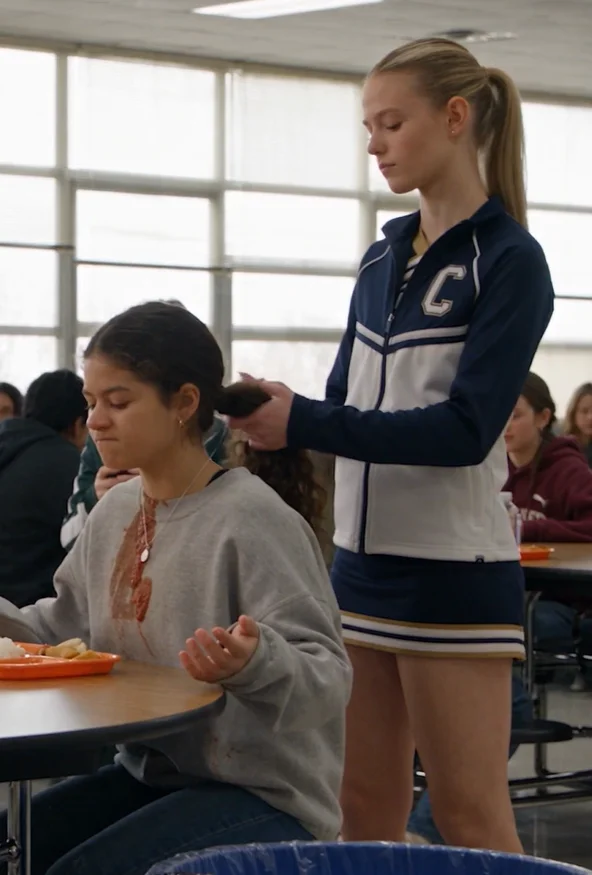
Eighty phones were recording inside the cafeteria as Peyton Vance wound my hair around her perfectly manicured fingers and pushed my mother’s silver pendant into the garbage. Just twenty feet away, Vice Principal Renee Brooks pretended to inspect the condiment station. Everyone assumed I would stay helpless on the tiled floor, the way I had stayed quiet for fifty-seven lunches, but my hands stayed loose and my weight shifted backward for a reason nobody there seemed to understand.
Oily marinara sauce slid through the front of my gray sweatshirt and cooled against my skin. The smell of tomatoes and industrial garlic sat in the air with bleach, fryer grease, and old milk. My lunch tray was ruined. My mother’s locket was gone. Peyton’s pale fingers tightened once more in my ponytail, twisting hard enough to sting my scalp.
“Your mom died in a ditch because she was trash,” she hissed, low enough that the kids closest to us laughed before the rest of the room even knew why. “And you smell just like her garbage.”
Behind her, Nora Bell held her phone up with both hands, recording from just over Peyton’s shoulder. Tessa and Brooke, the other two girls from Peyton’s squad, stood on either side of her with their own phones pointed my way. Two tables over, Mr. Henderson stacked empty trays as if the careful clatter of plastic could drown out what was happening.
Peyton hooked one finger under the chain at my neck and snapped the clasp. I heard the soft metallic pop before I felt it. Then the locket hit the rim of the wet slop barrel next to the blue recycling container and dropped into a mess of spaghetti, applesauce, and milk foam.
“Go dig it out, stray.”
She shoved me with both palms. The bench knocked against the backs of my knees. I let my shoulders move with the force instead of fighting it, set both feet under me, and breathed once through my nose the way Coach Reed had drilled into me a thousand times.
Never throw the first strike. Never give anybody your balance if you can keep it. And never let panic make your choices for you.
Peyton came again, fast and ugly this time, fingers clawed toward my face.
I shifted my left foot, turned my hips, and let her momentum cut through the space where my cheek had been half a second before. Her nails brushed only air. Her body pitched forward. One hand slapped the edge of the bench to catch herself. A sharp hush rippled out from our corner of the cafeteria.
Not total silence. Not at first. More like shock stumbling over noise.
Someone near the drink coolers said, “Whoa.”
Another kid laughed once and then stopped.
I rose from the bench slowly, keeping both hands open and low where everyone could see them. Peyton’s breath caught. It was tiny, but I heard it. She had been sure I would curl inward like I had every other day. She had counted on fear. What she got was me standing there, marinara dripping from my sweatshirt, with my face untouched and my feet planted.
“Don’t touch me again,” I said.
My voice didn’t shake. That surprised me almost as much as it surprised her.
Peyton straightened and tossed her ponytail back. “Or what?”
I could feel every eye in the cafeteria crawling over us. A few students had risen out of their seats for a better angle. Most of them still held their phones like shields. If I shoved her, if I even put a hand on her wrist, the story would become a fight. Not the fifty-seven lunches before it. Not the locket. Not the thing she had said about my mother. Just a fight.
So I took one step backward instead of forward and said, “You’re done.”
It sounded smaller than the moment deserved, but it was the truest thing I had.
Peyton’s expression hardened because my refusal had done something worse to her than a shove would have. It had made her look foolish in front of an audience she always controlled.
“What are you going to do, Carter?” she asked. “Cry to the office?”
I didn’t answer her. I looked past her at the wet slop barrel. My locket was somewhere in the top layer of ruined lunches, maybe six inches down, maybe more. Elena Carter had pressed it into my palm in a hospice room two years earlier when speaking had already become work for her. She couldn’t get the words out, so she’d opened the locket to show me the tiny photo inside—her and me at Ocean City when I was six, both of us windblown and laughing—and then she’d closed my fingers around it. Keep this, her eyes had said when her throat no longer could.
I was not leaving it in a barrel of half-eaten spaghetti because Peyton Vance wanted a reaction clip.
For a strange second, while the whole cafeteria held its breath, the previous fifty-six lunches crowded in on me all at once. Chocolate milk running off the edge of my tray on the second Tuesday in September. Peyton smiling while Brooke said oops like clumsiness could explain everything. Mashed potatoes slapped across the front of my notebook the week after that. The day dishwater hit my shoulder and Mr. Henderson told me, without even looking up from his clipboard, that some girls enjoyed drama and I should avoid feeding it. Another day when I switched tables and Peyton still found me by the emergency exit because people like her rarely bully by accident; they bully by ritual. Every little humiliation had trained the room to expect me to fold. Maybe that was why my feet felt so solid now. I was done rehearsing their version of me.





