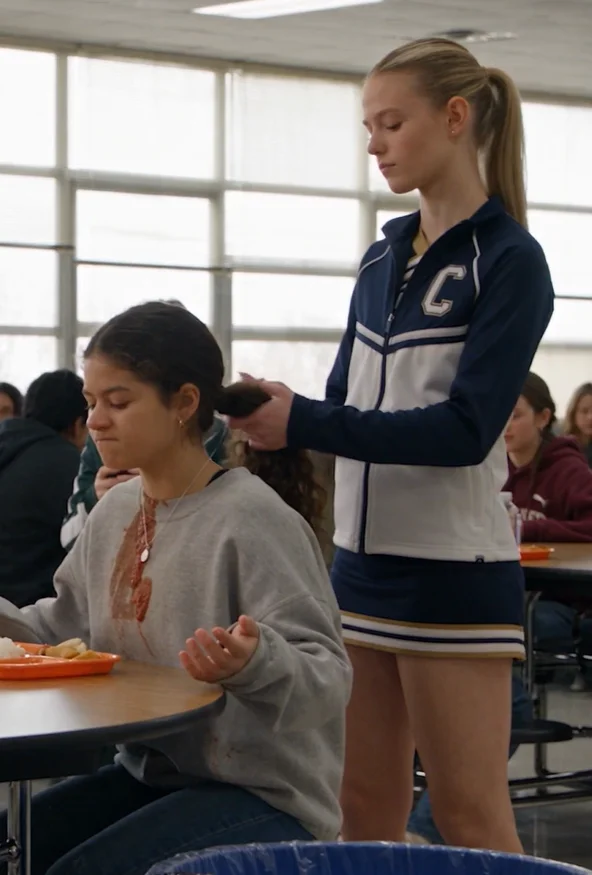
Some of it looked official: doors closing, legal pads filling, students called from class on white office slips. Some of it looked almost ridiculous. A secretary asking me to spell “slop barrel” for the record. A teacher checking whether noon lunch began at 11:50 or 11:52 on Fridays because timing mattered. Forms asking whether property damage had involved estimated monetary loss. It was strange to watch adult systems translate humiliation into boxes and categories. Strange, but not useless. Boxes could be used to minimize harm. They could also be used to force institutions to admit it.
Ms. Diaz interviewed Eli again and took a more detailed statement. He listed five lunches he clearly remembered, including the ranch on my wrestling shoes and the day Peyton dumped dishwater across my tray while Brooke blocked the aisle so I couldn’t move. Mr. Finch described retrieving my locket from the slop barrel and confirmed that he had seen food poured on me before, though he hadn’t always known names.
Mr. Henderson met with Ms. Diaz, then with Principal Laura Morgan. I didn’t hear the whole conversation, but by Tuesday afternoon he could barely look at me when he handed back our social studies quizzes. Guilt has its own posture.
Tessa surprised me most.
I found her outside the gym after school Tuesday, waiting with her backpack slung over one shoulder.
“I’m not doing this for you,” she said immediately.
“Okay.”
“I’m doing it because Peyton keeps acting like we all owe her loyalty forever.”
She looked almost angry that I wasn’t arguing.
“What do you want?” I asked.
“I already talked to Ms. Diaz.” She crossed her arms. “I told her Peyton had been going after you since September. I told her Friday wasn’t the first time food got dumped on you.”
I searched her face for some hidden twist. “Why?”
Tessa looked away. “Because I thought it was funny at first. Then it was normal. Then on Friday you just stood up and didn’t do anything back, and Peyton still went for your face.” Her jaw tightened. “It looked gross.”
Gross. It wasn’t a heroic word, but maybe that was the point. Some evils don’t get exposed because people suddenly discover moral language. Sometimes they get exposed because ordinary ugliness finally becomes impossible to call normal.
“Thanks,” I said.
“Don’t thank me yet.” She shifted her backpack higher. “I’m not saying I’ll do this in front of Peyton.”
“You already did enough.”
Tessa snorted softly, like she knew that wasn’t true.
By Wednesday, the original lunch report had become part of the dispute itself. Ms. Diaz showed Grandma Dee and me a summary of Vice Principal Brooks’s initial documentation. It described a “social disagreement” escalating when “both students rose suddenly and contributed to physical tension.”
That phrase—physical tension—would have been laughable if it weren’t dangerous.
“The video contradicts that summary,” Grandma Dee said flatly.
Ms. Diaz didn’t disagree. “The principal is reviewing all incident paperwork.”
“Did Ms. Brooks admit she saw the beginning?” I asked.
“She stated she became aware when voices rose.”
I almost laughed, but there was no humor in me. “Convenient.”
Principal Morgan joined the meeting near the end. She was in her early fifties with silver-blond hair cut to her jaw and the kind of calm voice that made other adults stop interrupting each other.
“I want to be clear,” she said. “The original incident characterization appears incomplete.”
“Incomplete?” Grandma Dee repeated.
Morgan held her gaze. “Yes. And I understand your concern about that.”
It wasn’t an apology, but it was the first time someone in authority had come anywhere near naming the real problem.
I handed over my notebook then. Not just the page from Friday. All of it.
Principal Morgan took longer than Ms. Diaz had to turn the pages. Maybe because she knew what they implied about the building she was in charge of. Maybe because each date made it harder to pretend this was a one-day dispute.
“Why didn’t this come to us sooner in a clearer form?” she asked, not accusingly.
I answered before Grandma Dee could. “Because every time it almost did, somebody told me to ignore it, move tables, or not react.”
Morgan looked down at the notebook again. “I see.”
No, I thought. You don’t. Not yet.
But at least she wasn’t looking away.
The weirdest part of all of it was that life kept making ordinary demands. There were vocabulary quizzes and wrestling drills and Grandma Dee asking me to take chicken out of the freezer. My grief and anger had to fit around homework. Peyton still laughed with friends in the hallway. The school’s heating system still made clanking sounds during announcements. Reality never stops to respect your major emotional event.
Wednesday night, I sat at the kitchen table pretending to do algebra while Grandma Dee mended a tear in one of her work aprons. After twenty minutes she set down the needle and asked, “What are you rehearsing in your head?”
“All the ways they could still mess this up,” I said.
She nodded like she expected that answer. “Then let’s name what they can’t take from you.”
I stared at the problem set. “What does that mean?”
“They can delay justice. They can dodge it. They can phrase it badly. But they cannot make you the girl who attacked first. They cannot make the video show different hands. They cannot put your necklace back in the barrel and call that imagination.”
I looked up. Her thread glinted under the kitchen light.
“And if they still fail?” I asked.
“Then we keep climbing.” She tied off the thread with one decisive tug. “The school is not the last adult in the world.”
That steadied me more than any promise that everything would turn out fine. Fine was never the real offer. Persistence was.
On Thursday, Coach Reed asked me to stay after practice.
“You look like you’re carrying a refrigerator,” he said.
“I’m fine.”





