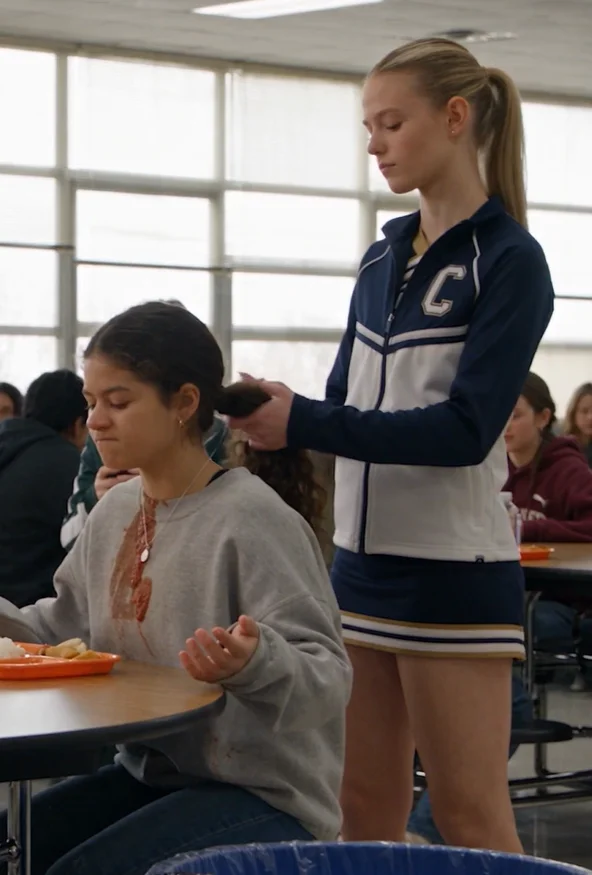
“I’m not asking you to save me,” I said. “I’m asking you not to help lie.”
Nora’s eyes filled with a kind of anger I didn’t expect—at herself, maybe, or at the whole machine we were both caught in. “I need to think,” she said.
She left before the first bell.
By lunch, the cropped video had done what bad evidence does best: it had made just enough people comfortable with a false story that the truth began to look argumentative. Two boys in line behind me joked about me trying out for cage fighting. A girl from choir asked whether my counselor thought I had anger issues.
When the final bell rang, I checked my phone as I walked toward the rec center.
There was a new email from Ms. Diaz to Grandma Dee and me.
Subject: Ongoing inquiry.
Inside was one careful paragraph saying interviews were continuing, no conclusions had been reached, and students were expected not to distribute media related to the incident.
Then, at the bottom, one sentence hit harder than the rest:
At this time, another version of the event has also been provided.
Another version.
It wasn’t just rumors anymore. Somebody had officially offered the school a different story, and the school was weighing it.
For the second night in a row, I walked into wrestling practice with my jaw clenched hard enough to ache.
And for the second night in a row, I knew the fight ahead of me wasn’t happening on the mat.
Saturday morning, Grandma Dee made pancakes and pretended not to watch me check my phone every four minutes.
“Nothing new will happen faster because you glare at a screen,” she said.
“I’m not glaring.”
“You’re trying to burn through the wallpaper with your eyes.”
I put my phone face down and helped her clear plates. Saturdays were usually my easiest days because school couldn’t reach me there. This one still felt like I was waiting in a hallway outside a closed office.
At eleven thirty, my phone buzzed.
Nora: Can I call?
I stepped onto the back porch before answering. The cold air needled through my sweatshirt.
“Hi,” I said.
Her voice came out rushed. “I told my mom everything.”
I gripped the railing. “Okay.”
“She was furious. Not at you. At me. At all of it.” Nora sounded half offended by her own relief. “She says if I recorded something that ugly and didn’t tell an adult, then I’m part of the problem.”
I closed my eyes. “Your mom’s right.”
“Yeah. I know.” A pause. “She made me send the original video to her laptop so Brooke couldn’t mess with my phone again. She wants me to email it to Ms. Diaz with her copied on the message.”
For a second I couldn’t speak.
“Maya?”
“Sorry,” I said quickly. “I’m here.”
“I haven’t sent it yet.”
“Why not?”
“Because if I do, there’s no taking it back.”
I looked out over Grandma Dee’s tiny backyard, the dead tomato vines, the fence with peeling white paint. “No,” I said. “There isn’t.”
Another pause. Then Nora asked, almost whispering, “If I do it, will people hate me?”
Honesty was the only thing I had left that felt clean. “Some people might.”
She laughed once, unhappily. “Awesome.”
“But some people should be ashamed they didn’t do it first.”
She breathed out. “I’m sending it.”
Ten minutes later Ms. Diaz forwarded the message to Grandma Dee and me, acknowledging receipt of the original file. She didn’t attach it to the reply, but just knowing it was in adult hands made my knees weak. The truth had finally entered the building through an actual door.
On Monday, school felt different the moment I walked in. Not better. More alert. Teachers looked at me a little longer. Peyton passed me in the hall without speaking. That, more than anything, told me the video had done damage she could feel.
At my locker, a seventh-grade boy I barely knew mumbled, “Hey, that sucked what happened,” and then hurried away before I could answer. A girl from art who had never spoken to me before left a sticky note on my notebook that said simply YOU DIDN’T DESERVE THAT. Those tiny gestures should not have mattered much. They did. Not because I needed everyone to like me, but because for weeks the room had treated what was happening as if it were somehow socially neutral. It wasn’t. Once the truth had a shape people could recognize, some of them finally remembered they had choices.
Ms. Diaz called me in second period. Her desk held a printed interview schedule and a stack of incident forms. “I viewed the original file,” she said. “It materially changes the understanding of Friday’s lunch event.”
Materially changes. Adults loved phrases that made huge things sound neat.
“What does that mean?” I asked.
“It means your account regarding the chain, the slop barrel, and the failed physical contact is supported.”
Some knot in my chest loosened. Not all the way, but enough for air.
“Then it’s fixed?”
Her expression shifted in a way that warned me before the words did. “Not fully. The review process now involves administrative correction, witness statements, and response from the other family.”
“Because her dad is on the board.”
Ms. Diaz chose her words carefully. “Because when a family disputes findings, the school is required to follow its own procedures. His position means the matter will be watched closely, not that he decides it himself.”
That answer was fair. It still tasted bitter.
Over the next two days, I became weirdly familiar with the machinery of adults trying to catch up to what children had already lived through.





