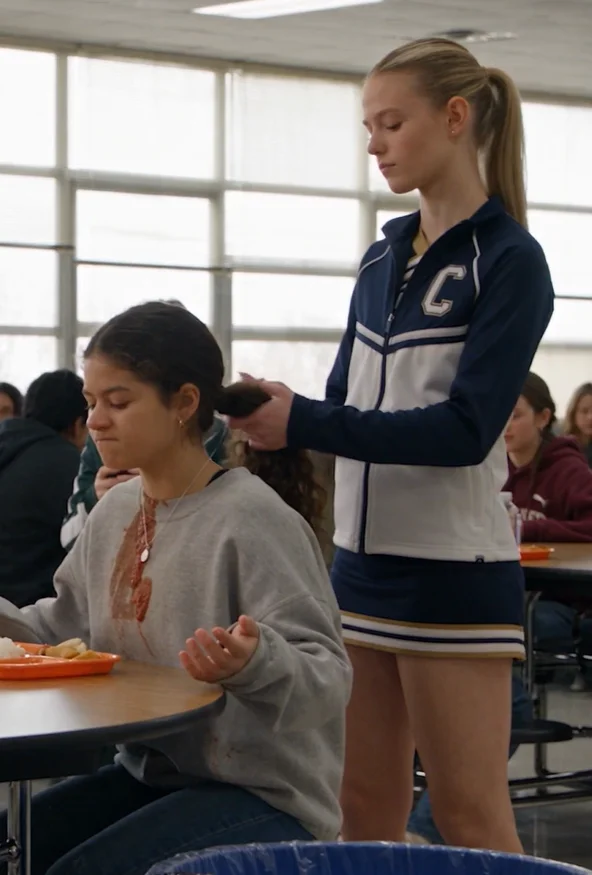
“That wasn’t a yes-or-no question.”
I sat on the edge of the mat and wiped sweat from my face with my sleeve. “The video helps, but everything still has ten meetings attached to it. And everyone keeps talking like words on forms are complicated when they’re not. She did it. They watched. The end.”
He sat beside me, forearms on his knees. “Truth and proof are cousins, not twins.”
“There you go again.”
“With the fortune cookie philosophy?”
“Yeah.”
He smiled a little. “You’re tired enough to make fun of me, which means you’ll survive.” Then he sobered. “Listen carefully. If adults are taking statements now, they are also measuring whether you can be pushed into a mistake. Don’t give them one.”
I hated that he was right.
The next morning, Ms. Diaz told me the Vance family had submitted their own version. Peyton claimed I had stood “aggressively” before any contact, that the chain broke accidentally when she tried to calm me, and that the drop into the slop barrel happened during “commotion.”
“Commotion,” I repeated.
“I’m telling you this because you deserve transparency,” Ms. Diaz said. “Not because their statement aligns with the evidence.”
“So why does it matter?”
“Because process matters when accountability lasts.”
I didn’t like the answer. But I understood it better than I wanted to.
At lunch that day, three sixth-grade girls stopped me on the way to the milk cooler.
“Are you okay?” one asked.
I blinked at them. “I think so.”
“We saw what happened,” another said. “Not on Friday. Like… before.”
She looked nervous. “Peyton dumped pudding on your backpack in October.”
That memory flickered back: orange pudding cup, my zipper sticky for days.
“Would you tell Ms. Diaz that?” I asked.
The girls looked at each other. The first one nodded. “Maybe together.”
“Together is fine.”
They did. Their statements weren’t earthshaking, but they added shape to the pattern. Pattern mattered. Pattern turned isolated mean acts into something nobody honest could call accidental.
By the end of the week, one fact had become impossible to ignore: the original documentation from the school’s own vice principal did not match the best available evidence.
That didn’t only matter for me. It changed the temperature in the building. Once students realized an adult report could be contradicted, more of them started talking about times they had watched things and told themselves it wasn’t their business. One eighth-grade boy I recognized from the far lunch tables stopped me outside science and muttered, “Sorry I never said anything before.” I wasn’t sure what to do with apologies arriving after proof, but I was beginning to understand that delayed courage was still better than none.
That should have been enough to settle things.
Instead, Friday afternoon brought a thin envelope in my last class, hand-delivered by a secretary who wouldn’t meet my eyes.
Inside was notice that due to “ongoing conflict concerns” and “physical escalation observed during the cafeteria incident,” I was being temporarily removed from the next Tuesday wrestling club practice on school grounds pending final review.
Not a full suspension. Not yet. But enough.
Enough to tell me somebody was still trying to preserve a lie by splitting the difference between a bully and the girl who refused to swing back.
I folded the paper carefully, because if I crumpled it, I might also scream.
When I looked up, Peyton was standing by the classroom door, pretending to wait for Brooke.
She saw the letter in my hand.
And she smiled.
The provisional notice felt worse than the lunch itself for about an hour.
I read it three times in the hallway outside class, each pass somehow making it more insulting. The wording had been polished so smoothly that anyone glancing at it might think the school was simply being careful. No one reading it cold would understand that caution had landed on the wrong child.
Pain and humiliation are one thing. Injustice on paper is another. You can wash marinara off your skin. You can scrub slop out of a locket hinge. But once a school prints your name beside words like conflict concerns and physical escalation, the stain tries to act permanent.
I made it to the girls’ bathroom before crying.
Not loud. Not dramatic. Just the kind of crying that happens when your face finally loses the strength to hold itself together. I sat in the last stall with the folded notice in my fist and let the unfairness move through me for exactly three minutes. I know because I counted breaths the way Coach Reed taught us to count through hard positions on the mat.
At one hundred and twenty, I wiped my face and stood up.
I splashed water on my face and studied myself in the spotted bathroom mirror. My eyes were red. My mouth looked stubborn. There are moments when you can almost see two versions of your next hour standing side by side. In one, I stormed into the hall and became exactly as reckless as everybody feared. In the other, I kept the hurt but aimed it. I chose the second version because I had spent too many months giving other people the right to decide who I was.
I had already decided one thing in the hallway outside English: I was not going to let them turn this into a social media war.
Eli suggested it first when I showed him the notice near my locker. “Post the full story online,” he said. “If people see the video and what they’re doing to you, they’ll freak out.”
He meant well. He always did.
“No,” I said.
“Why not?”
“Because I don’t want strangers sharing my mother’s locket like it’s content.”
He opened his mouth, shut it, then nodded. “Right. Sorry.”
“It’s okay.” I looked at the paper again. “I just want the adults in the building to do their jobs.”





