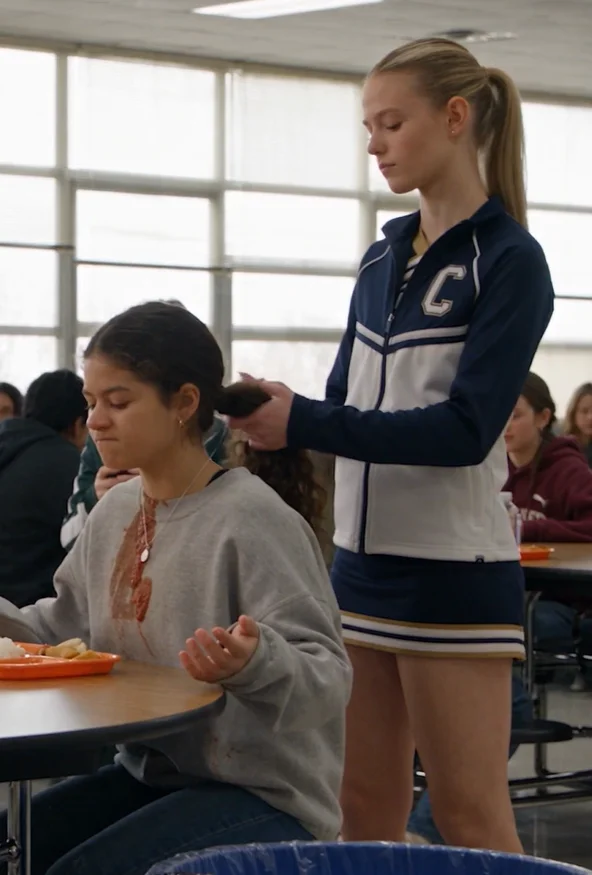
When I stepped onto the mat for my first bout, the overhead lights felt harsher than usual. For a second I was terrified I would freeze—not because of my opponent, a stocky girl from Westlake whose singlet read HARRIS, but because my brain had gotten too used to anticipating harm in public spaces. Then the whistle blew. Muscle memory took over. Grip, level change, sprawl, reset. The world narrowed to one circle, one body, one clean set of rules.
I won on points, 6–3. Nothing dramatic. No miracle comeback. Just disciplined wrestling and steady breath. When I jogged off the mat, Coach Reed clapped my shoulder once and said, “See? The story is not finished just because a bad week tried to make itself the headline.”
Kiara shoved a sports drink into my hand. “You looked mean out there,” she said approvingly.
“That’s the nicest thing anyone has said to me all month.”
On the bus ride home, I watched the lights of Briar Glen blur by the window and realized I had spent almost the entire evening without thinking about Peyton. That felt bigger than the win. It felt like getting part of my concentration back from somebody who had no right to own it.
When Grandma Dee picked me up from the rec center parking lot, she asked how I did.
“Won by three,” I said.
She grinned. “Your mama would’ve bragged to strangers in the grocery line.”
“You still can if you want.”
“Don’t tempt me.”
We drove home in comfortable silence. I touched the locket once at a red light and noticed that for the first time since Friday, the gesture felt affectionate instead of defensive.
But something essential had changed.
Adults were watching the right things now.
The seat by the emergency exit belonged to no one special anymore.
And when I walked into lunch, I no longer felt like prey entering a familiar trap.
Weeks later, right before Thanksgiving break, Ms. Diaz called me into her office one last time.
“I wanted you to know,” she said, “the district completed its internal review. Additional supervision procedures are in place for lunch, and staff have been formally directed on incident documentation expectations.”
“Does that mean anybody got in trouble?”
She gave the kind of answer adults give when privacy rules matter. “It means the concerns were substantiated and addressed.”
That was enough. I didn’t need public humiliation as payment. I needed the next kid in my chair to face better odds.
When I left her office, I passed the display case by the main entrance. One shelf held photos from fall activities. Wrestling club had a new team picture pinned crookedly in the corner. I stood there for a second, looking at myself in the back row—hair pulled back, jaw stubborn, shoulders square.
A quiet girl in a gray sweatshirt.
A girl with a dead mother and a repaired necklace.
A girl who had been mistaken, over and over, for easy.
I touched the locket once, then headed to lunch.
The cafeteria was loud in the ordinary way that healthy places are loud. Trays clattered. Somebody argued about fries. Mr. Finch waved from the serving line. Eli had saved me a seat near the center. Nora was already there. So were two of the sixth-grade girls who had given statements. When I sat down, the conversation shifted naturally to math homework and the upcoming wrestling meet and whether cafeteria pizza could legally be called pizza.
Nobody looked at me waiting for a scene.
No one reached for my tray.
No one touched my hair.
For the first time in fifty-eight lunches, I ate while the whole room stayed gloriously uninterested.
After lunch, when I walked out into the hallway, I caught sight of my reflection in the narrow window of the trophy case again. The same girl. The same gray hoodie. The same dark hair pulled back. But there was one difference I could finally name. I no longer looked like somebody waiting for permission to exist comfortably in public.
That evening, I took my notebook out one last time and showed Grandma Dee the final page. She read it, kissed the top of my head, and said, “Keep it. Not because you need to stay inside this story. Because one day you may need to remember exactly how strong you already were.”
I slid the notebook back into the dresser drawer, not under my socks this time, but on top where I could reach it without shame. Then I touched the locket at my throat and stood for a long minute in the quiet of my room. I thought about my mother. About Coach Reed. About Eli blurting the truth from two tables away. About Nora choosing not to keep helping a lie. About Ms. Diaz listening. About the fact that institutions move slowly but people decide, moment by moment, whether they will make that slowness an excuse.
For the first time in fifty-eight lunches, the story I carried home from school did not belong to Peyton.
And that, more than silence, felt like peace.





