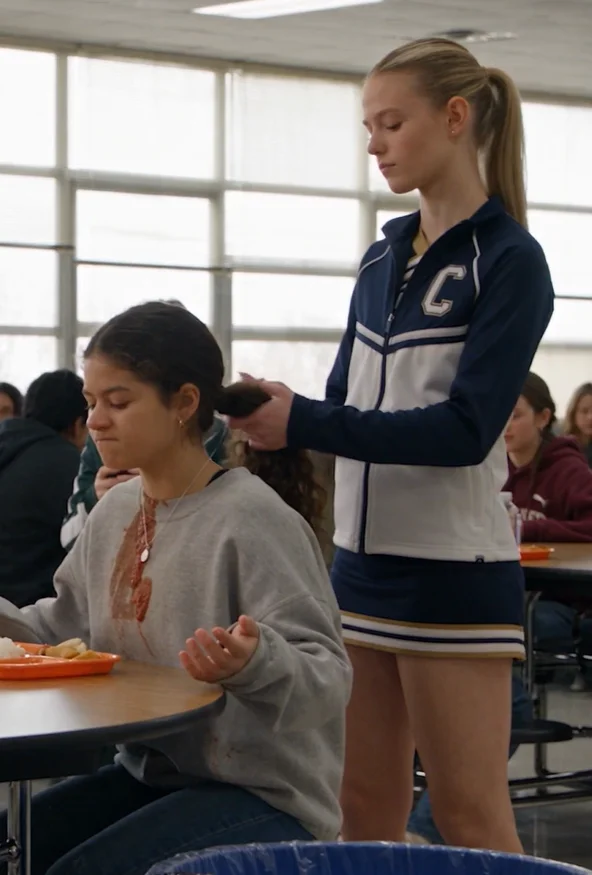
Brooks looked between us. “I’m going to need calm voices.”
My skin felt too tight. “She poured sauce on me, insulted my mother, ripped my necklace off, and threw it into the slop barrel.”
Peyton’s expression did not change. “We were joking. She got aggressive when I tried to apologize.”
I actually laughed then, a short disbelieving sound. “Apologize?”
Brooks’s mouth thinned. “Maya, watch your tone.”
There it was. Not justice. Tone.
“My tone?” I asked. “She just—”
“Maya,” Brooks said again, sharper.
I bit down on everything else. Coach Reed said anger can be useful, but only if you make it carry weight instead of spill everywhere. So I made myself inhale once. Exhale once. Speak plainly.
“I did not touch Peyton,” I said. “She shoved me. Then she tried to scratch my face.”
Peyton held up one perfect hand. “Look, she moved at me, I lost my balance, and now she’s making this into some giant sob story because she likes attention.”
My fingernails dug into my palm beneath the table.
Part of what made the whole thing so crazy was that I had chosen that corner table on purpose back in September because it felt safe. It was near the emergency exit and the wall, which meant fewer directions trouble could come from. After my mother died, crowded spaces started feeling louder than they used to, so sitting at the edge of the cafeteria helped me breathe. Peyton had noticed that within a week. What looked to everyone else like a random target had been, to her, a visible preference she could invade every day until even safety felt rented.
Brooks turned to me. “Did you stand up quickly?”
“Yes.”
“Did you say something confrontational?”
“I said, ‘Don’t touch me again.’”
“And before that?”
“Nothing.”
Brooks clicked her pen. “Maya, I need you to understand how these things appear when emotions are high. If there was mutual escalation—”
“It was not mutual.”
That came out harder than I meant it to. Her pen stopped moving.
For a second the room held still.
Then Brooks said, “I am documenting this as a lunchroom disagreement that became physical from both sides.”
I stared at her, certain I had heard wrong. “Both sides.”
“You admit you rose from the bench in a confrontational way.”
“I stood up.”
“After ongoing tension.”
“After she threw my mother’s locket in the trash.”
Peyton folded one ankle over the other and examined her nails.
“I’ll call your guardian,” Brooks said. “For now, you’ll both return to class after cleanup. I expect distance between you.”
It was over that fast. Fifty-seven lunches. A chain snapped. My mother dragged through the dirt. And the official words on paper were disagreement and both sides.
Brooks let me rinse my sweatshirt in the nurse’s bathroom and borrow a plain gray gym tee from lost-and-found. The shirt hung on me. I tucked my locket into the front pocket of my jeans because the chain was broken. When I came back out, I saw Brooks talking quietly to Peyton near the main office door. Peyton didn’t look troubled. She looked bored.
I wanted to scream. Instead I went to math.
By last period the whole seventh grade seemed to know. I could feel it in the side glances, the pauses when I walked by, the way two boys in science whispered the word trash and then stopped when I looked at them. Someone had definitely shared a clip, or at least bragged about having one. My scalp still hurt where Peyton had twisted my hair.
After school I walked to the community rec center instead of going straight home. My grandmother, Dee, worked the late shift at the hospital laundry on Tuesdays. She wouldn’t be back until after seven. The rec center sat four blocks from school, brick and square and always a little too hot in winter. Coach Reed was already on the wrestling mats setting out practice bands when I came in.
Daniel Reed had retired from the Army long before I met him, but the soldier never quite left his posture. He moved like every step had intention. He wasn’t loud, which somehow made him stricter. He had trained me since fifth grade, after Grandma Dee got tired of seeing me come home folded into myself every time life got rough.
He took one look at my face and said, “Locker room. Then office.”
I changed into practice shorts and a team shirt, rinsed the dried sauce from my neck, and sat down across from him in the tiny office that smelled like tape and coffee.
“What happened?” he asked.
I told him.
Not every detail. I couldn’t make myself repeat Peyton’s exact words about my mother. But I told him about the locket, the shove, the missed swipe, the office, the phrase both sides.
He listened without interrupting, fingertips pressed together under his chin.
When I finished, he asked only one question first. “Did you hit her?”
“No.”
“Did you grab her?”
“No.”
“Did you do anything you are trying to hide from me?”
“No.”
He nodded once. “Then your job now is precision, not panic.”
I looked down at the locket in my hand. The hinge squeaked when I opened it. My mother smiled up from the tiny oval photo as if she had never been sick a day in her life.
Coach Reed slid a legal pad toward me. “Write the sequence while it’s fresh. Times if you know them. Names. Exact words as close as you can. Every detail you remember.”
“I already remember it.”
“That isn’t the same as documenting it.”
So I wrote. I wrote about Nora’s phone. About Mr. Finch pulling the locket out of the slop. About Eli speaking up. About Brooks watching and then pretending she hadn’t. I wrote until my hand cramped.
When I was done, Coach Reed read the page without comment and handed it back. “Good. Keep this. Make a copy when you get home.”





