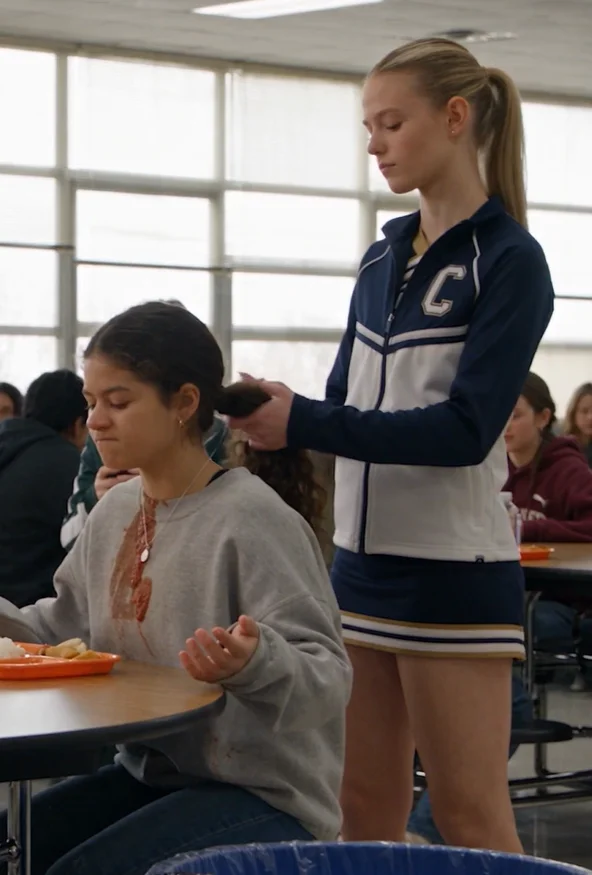
Ms. Diaz’s office was down by the library and actually looked like people told the truth in it. There were plants on the window ledge and a box of tissues nobody had hidden in shame. A poster on her wall said YOU DESERVE TO FEEL SAFE HERE. Usually I hated school posters. That one made me want to test whether it meant anything.
Grandma Dee came straight from the hospital laundry in scrubs and a cardigan, smelling faintly of starch and dryer sheets. She sat beside me on the couch while Ms. Diaz took the chair opposite us with a legal pad balanced on her knee.
“I’ve read Ms. Brooks’s preliminary incident note,” she said. “I’d like to hear from Maya first.”
Not from Grandma Dee. Not from the summary. From me.
So I started at the beginning—not day fifty-seven, but day one. The first lunch Peyton had tipped my carton of chocolate milk and told everybody it was an accident. The time Brooke had “tripped” and sent mashed potatoes over my notebook. The week they moved to dishwater because stains looked funnier when they weren’t even food. The names. The laughs. The tables that went quiet and then loud again the moment I looked away.
Ms. Diaz asked questions that made sense. “How often did staff observe any of this?” “Did you ever report it previously?” “Who was seated nearby on the worst days?” “Why did you begin documenting it?”
I told her the truth. I had reported two earlier incidents in half-ways, the kind that people can reinterpret as ordinary middle-school meanness if they want to. I had stopped after adults kept saying things like maybe they’re trying to get a rise out of you, don’t give them the satisfaction, sit somewhere else. As if moving my body were the same thing as solving a problem. As if I was the one carrying it from table to table.
There was one lunch in October I didn’t tell Ms. Diaz about until she asked a fourth time whether I had ever tried changing my behavior. Peyton had walked past my table and knocked my water bottle into my lap. Not a major disaster. Just enough to make me jump. When I muttered, “Seriously?” she had leaned down and said, “You make it too easy.” I had gone to the bathroom after that and stood in the stall listening to the end of lunch because returning felt worse than hiding. I mention it now because that was the day I understood something important: bullying is not only about the messy big moments. It is also about teaching you to rearrange your own life around the possibility of somebody else’s cruelty.
Ms. Diaz underlined something on her pad when I said that. “Have you been avoiding school spaces because of them?”
“Not whole spaces,” I admitted. “Just parts of them. The corner near the vending machines after lunch. The right side of the bus lane. Sometimes the hallway by the gym if I hear cheer shoes first.”
Grandma Dee closed her eyes briefly, and I hated that my survival strategies could hurt her on contact. But I kept going because the truth was already overdue.
Then I gave Ms. Diaz my blue notebook.
She turned the pages slowly. Day after day. Dates in the corner. Pencil pressed harder on the worse entries. Sometimes one line, sometimes six. On the day Peyton had poured ranch on my wrestling shoes, I had written so hard the point nearly tore through the page.
“You kept this for forty-five days,” Ms. Diaz said quietly.
“Forty-six now.”
“And the first eleven incidents before that aren’t included?”
“No. I started writing after day twelve.”
Grandma Dee’s hand tightened around her purse strap. “This child has been eating fear with her lunch for nearly three months.”
Ms. Diaz nodded once and wrote for almost a full minute. “I can’t promise outcomes before reviewing everything,” she said. “But I can promise I’m opening a formal harassment inquiry today.”
The word formal hit me almost as hard as both sides had, except in the opposite direction.
Ms. Diaz asked for names of likely witnesses. I gave her Eli first. Then Mr. Finch. Then Nora, even though I didn’t know if she would talk. Tessa and Brooke might lie, but they had been there. Mr. Henderson had seen enough to stop it and hadn’t. Vice Principal Brooks had seen enough, too. Saying that one out loud made my stomach hurt.
“Do you know whether any student recorded the lunch incident?” Ms. Diaz asked.
I remembered Nora’s phone, held steady at shoulder height. “Yes.”
“Do you have the video?”
“No.”
“Do not seek it by pressuring anyone,” she said. “But if someone voluntarily offers you a copy, preserve it and send it to me without editing.”
That sounded almost too simple. Preserve it. As if truth could survive middle school if handled correctly.
When I stepped back into the hallway after the meeting, I felt taller and more frightened at the same time. A formal inquiry meant adults were finally looking. It also meant Peyton would know somebody had stopped accepting the old version.
Grandma Dee squeezed my shoulder before she left for work. “You did the hard part,” she said.
“I don’t think that was the hard part.”
She gave me a sad little smile. “Maybe not. But it was the part that opens the rest.”
Between study hall and lunch, I passed the trophy case outside the gym and caught my reflection in the glass. Gray hoodie. Scabbed knuckle from wrestling. Hair pulled back tighter than usual so nobody could grab it easily. I looked like myself and also like a version of myself under inspection. A formal inquiry does that. It takes your pain, puts it under fluorescent lighting, and asks if you can organize it neatly enough to count.
She proved it at lunch.





